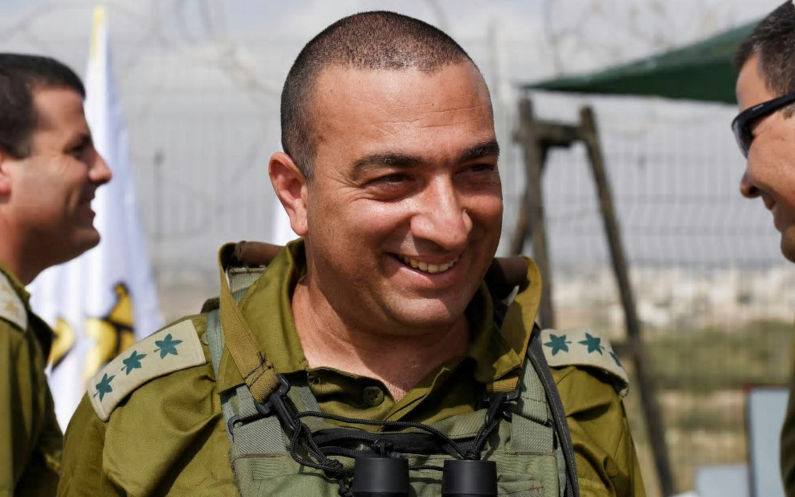
Brigadier General Yisrael Shomer, head of the IDF Operations Division, has finally faced the consequences of his actions.
Until Wednesday, the Israel Defense Forces and the State of Israel believed that Brigadier General Yisrael Shomer, the head of the army’s operations division, was a man of total integrity. He rose through the ranks to his current position, one of the most important during wartime. Reichman University awarded him an honorary doctorate in 2024 in a ceremony dubbed “Israeli Heroism”.
However, on Wednesday 3 June we were informed that the chief of staff had decided to dismiss him from the army. A statement issued by the IDF spokesman stated that “Shomer’s request to step down was accepted”, a way of preserving what’s left of his honour.
Shomer is suspected of “exploiting power relationships” and “moral offences”. In other words, he had a sexual relationship with a subordinate. So much for Shomer’s total integrity.
There are few times in life when you can take pleasure in someone’s downfall; this is one of them. On 3 June, belated justice was served. In a truly moral army, Shomer would have been dismissed 10 years and 11 months earlier.
Friday 3 July 2015: Qalandiyah crossing, outside Ramallah. Shomer, the commander of the West Bank-based Binyamin Brigade, was stuck in traffic with his driver when a teenager from a refugee camp came up to his car and smashed its window with a large rock almost at point-blank range. Shomer was angry. He and his driver got out of the car and chased after the boy as he fled. Shomer fired his gun three times at the teen’s back at a distance of six to seven metres and killed him.
It was, by any standard, an execution. The boy posed no immediate danger. Witnesses said that, before leaving, Shomer turned the boy’s body over with his foot, the way one would the body of an animal, to make sure he was actually dead. It never occurred to him to call for medical help. Some later heard him boast about his shooting.
A year later, the chief military prosecutor ended the investigation on the grounds that the killing was an “operational accident”. In September 2020, the High Court of Justice, which gives carte blanche to war crimes, rejected an appeal by the boy’s family against the prosecutor’s decision. Yair Lapid [leader of the opposition], of course, rushed to defend the cowardly officer who killed a fleeing boy. The then Chief of Staff Gadi Eisenkot, the last of the righteous, delayed Shomer’s further rise in the ranks. Eisenkot’s successors put Shomer back on the promotions track.
Shomer did not know who he had killed or showed no interest in finding out. Mohammad Kasba was 17 at the time of his death. He was the son of Fatma and Sami Kasba, their third son to be killed by the army. The other two, Yasir, age 10, and Samer, 15, were shot in the head within 40 days of each other in the winter of 2002.
When I visited their meager home for the first time in the Qalandiyah camp, I met their younger brother Mohammad, who was four years old at the time. Back then, no one could have known that Mohammad was fated to be killed 13 years after his two brothers, this time by a brigade commander.
Shomer’s success in avoiding all punishment foreshadowed the deterioration of the army’s standards. By deciding not to put him on trial and subsequently promoting him to top positions, the army was in effect saying to its soldiers, kill as you please – capital punishment for children throwing stones is legitimate, even desirable. The genocide in the Gaza Strip, the “Messiah” patches appearing on army uniforms and the collapse of moral boundaries were all born at the Qalandiyah crossing.
A member of Kibbutz Kfar Aza, who went out in running shorts and a knife to battle the terrorists who had invaded his community on October 7, Shomer was deservedly praised at the time for his act. But justice finally came on Wednesday, in particular regarding the memory of Mohammad Kasba. Once again, it revealed the distorted values of the most moral army in the universe.
Unjustified execution of a boy? Promotion. Forbidden affair? Fired.
Republished from Hareetz

Gideon Levy is a Haaretz columnist and a member of the newspaper’s editorial board. Levy joined Haaretz in 1982, and spent four years as the newspaper’s deputy editor. He was the recipient of the Euro-Med Journalist Prize for 2008; the Leipzig Freedom Prize in 2001; the Israeli Journalists’ Union Prize in 1997; and The Association of Human Rights in Israel Award for 1996. His new book, The Punishment of Gaza, has just been published by Verso.