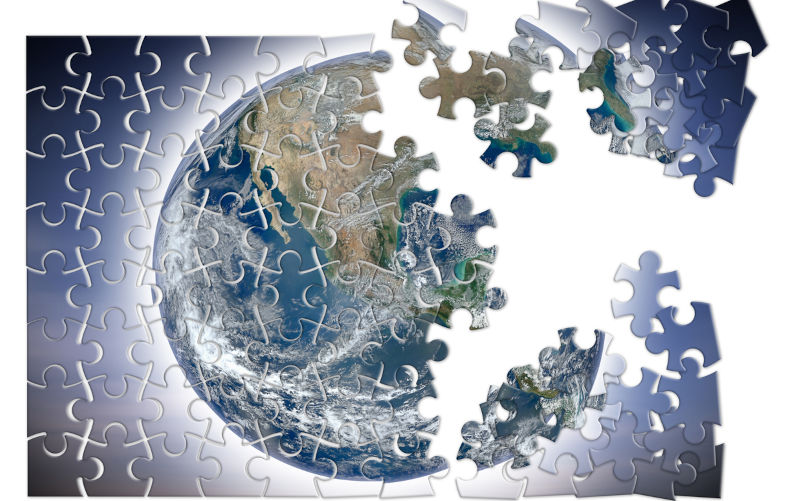
A new book examines how to deal with the complex problems caused by natural and humanitarian disasters, technological failures and geopolitical tensions.
Rarely a day passes without headlines describing national, regional or global crises. The world is disrupted by war, climatic extremes, geopolitical tensions, the risks of untamed technology, disease outbreaks, populist policy upheavals, tariffs, trade chokepoints and more. Attention and political debates shift from one to another, up and down the lists of what are variously termed polycrises and global catastrophic risks. Leaders and media pay attention to crises one at a time, from time to time.
Right now, societies and governments across the world are re-learning that conflicts and disruptions arise from ignored or badly managed preconditions, erupt with variable speed, change shape, bleed across boundaries, merge and coalesce with other risks, and produce long-term and often unexpected impacts. We should not be surprised.
In a new book, Re-imagining Risk and Disruption, colleagues and I explore the commonalities displayed by the risks and disruptions listed above and others. The aim is better understanding of their shared problem attributes that can inform more consistent and efficacious responses. Our starting point is to gather significant risks and disruptions, whether natural, human or mixed in origin and impact, into the single, broad category of ‘complex unbounded problems’ (CUPs). This is closer to the interactive ‘polycrisis’ construct than other categorisations.
Drawing on terminology from the disaster field, CUPs contrast with lesser but not insignificant ‘routine’ and ‘non-routine’ problems as:
- large to extreme in scale
- ill-defined and dynamic in space and time
- creating deep uncertainties not amenable to quantification
- having impacts that are likely severe or even catastrophic
- high profile with intense and long-lasting societal interest
- having multiple and interacting causes
- seemingly being beyond existing knowledge, institutional and logistical capacities.
We posit that humanity now faces more and bigger CUPs, which are faster in their development, with wider and more insidious impacts that have fewer trustworthy policy levers at hand. We explore four past, ongoing and unfolding situations: global environmental degradation (especially global heating); nuclear accidents (especially the Fukushima disaster); pandemics and other biological threats; and the threat of over-utilisation of near-Earth space.
The list of risks to explore was depressingly long, but our sample mixes scale, as well as human and natural causes and impacts. They exist at various points along the ‘boom continuum’, a schema of largely military origin that looks far left of ‘boom’ (the event) for signs of problem development and far right for long-tail impacts and lurking re-emergence. This prompts attention to when problems emerge and the common ignoring of warning signs. We identify shared problem attributes across these risks and disruption that, once recognised and taken together, can sharpen appreciation and preparedness.
First, CUPs can interact and display coalescence, combining to create enlarged and more complex challenges. War worsens environmental decline; ungoverned resource extraction worsens human development; AI nourishes disinformation and populist ructions; and the proliferation of orbital debris or weaponisation of space portends a ‘dark sky’ and the disabling of numerous, essential satellite-dependent services.
Second, CUPs reflect exceedance of the boundaries and safeguards that we imagine or assume keep our societal and environmental systems functioning in beneficial ways, be those technologies, policies, engineering works or warning systems. Third, CUPs exploit the porosity and interdependence of many domains – economic, ecological, informational – enabling spread and cross-domain damage.
Fourth is the recurring unsoundness in human understanding and foresight, and in policies and practice that underlie numerous dire situations. Repeatedly, left and far left of boom signs and clues are overlooked – at times knowingly – allowing the pretence or mistake of surprise. Along with considerable successes, responses to COVID saw the lessons from previous pandemics ignored. Vulnerabilities in the boundedness of nuclear facilities were known before the shock of Fukushima. Over three decades of warnings and proven, available counter measures to arrest global heating, we have had, at best, half-hearted responses. The dangers inherent in the current exponential crowding of the space commons have been forecast, with only marginal remedies emerging.
When problems coalesce, breach porous protective boundaries and are viewed through unsound lenses, they evolve to become more than the sum of the parts, displaying the abilities of a complex adaptative system. The problem itself changes and gains new capacities, with variable and increasing tempo of problem onset, whether in ‘slow burn’ CUPs like climate change, or the seemingly sudden manifestations of military adventurism or a nuclear accident.
What can be done against a rising tide of disruption? We must positively seek the best possible outcome amidst worsening circumstances. We must collectively recognise threatening phenomena and share knowledge about their nature, as common understanding promotes clearer problem-matching, which is a prerequisite for designing the solutions human society so needs.
Identifying and celebrating the vital role of collective endeavours that carry on beneath the shrieking criticism of globalism is critical. These include the less well-known international organisations and processes that serve us well; scientific collaborations that make us wiser; the coordinated work of humanitarian and environmental NGOs.
The taming of AI is paramount, the purpose of which must be to support people and planet, not carelessly risk both. Opposing the misleading simplifications of populist authoritarians on critical issues like climate change and demonstrating the benefits of shared human endeavour, even of peace itself, is essential to humanity’s very survival.
We need a clear lens for defining, examining, contesting and managing a world of ever larger, more complex, and disruptive challenges. Those we have surveyed in our book and others lurking in the wings could prove to be beyond our coping capacities as a species and society. We should fear, but not accept, the inevitability of that.

Steve Dovers
Steve Dovers is an Emeritus Professor at the Fenner School of Environment and Society, Australian National University, a Fellow of the Academy of the Social Sciences in Australia, and chair of the Research and Technology Advisory Committee of the Australian Research Data Commons and of the Science Advisory Committee, Mulloon Institute. He pays enduring appreciation of co-authors Peter Weiske, William Durch and John Handmer.