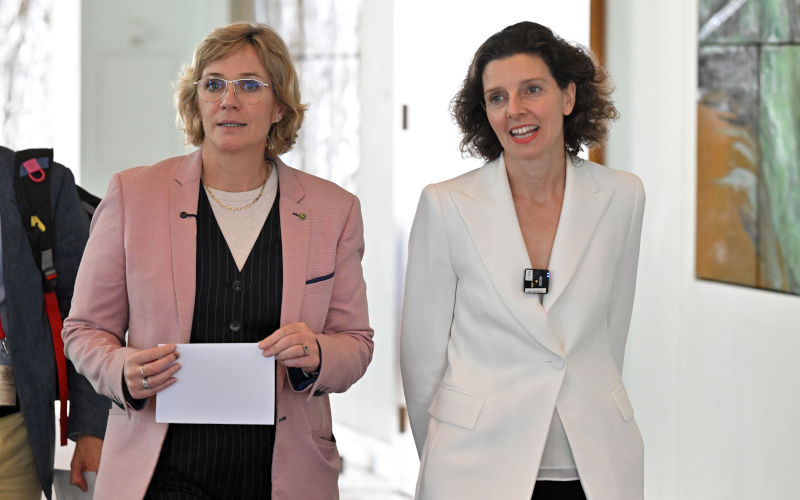
The launch of Community Strong Australia was a strategic move to position independents so they can offer a positive alternative to the two-party system.
Last week, Zali Steggall and Allegra Spender launched Community Strong Australia. Within hours, the commentary was fixing on the party’s name, its structure and whether two MPs could hand-pick candidates. Almost no one asked the question that matters. What problem is this trying to solve, and for whom?
The problem is real and it is structural. For years, ordinary people have been asking who and what they can vote for to replace a two-party system that has stopped serving them. One Nation offers an answer – grievance with a scapegoat attached and a billionaire’s hand on the wallet – and it is the wrong one. The task was never simply to reject One Nation. It was to find a better answer. Community Strong Australia is an attempt to do so; it deserves to be assessed on those terms rather than on its branding.
This is the part the early commentary has skipped, and it is the part that decides everything. Building this party is strategic, not naive. Begin with the field it is entering, a field that was deliberately tilted. The donation and spending laws Labor and the Coalition passed in February 2025, in the final months of the last parliament, were not neutral housekeeping. Steggall has called them a stitch-up to freeze out competition. Monique Ryan, who has declined to join the new party, uses the same word. The laws commence on 1 July 2026 and lock the constraints in for everyone who comes next.
On top of the money sits a structural wall. A Senate seat is generally won above the line on the ballot and only a registered party can sit there. A lone independent cannot. Read together, these facts change the meaning of forming a party. It is not a retreat from principle. It is the only vehicle that can contest the upper house at all. Refusing to create it, because a party feels less pure than an independent, would be the naive choice. Building it is the strategic one.
What has actually been lodged is worth reading before judging. Under the party’s draft constitution, the members are the elected representatives and candidates, not a paying rank and file who preselect and direct. Candidates still emerge from community processes. There is no leader, and none is created until at least ten MPs join. On the floor, members keep a free vote on everything except supply and confidence. That is not the architecture of a conventional party. It is closer to a co-operative, a form Australians have long trusted, created when the big players would not serve them, from the grain growers who pooled into Co-operative Bulk Handling (CBH) to the credit unions formed by people the banks would not bank. A co-operative pools expensive shared infrastructure while leaving each member their independence and their vote. On the question that matters most, who holds the power, it distributes rather than concentrates.
The obvious worry is that a free vote becomes a caucus of convenience that fractures on the first hard bill. The evidence from the crossbench cuts against the fear. The Australian National University examined how the community independents voted across the last parliament and found cohesion, on some measures higher than in the major parties, and reached with no whip and no penalty for crossing the floor. Where members differed, on amendments to the Fair Work Act and on votes concerning Gaza, they did so openly and on substance. That is not a bloc failing to hold. It is considered representation conducted in public, the product of people reaching alignment by argument rather than instruction. A healthy democracy is not the absence of disagreement. It is disagreement handled well: patient work that builds something everyone can live with.
None of this resolves all the objections, which should be stated plainly. The model has so far proven itself in some of the wealthiest seats in the country. Whether it can be extended into the places where the new laws bite hardest is a promise, not yet a demonstrated result. The early concentration of power matters too. In these first months, before there is a membership base, the two sitting MPs make the founding decisions. Whether that gatekeeping is temporary scaffolding or permanent architecture is precisely what the 100-day consultation now beginning must settle. What was lodged is a draft, registration is not final until October, and accountability runs in both directions, since a candidate who fails is worn publicly by the members who chose them.
The sharpest open question is money. The website and the draft constitution are silent on funding. Whether the party will cap donations, refuse support from particular industries or disclose more tightly than the law requires has not been stated. That is the first question to put to it. The same question belongs to every party, including the established ones whose disclosure regimes are slow and partial. A new vehicle asking for trust has to show its receipts.
Underneath the structural argument is a simpler political truth. People do not vote for independents because they are independents. They vote for a candidate they believe will stand up for them and get things done. The independent label was never the product. Genuine representation is. Most people are also more at home with a party than a movement, so choosing that familiar form is not a betrayal of the independent brand. With a genuine foundation, it offers the ordinary voter a serious alternative that a scattering of unaligned candidates never will.
Seen as political economy, this is strategic move to fill a gap in the market. The major parties are losing their grip. The Coalition’s fault lines between moderates and conservatives, city and region are showing. The defecting voter has been left with nothing credible to choose. One Nation has rushed to fill that vacancy, trading on grievance. Filling it with something accountable, transparent and durable, is not idealism. It is strategy: a way to overcome being shut out of the Senate and striking a ceiling in the lower house.
So, this is a development worthy of serious consideration, with both eyes open and the hard questions still on the table. It is a better answer than the politics of grievance, and it is being built in the open, where a healthy democracy does its work. Every solution begins with a conversation, and this is one of the most important we will have.

Sue Barrett
Sue Barrett is a business leader and community activist based in Goldstein, committed to fostering dialogue and fairness in Australian democracy.