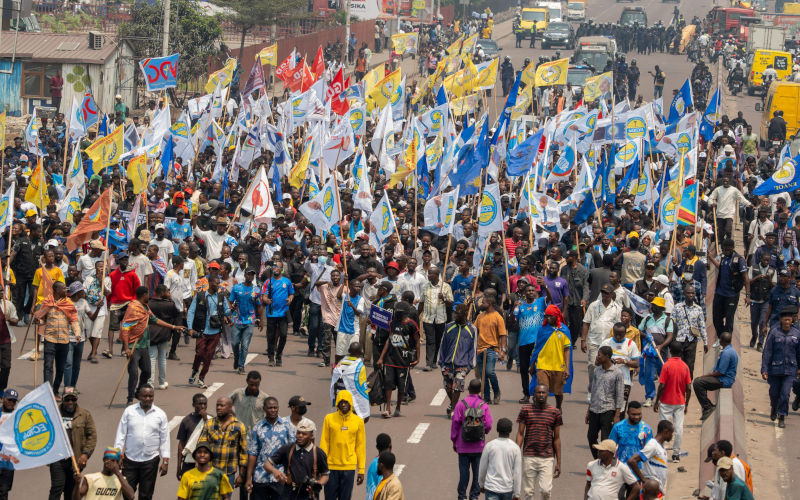
Too often, the Global South is portrayed through crisis and through outsiders’ eyes. In this speech to the Belt and Road Journalists Forum, Gordon Joseph details how stronger media partnerships and fairer access to technology could put local voices in control.
Let me begin with a question.
Who has the right to tell our stories?
Who decides which suffering deserves international attention? Whose tears make the headlines? Whose voices are trusted to explain a crisis, a conflict, a struggle for human rights or the everyday realities of ordinary people?
Because when our stories are told by others, through their priorities, their assumptions and their interests, we risk losing more than control of the narrative. We risk losing control of how the world understands us.
We have often been spoken for
For too long, the global news landscape has been marked by an imbalance between the Global North and the Global South.
Too often, Africa and other parts of the developing world enter the international news cycle through the language of crisis: war, poverty, corruption, hunger, political instability and disaster.
These are real issues. They must be investigated. They must be reported. No journalist should look away from suffering simply because the truth is uncomfortable.
But where are the stories of our innovation? Our intellectual traditions? Our scientific achievements? Our democratic struggles? Our communities finding solutions to problems the world has yet to understand? We are not short of these stories. Nairobi, Kenya, is becoming a world-class technological hub. Often referred to as the ‘Silicon Savannah’, Nairobi is at the forefront of cutting-edge innovation. South Africa is leading important research in the treatment of tuberculosis (TB). Angola is using satellites to find water. Rwanda is ensuring nutrition for all children, one egg at a time. In Namibia, we are removing barriers to education – the idea of education being the great equaliser is not just a talking point in Namibia. These stories are Africa too. We are finding solutions to problems that the world sometimes doesn’t even know exist yet.
Where are the stories that allow our people to be seen not merely as victims of history, but as agents of their own future?
The problem is not that others tell our stories. The problem is when they have greater power to define those stories, distribute them and make the world believe their version is the only credible one.
We must be honest about that imbalance if we are serious about changing it.
Journalism is not neutral to human suffering
There is another issue I want to raise, one that goes to the heart of my own journalism.
I have never been entirely comfortable with the idea that journalists must be detached from the stories they cover.
I understand the importance of independence, fairness, verification and professional distance. I understand that journalists must challenge their own assumptions and give people a fair opportunity to respond.
But I ask: when a child is denied basic rights, when a community is dispossessed, when corruption steals resources from people who desperately need them, or when the powerful abuse their authority, what exactly are we being asked to remain neutral about?
Credible organisations, agencies and the association of genocide scholars are telling us that what is happening in Gaza is genocide. The scenes are playing out in 4K in real time. How can we be neutral in the face of such cruelty? ‘Never again’ cannot be reserved for some. What’s happening in Gaza, and the neutrality of the media, is a moral failure. So is the lack of coverage on the displacement of thousands in the Democratic Republic of the Congo (DRC). And the violence in Sudan. The suffering of the DRC and Sudan must be heard. We must tell their stories. They too matter.
Are we to be neutral between evidence and falsehood? Between accountability and impunity? Between a documented human rights violation and the attempt to conceal it?
I do not believe so.
Our duty is not to be neutral between truth and falsehood. Our duty is to pursue the truth fairly, rigorously and courageously.
The AI challenge: who owns the future of our newsrooms?
Now, just as we confront these historical inequalities, we are entering another period of profound change.
Artificial intelligence is transforming journalism and broadcasting. It can translate languages, analyse documents, transcribe interviews, identify patterns in large datasets and help newsrooms produce content faster and at lower cost.
For under-resourced newsrooms in Africa, Asia, Latin America and the Caribbean, these tools could be enormously valuable.
These are real opportunities.
But we must also confront the risks.
What happens when media organisations replace journalists with automated content? What happens when algorithms determine which stories deserve visibility? What happens when AI systems reproduce the biases of the data on which they were trained? And what happens when the voices, languages and experiences of our communities are poorly represented in the technology shaping our information environment?
There is a danger that we will become consumers of technologies developed elsewhere, using systems whose priorities, assumptions and commercial interests we have little influence over.
There is also a danger that, in the race to publish faster and cheaper, we will lose something that cannot be measured by productivity alone.
The journalist who sits with a grieving mother. The reporter who returns to a community long after the cameras have left. The broadcaster who understands the silence in a survivor’s voice. The investigator who recognises that a document is not merely data, but evidence of a decision that has changed thousands of lives.
AI can help us process information. It cannot be allowed to relieve us of responsibility for what that information means.
From isolation to cooperation: we cannot afford to work alone
We cannot build a stronger Global South media landscape if every newsroom continues to fight its battles in isolation.
I propose that we pursue practical forms of cooperation.
- Build cross-border investigative partnerships.
- Create a Global South content-sharing network.
- Pool resources and expertise.
- Invest in journalist-to-journalist relationships.
- Develop multilingual distribution platforms.
- We should explore a practical network that connects journalists’ unions, public-interest media organisations, universities, journalism schools and independent newsrooms.
Our purpose must be to expand the number of credible voices in the world, and establish a Global South journalists’ cooperation framework to connect newsrooms, journalists’ unions and investigative networks for regular collaboration and information exchange.
Conclusion: our stories are not someone else’s property
I come from Namibia, a country whose history reminds us of the cost of having others exercise power over our lives and define our place in the world.
That history makes questions of voice, dignity, equality and self-determination deeply important to me.
And as a journalist, I have learned that the struggle for accountability is never finished. Power does not surrender its privileges simply because we have exposed an injustice. Nor does an unequal media system correct itself merely because we have acknowledged that it exists.
Change requires organisation. It requires resources. It requires solidarity. And it requires people willing to insist that things can be different.
I want to leave you with one final thought.
The Global South does not lack stories. It does not lack talent. It does not lack courage. Too often, what it lacks is equal access to the resources, networks and platforms that determine which stories reach the world.
We must change that.