Despite what the Government and some of the mainstream media will have us believe, the “News Media Bargaining Code” does nothing to protect or enhance quality journalism in Australia. There are better ways to achieve that.
The Morrison government and the Australian Competition and Consumer Commission (ACCC) are locked in a battle with Google and Facebook to break what it asserts is a “massive bargaining power imbalance” held by the two big tech firms over news businesses.
Google leaving Australia serves nobody, but it is not an empty threat
According to the ACCC, this “bargaining power imbalance” forces the news businesses to accept “terms of service that are less favourable”. The ACCC does not say what it is less favorable than, but obviously not less favourable than terms provided to every single other news market and wider information market entrant. All content providers are offered the same terms of service by search and share platforms such as Google, Facebook, Twitter, Bing and Instagram. They all provide links between readers and their content for free.
It is impossible to see how news businesses can get better terms of service than that, although the news businesses have found a way. They have submitted that Google and Facebook should pay them for the privilege of providing the search and share services that the digital giants have been providing to news businesses for free for nearly two decades. The better terms of service that the news businesses are angling for are that some of their costs will be covered by their competitors – upwards of $1 billion a year if News Corp has its way.
There is no precedent for such an arrangement in competitive markets. But the ACCC has seen fit to develop a News Media Bargaining Code that will in fact reverse the supposed imbalance in favour of the news businesses.
Market interventions are sometimes justified, but they are meant to correct, not reverse, imbalances. Moreover, the ACCC’s data do not establish that an imbalance exists, let alone the “massive” one asserted by the ACCC chairman, Rod Sims. The ACCC’s data indicate that while Google services 94% of search requests in Australia, this does not translate to a monopoly in digital advertising revenues – far from it.
According to the ACCC, Google “only” commands 42% of digital advertising revenues in Australia. The news media platforms themselves follow closely, with 39%, when their income from digital classified and display ads is included. Facebook brings up the rear with only 19%.
When the total market of available advertising revenues is taken into account, Google and Facebook’s shares are only 22% and 10% respectively of the total available advertising revenues. The “old” news media businesses still enjoy more than 60% of the total available.
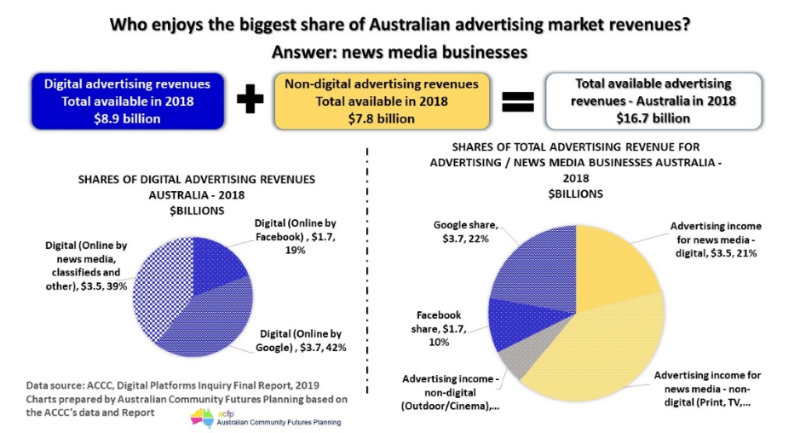
This “battle” is all about advertising market share. With the rise of digital advertising, news businesses no longer command the 90%-plus market share of available advertising revenues they used to have.
The ACCC’s job is to put consumers first by maintaining a level playing field for competition. A mandatory code that can only reduce competition in both news and advertising services is not a reasonable way to support consumers. It favours the traditional news businesses too heavily by giving them preferential terms for distribution on the web, thus reducing, not enhancing, diversity of journalism in Australia.
Here are 12 far less costly and disruptive actions the Morrison government could take to help journalists play their part in supporting an open democracy:
- Make FOI applications easier and cheaper: stop knocking back federal FOI applications back at unprecedented rates and redacting, without accountability, large slabs of material.
- Develop and maintain real time transparent registers of lobbying and political donations: save journalists the trouble of having to develop their own “Citizen’s Transparency Hubs” such as the one developed by The Guardian.
- Stop criminalising public interest journalism: stop intimidating journalists through threats of jail sentences. Journalists in a democracy are supposed to hold governments to account and shouldn’t be threatened for doing that vital job.
- Lift the veil of secrecy on government misconduct: reverse some of the national security laws that now make it impossible to hold governments to account for any illegal behaviour in relation to classified security matters.
- Establish a federal integrity commission: AAP and other wire services could then afford to assign journalists to centralised corruption inquiries.
- Reverse cross-media ownership laws: stop allowing one or two mega news businesses to own all three non-digital platforms (print, TV and radio) in one geographical area.
- Develop regulations to prevent further media market power imbalances: for example, prohibit Murdoch from disabling AAP and prohibit any news business from acquiring a search engine and thereby vertically integrating news production and distribution (the Code, if it proceeds, will help Murdoch by facilitating a raid on Google).
- Stop de-funding the main independent news agency we are lucky enough to have – the ABC: stop pressuring it (via that de-funding and raids on sources) into less and less editorial independence. Reinstate the $783 million cut from the ABC’s budget since 2015.
- Avoid plunging news businesses into further decline in editorial integrity by deleting provisions in the Code requiring notice of algorithm changes: this simply provides news business with information about where clicks will come from and will narrow diversity of content. Replace the Code’s algorithm notification provisions with a requirement to submit codes of practice for approval by ACMA and independent compliance audit.
- Fund government agencies vital to the support of journalism: ensure ACMA is resourced and independent so that it may do a better job of maintaining compliance with approved journalistic standards and reverse funding cuts to the Australian Bureau of Statistics.
- Create an Australian Commission for Independent Public Interest Journalism: hypothecate the taxes paid by digital platforms and news businesses. This Commission could function in a similar fashion to the Australian Olympic Commission, which identifies high quality athletes for receipt of grants to improve their chances at the Olympics. The Commission for independent journalism would have to ensure it approves grants only to news agencies, journalists or news project proposals that are genuinely independent.
- Commence a nationwide community engagement process for development of a legislative framework for ethical and fair regulation of a free and open democratic digital information market.
We are still at the start of the digital age, yet governments have lagged behind on the regulation of the now massive information market that is needed to protect our democracy. There is too much focus on the faults of the digital platforms while governments fail to do their job in designing the sort of legal framework necessary for regulation of a changed media market.
Australia’s government could lead the world in this area.

Bronwyn Kelly is the Founder of Australian Community Futures Planning and the author of By 2050: planning a better future for our children in 21st century democratic Australia and The People’s Constitution: the path to empowerment of Australians in a 21st century democracy. View her writing on Substack at bronwynkelly.substack.com or at austcfp.com.au
Comments
4 responses to “Twelve points to help journalists and save democracy”
The buffoons in Parliament are not the real government. They the rubber stamps of the de facto government of Australia, which is the media corporations and their advertisers. Google, a great benefactor to the world including the Australian people, is being chased out of Australia by the crooks who are the de facto Australian government.
The ACCC does not understand the media industry.
A very fine old book ” The manipulators: America in the media age” by Robert Sobel published a model of the industry, defined as four roles : Source, Packager, Carrier and Market.
Modern “social media” do not change those roles, nor do they provide ANYTHING “Free”. The business model for Facebook, published by Zuckerberg when it started, is to mine the content of subscribers’ private messages and choices and “likes” so as to sell their privacy to the advertisers. (It is difficult to think of a business more anti-social.)
The current generation of “social” media are essentially carriers, but with tricky terms and conditions in which subscribers renounce a lot of rights to content and privacy.
The authors and publishers of news do not need to accept those T&Cs. If they decline, they can maintain their copyright as a “Source”.
If the ACCC understood the media industry and fulfilled its duty to consumers, it would explain what “social” media really costs them. Instead of parroting the line that it is “free”.
I offer an alternate perspective to the one presumed here (that this is about market share, tax revenue and/or only protecting the Murdoch political power) for consideration.
Any one following US and world news rather than the censored version in Australia would not have missed Google’s change of fortunes after it made overtures to China and attempted to provide Google services in China that complies with Chinese law. Facebook did not see a reversal of fortunes until recent refusal to curate its platform and censor foreign (to the mainstream US narrative) sources of information. This is despite decades of complaint about their invasion of privacy and secret data collection and experimentation on its users, monopoly in the search and social media sectors respectively, and Cambridge-Analytica et al attacks on the necessary foundations of democracy.
Now suddenly, the snivelling conniving Morrison government that only attacks the weak and sidles up to bullies, attacks Google and Facebook? Methinks this is more about the streamlining and control of diverse news sources and information, the expansion of the Psyops-Military-Industrial complex if you will, and the formation of a war ready Ministry of Truth, whether it’s a hot war or a cold one. In any case, I’m glad we’re no longer on the losing side of the war narrative with Joe Biden in charge, painting ourselves into the corner of the White Supremacist overlord wanting to dominate a diverse world with a racially exclusive ideology.
The social media operators are being pressed into being censors.
They are hopelessly clumsy and inept, of course, because, as Carriers, the only thing they know about content is its value for advertising purposes. They are fish out of water, and yes, China observed that about Facebook.
Yes, Morrison’s attack on the media bullies is equally inept. Because it is wrongly motivated by an attempt to protect the oligopolies of the Australian news industry, notably Murdoch. A prominent Party donor.