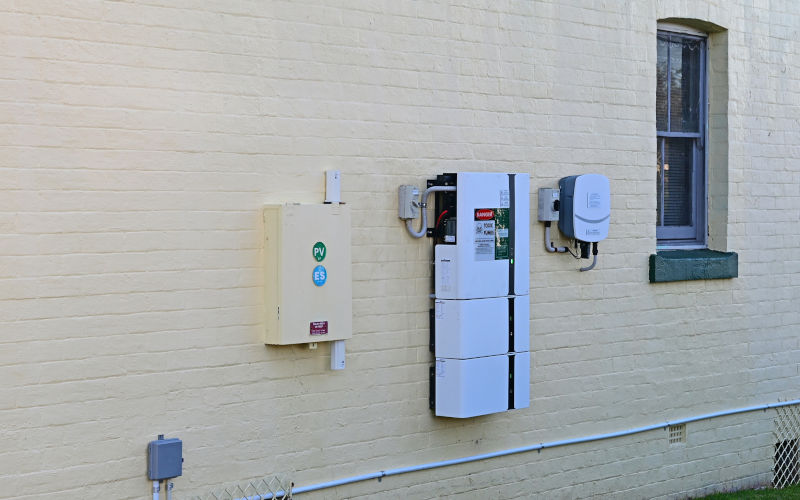
Australia’s home battery rollout shows how infrastructure can be distributed rather than concentrated. The same principle could reduce the pressure AI data centres place on power, water, housing and local communities.
In Magnifica Humanitas, issued in May, Pope Leo XIV cautioned against the centralisation of technological power and its ‘distorting effects’ (§5). He called for data, algorithms and digital platforms to be recognised as a form of the common good. “When these goods remain concentrated in the hands of a few,” he argued, “a new imbalance is created” (§67).
Magnifica Humanitas drew attention to the material impact of AI and other technologies. The pope argued that “care for our common home and our responsibility toward the poor and future generations require that the use of the goods of creation and the new possibilities offered by technology be regulated in such a way as to respect the environment, avoid waste and prevent new forms of exploitation” (§67).
How should Australia approach technology in light of this challenge?
Data centre rollout is already making ordinary Australians compete with mainly offshore-based firms for fundamental needs like energy, water and housing. Why are we offering these overseas tech giants the keys to the city?
The main reason they want to move into Australia is because communities in the United States are firmly against data centres and have already been making the objections that Australians are now making. Instead of answering objections in their home country, the companies have set their sights on Australia where – until now – resistance had been muted.
Word has now got out, thanks to grassroots campaigns in communities around the country, and data centres have fast become a friendless and unwanted presence. Change.org states that signatures on Australian petitions opposing local data centres have tripled from 40,000 to 120,000 since June.
In Australia’s case, freely handing over our resources is even worse than it would be in the United States: all the control remains in foreign hands and much of the profit goes offshore. The least we could do is press our advantage to carve out space for sovereign AI, as recently called for by the ACTU, UNSW AI Institute, Adelaide University Australian Institute for Machine Learning and Kingston AI Group. Instead, we are gifting offshore companies our potable water supply, our power supply and our construction workforce. It is the 21st-century version of a banana republic.
Data centre investment is not a decision made in a vacuum. Investment in all other kinds of construction, critically including housing, is sliding (US figures here). Had the Firmus IPO gone ahead, that alone would have soaked up around $7 billion in investment that could have gone into projects of greater social utility.
There appears little doubt AI can be a helpful technology, but the data centre construction boom is causing market distortions that affect living costs and may also prove to be an investment bubble.
In the section of Magnifica Humanitas that directly deals with data centres, Pope Leo says: “It is essential to develop more sustainable technological solutions that reduce environmental impact and help protect our common home” (§101).
The good news is that such solutions already exist.
Cloud computing doesn’t have to be housed in large data centres. It can be distributed at the level of households and small businesses. Such an approach has multiple benefits, including:
- Our existing energy and water infrastructure doesn’t have to adjust for sudden very large increases in demand.
- They can use smart energy technology to draw on household power at optimum times, allowing the financial benefit to be realised at the household level.
- MIT researchers say distributed data centres are only 2–5 per cent of the cost of large data centres (others claim 20 per cent) and they do not draw resources away from housing construction.
- Distributing computing in this way carries a far lower security risk than concentrating it in large sites, as Ukraine and Russia are learning right now.
The analogy is the government’s own household battery scheme. Australia has installed 14 GWh of household battery storage into 500,000 households in just over a year, equal to 14 large-scale battery installations, without any community pushback. Quite the opposite: home batteries give households and communities more say over their own power use.
What better way to listen to a community feeling disempowered on so many fronts right now and heed their opposition. Call a halt to large-scale data centre construction and instead roll out a means for the community to share in the profits of the AI revolution.

Michael Walker
Dr Michael Walker works in the Justice and Peace Office of the Catholic Archdiocese of Sydney. He teaches at Australian Catholic University.