John Menadue

  • Royal family are even more secretive than MI5.

    Jenny Hocking has been researching and publishing some vital information about the dismissal of the Whitlam Government by Sir John Kerr . In that research, she has been denied access to the papers.  She is taking legal action in the Federal Court against the National Archives to release correspondence between Sir John Kerr and the Queen.  (See ‘The Palace Letters‘)

    In The Times, Ben MacIntyre writes about the secretive nature of the British Royal Family. See his article below from The London Times of October 28, 2016. John Menadue. (more…)

  • RICHARD WOOLCOTT. The present threat to global security.


    In the second decade of this century we are living in a greatly changed world, compared with that to which we accustomed ourselves, following the defeat of Japan and Germany in WWII in the second half of 1945.

    The international “rules based “situation of the late 40s and early mid 50s was essentially created by the US with some British and French support. It is now completely dated and out for touch with the present situation, driven as it is by the rise of China and India,and the rapid growth of the domestic economies of Indonesia,Vietnam, Thailand, the Philippines and Malaysia.

    The apparent present insistence of the US that no other power, including China,should resist its belief in its own global supremacy, can be a serious danger to global stability.

    Also, a threat of Russian ambition,promoted by the US, is not the main threat to peace at present. As US supremacy recedes,Chinese power rises and Russia continues its recovery, it is US resistance to this tide of historic change now underway,which puts at risk,as this century unfolds both global security and the emergence of an Asia Pacific community.

    If Australia does not respond promptly,we shall find ourselves left behind.

    Richard Woolcott, Former Secretary of the Department of Foreign Affairs and Trade (1988 – 2002), Permanent Representative to the United Nations (1982 – 1988)

  • ARTHUR CHESTERFIELD-EVANS. Compulsory Third Party insurance in NSW- a Bad System about to Get Worse?


    CTP, Compulsory Third Party insurance (Green Slips) in NSW are looking increasingly like a scam. In theory, if you are injured in a motor vehicle accident that is not your fault, all ‘reasonable and necessary’ treatment is currently paid for by your insurer. People might assume this means good, standard medical practice. This is not so.

    In principle, patients are entitled to immediate and early treatment but the first problem is that insurers have up to 3 months to decide if they are liable for the accident. Payment can be delayed until the liability is accepted. Sometimes when two cars collide both insurers decide that the other is liable, and neither will pay. This is quite common. (more…)

  • ROBERT MANNE. How we came to be so cruel to asylum seekers.

    This is an edited extract of a talk delivered to the Integrity 20 Conference at Griffith University on October 25, 2016


    If you had been told 30 years ago that Australia would create the least asylum seeker friendly institutional arrangements in the world, you would not have been believed.

    In 1992 we introduced a system of indefinite mandatory detention for asylum seekers who arrive by boat. Since that time, we have accepted the idea that certain categories of refugees and asylum seekers can be imprisoned indefinitely; that those who are intercepted by our navy should be forcibly returned to the point of departure; that those who haven’t been able to be forcibly returned should be imprisoned indefinitely on remote Pacific Islands; and that those marooned on these island camps should never be allowed to settle in Australia even after several years.

    How then has this come to pass? There are two main ways of explaining this. (more…)

  • JOHN MENADUE. Our Working Holiday Programs have lost their way.


    I have been an advocate of Working Holiday Programs (WHPs) for over 40 years. These programs were an excellent opportunity to ‘foster closer ties and cultural exchanges between Australia and partner countries with particular emphasis on young adults.’. The programs were reciprocal.

    But the nature of WHP’s have changed dramatically in recent years. In Australia they have become mainly labor market and cheap labor programs.

    A recent report of the Fair Work Ombudsman has drawn attention to widespread exploitation and underpayment of working holiday makers.  (more…)

  • PAUL DALEY. Why Australia Day and Anzac Day helped create a national ‘cult of forgetfulness’.

    Australia Day and Anzac Day are months away.

    But I’m getting in early. It’s beyond time Australia cast off these sturdy cultural crutches that both, somehow, define national birth, so we can discover who and what we truly are.

    Australia Day, celebrating British invasion in 1788, and Anzac Day, marking Australia’s involvement in the failed invasion of the Ottoman empire in 1915, are but relatively recent, fleeting moments of note among innumerable others in our 60,000-year continental human history. (more…)

  • BINOY KAMPMARK. Des Ball: The man who sank the myth of controlled nuclear warfare

    The late Professor Des Ball of the Australian National University’s Strategic and Defence Studies Centre came as close as any on being a public intellectual on nuclear strategy.

    While some of his counterparts in the United States felt that using nuclear weapons was feasible and sound, Ball, who died last week, issued his pieces with mighty caveats and sensible qualifications.

    Controlling the process of deploying weapons of mass extermination in an active theatre, far from being deemed obscene, was lauded by advocates. Human sense will always prevail, somehow. (more…)

  • TONY KEVIN. Clinton-Putin-Trump: foreign policy dimensions of the final debate.


    There is no doubt that Hillary Clinton trumped her contender on domestic economic and social policy issues, migration, and proper respect for women. She has neutralised the personal emails and Clinton Foundation questions. Barring the unforeseeable, she will cruise to victory next month.

    On foreign policy, her words and what she left unsaid left many important questions: and Trump more often found himself on the right side of the foreign policy argument, for those who follow these things. Such debates proceed according to a free flow of their own and important issues easily get submerged and diverted as the caravan rapidly moves on. Here are my notes for what they are worth. (more…)

  • HAMISH McDONALD. What really happens at Pine Gap.

    Hamish McDonald wrote this article in the Saturday Paper on October 1, 2016. The paper was also a tribute to Des Ball who died recently. He was the best informed and independent commentator on Pine Gap.  The following is an introduction to Hamish McDonald’s article with a full link at the end to the Saturday Paper.  John Menadue

    It’s one of two sacred sites to which you can drive from Alice Springs. The other is the red stone monolith of Uluru, said by the Pitjantjara to bring down a curse on anyone who removes a rock.

    This one, though, is the huddle of gleaming white fibreglass domes known as Pine Gap which, if penetrated by the uninitiated, could threaten the security of the West. (more…)

  • JAMES ROSE. From Tampa to now: how reporting on asylum seekers has been a triumph of spin over substance.


    Spin designed to dehumanise and demonise asylum seekers.

    This year marks the 15th anniversary of one of the most divisive national election campaigns in Australia’s recent history: the Tampa affair.

    Coming just weeks after the September 11 terror attacks, the pitched battle between John Howard and Kim Beazley drew heavily on fear and panic. The divisions of 2001 are not only still with us, but they are far deeper today.

    The September 11 terrorist attacks in the US were given a sharp-knife twist here in Australia. The country was still entangled in the issue of the MV Tampa and its cargo of more than 400 desperate asylum seekers. And there was a public outcry over the events surrounding the interception of the SIEV-4 and its 223 asylum seekers – some of whom, politicians claimed, had thrown their children overboard.

    The way the media frames public debate on asylum seekers and their impact on Australia was forged in this time. Three key strategies helped achieve this. (more…)

  • NICHOLAS FARRELLY. What is King Bhumibol’s legacy?

    New Mandala co-founder Nicholas Farrelly reflects on a remarkable and contentious reign.

    The 70-year reign of Thailand’s King Bhumibol Adulyadej started and ended inauspiciously. It was a family tragedy that unexpectedly brought Bhumibol to the throne. He went on to become the world’s longest serving monarch but, in death, his formidable legacy is deeply tarnished by the ambitions of those who fought hardest to defend him.

    In 1946, the untimely and mysterious death of his older brother, King Ananda Mahidol, catapulted the young Prince Bhumibol into a role for which he was unprepared. King Ananda died violently in Bangkok’s Grand Palace. He was found in bed with a pistol shot to the head. To this day, nobody knows who pulled the trigger. Forensic reports suggest that neither suicide nor an accident were likely. Whispered speculation about regicide has continued ever since. (more…)

  • DAVID JAMES. It will take more than a royal commission to tame the banks

    The recent appearance in parliament of the chief executives of the Big Four banks was notable for its well orchestrated apologies, which were about as convincing as a life insurance ad that promises only to pay out to the immortal.

    (more…)

  • PETER DAY. Is western civilisation bored?


    Religion. The mob. Capitalism. Fundamentalism. Bad parenting. Racism. Materialism. Youth unemployment. Poverty. Thugs. Multiculturalism. Rich vs poor …

    Take your pick; even add to the list, as we collectively grapple to decipher the root causes of the violence and the mental illness that pervades our world – be it terrorism, random shootings, war, suicide.

    ‘Man’s inhumanity to man’ shakes us to the core. We start to question what it means to be human. We apportion blame. We want answers. ‘Gosh’, we ask, ‘what just happened?’ (more…)

  • Catholic Bishops – It Is Time To Bring Them Here

    Statement in support of offshore detainees
    By Archbishop Denis Hart, President, Australian Catholic Bishops Conference

    One of the greatest crises of our day is the plight of people forced from their own countries by war, persecution or poverty and forced to live without a home, without safety and often separated from their families.

    Pope Francis has called on Catholics to welcome such vulnerable people as our brothers and sisters. In Australia, we do not have to directly meet the responsibilities that many other nations bear. But we do bear the shame of the expulsion and harsh treatment of the people who sought our protection only to be detained on Nauru and Manus Island. (more…)

  • JOHN MENADUE. Privatisation and the hobbling of Newcastle Port.


    The downsides of privatisation are becoming clearer.

    A recent example, which has received little publicity in the mainstream media is the hobbling of Newcastle Port for the benefit of Port Botany.

    In this blog on 5 September 2016 ‘JOHN AUSTEN. How port privatisation will hobble Newcastle’ John Austen pointed out that in the sales of Port Botany (2013) and Newcastle Port (2014), the NSW Government hobbled the development of Newcastle Port and the Hunter Region. (more…)

  • LYNDSAY CONNORS. Cometh the hour, cometh the man?


    Is the Hon. Simon Birmingham, Federal Minister for Education and Training, the man?

    In his recent appearance on the ABC’s Q&A, Senator Birmingham announced that there are private schools that are ‘over-funded’.

    This came as the Turnbull Government is under pressure to commit the Commonwealth to meeting its share of the funding required to achieve the Gonski resource standards. The Coalition Government will have, reluctantly, funded only one-third of the transition towards those standards by 2017. For schools that are yet to reach the appropriate standards under the formula developed by the Gonski Review in 2012 the Commonwealth bucks will stop there. The Coalition budget commitment of only $1.2 billion over four years will not do much more than cover the effects of inflation. It falls far short of the $3 billion needed to bring all schools to the Gonski standards in 2019 according to the timetable foreshadowed by the previous Labor Government. (more…)

  • JIM COOMBS. “CIRCLE” Bail Hostels


    One of the common reasons for incarceration of Aboriginal children is failure to appear at court and breach of bail conditions (often a residence condition). One way to overcome this is to establish “bail hostels” like those in the U.K. Too often ignorance of the need to comply, losing court papers, illiteracy, and homelessness militate against compliance with the requirement to appear at Court on the appointed day. This often leads to an arrest warrant being issued, arrest, incarceration, and often refusal of renewed bail. This is both costly and administratively time consuming, when the infraction that led to it would rarely lead to a prison penalty. Research by the NSW Bureau of Crime Statistics (BOCSAR) shows that this is so for persons before the courts generally. (more…)

  • ROBERT MANNE. Oh, No Jim, No Jim, No Jim, No


    As readers of John Menadue’s blog might be aware, I believe that Australia ought, on the one hand, to find homes in the next months for the 1,700 or so refugees and asylum seekers on Nauru and Manus Island who we are allowing to be destroyed in body and spirit and, on the other, retain the policy of naval interception and return to point of departure so as to avoid a return to the situation of 2009-2013 when 50,000 asylum seekers reached Australia by boat and 1,000 or 1,200 drowned.

    Accordingly, my position on the question of how Australia should now respond to the asylum seeker issue is close to Father Frank Brennan’s and, roughly speaking, equidistant between the position of two other panellists on Monday night’s Q & A, the legal idealist Professor Jane McAdam, and the military realist, the architect of the Operation Sovereign Borders policy, General Jim Molan. While however I disagreed with several of Jane McAdam’s ideas, I was appalled and angered by both the tone and content of several of Jim Molan’s remarks. (more…)

  • PETER YOUNG. Unlike Jim Molan, We must not look away from the harm we are causing.


    Monday’s Q&A gave a good insight into the philosophy and principles behind Australia’s Sovereign Borders Policy as described by one of its chief architects Jim Molan. Most telling was his argument that the means of maintaining tight border control and supposedly saving lives at sea justified the ends of indefinite cruelty, suffering and mental harm. He showed no empathy towards the suffering imposed by the policy he authored and did not have the courage to acknowledge the overwhelming evidence of the mental harm it produces resulting in mental illness, self-harm and suicide. It was clear that from the perspective of the Sovereign Borders that the continued punishment and suffering of the people in Nauru and Manus, as well as those in Australia with temporary protection visas is seen as a necessary part of the policy. (more…)

  • JOHN MENADUE. Cars, submarines –costs and jobs and a likely disaster.


    Last week we saw the end of car manufacturing in Australia by Ford. It was a sad day for many people. Toyota and General Motors will be gone next year.

    Joe Hockey goaded our car manufacturers to leave Australia. He obviously thought Australia would be better off without them. Instead this government which claim’s business and economic expertise has agreed to submarines being built in Australia at horrendous cost, at great risk and with few benefits.

    The closing of the three car manufacturers and the much hyped submarine building in South Australia, is an example of flawed industrial policy and outrageous protection. (more…)

  • JOHN MENADUE. Preferential treatment for private patients in public hospitals in NSW.

    See below a poster from NSW Health which is being displayed in public hospitals in NSW.

    Readers may be interested to comment.

    Two things interest me. The first is that the advertisement infers that if you have private health insurance you will get superior service in a public hospital. That surely attacks the principle that in public hospitals patients are to be treated according to their therapeutic needs and not on the basis of income or private insurance. The former CEO of Medibank Pte proposed that PHI members should have priority in Emergency Departments.

    The second is that there is an inefficient churning of public money. The Australian taxpayer provides $11 billion p.a. in a subsidy to private health insurance. This subsidy is apparently to be used in part to pay bills for private patients in public hospitals. How much more efficient it would be for the Federal government to abolish the subsidy and adequately fund public hospitals. This churning of money is a symptom of the division of responsibilities in health in Australia and in the inefficiency of private health insurance.. The administrative costs of PHI are three times higher than those of Medicare. PHI premium increases over the last decade have been double the rate of CPI.


    img_0188-4

  • John Menadue. Australia, the White Man’s Media and Donald Trump


    This article was first posted on 29 January 2016.  The situation has worsened since then!

    I am usually interested in politics but I am already sick and tired of the US elections and Donald Trump. And we have twelve months to go!. Forget about Indonesia, China, Japan and India. Our media does not think them important! They go instead for Donald Trump. Or the latest snow storm in New York.or a bombing at the Boston Marathon.

    But Donald Trump is easy copy at the moment  for our lazy and derivative media. (more…)

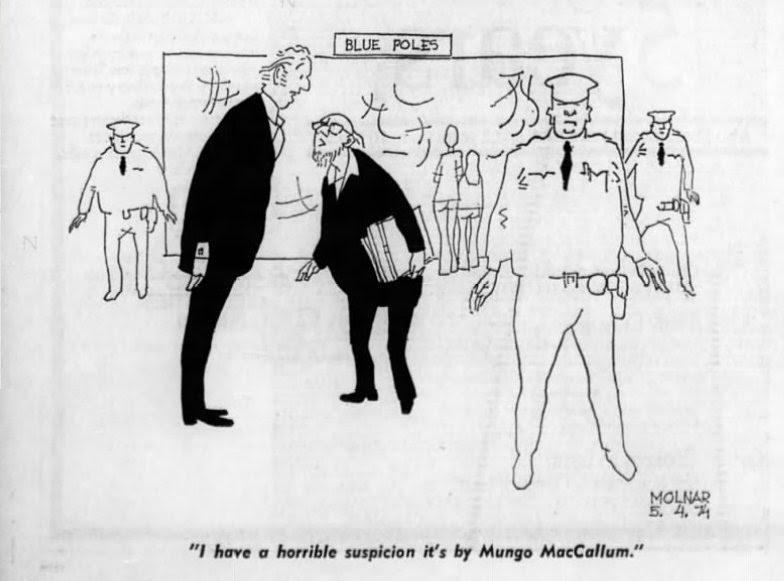
  • Gough Whitlam and Blue Poles.


    Blue Poles is in the news again. It was purchased for $1.3 million and is now valued at $350 million. The disparaging nature of the campaign against the purchase is reflected in Molnar’s cartoon (below) of 5 April 1974.

    Mungo would be chuffed!

  • JOHN MENADUE. Dental Care – Medicare – Private Health Insurance.


    Funding a Medicare dental scheme instead of the subsidy to PHI. 

    The PHI subsidy of over $10 billion p.a. would be much better spent on a Medicare dental scheme.

    In the following article Jennifer Doggett in Croakey, reports that about one third of Australians put off going to a dentist because of costs. (more…)

  • DAVID CHARLES. Venture Capital and Start Ups – Is Berlin an example for Australian capital cities?


    During a visit to Berlin in mid September this year I was struck by the way the venture capital and start up scene in Berlin had shifted from being something of an exotic hothouse flower to one of the leading places for new business creation in Germany and indeed Europe. Ernst and Young in its 2015 study Liquidity meets Perspective: Venture Capital and Start Ups in Germany argues that Berlin is the new kid on the block and has already got some impressive milestones behind it. Between 2011 and 2015 17,000 jobs were created.

    According to Ernst&Young, in terms of start ups and the mobilization of venture capital Berlin may have already caught up with London as the leading European location for tech based businesses. In 2015 Euro 2.9 billion of tech start up business took place in Germany. Of this over two-thirds was in Berlin with the lion’s share of deals being in IT and communications and E-Commerce. This placed Berlin ahead of London in that year.

    The question is how did this come about given the special nature of Berlin and its complex post World War 2 history as an island economy which had lost much of its industrial base? Are there pointers that Australia (and indeed the major Australian capital cities) can learn from in developing our own start up eco-systems? (more…)

  • ROBERT MANNE. Rescuing 1700 marooned people.


    At present the chief priority of those concerned about the refugee situation in which Australia is directly implicated is to save the lives of the 1500 or so on Manus Island and Nauru and the 250 or so at present in Australia on medical grounds.

    When this is achieved the next priority will be to struggle to provide the present “case-load” of around 30,000 refugees and asylum seekers in Australia with full citizen rights—to be treated as refugees brought to Australia have been treated—so they can live decent human lives.

    What is peculiar about the nature of the political problem posed by Nauru and Manus Island? (more…)

  • GRAEME ORR. Party Over? Reforming Australian Political Finance


    After decades of halting debate, the momentum for political finance reform has never been greater.   At a national level, this comes off a low base. Australia has the laxest political finance system of all our common law cousins: Canada, UK, US, New Zealand.

    But don’t hold your breath. Any systemic reform faces two hurdles: one real, one more imagined. The real hurdle is political will. The perceived hurdle is constitutional. Let’s take them in reverse order. (more…)

  • TONY KEVIN. Shipwreck tragedy raises broad issues of duty of care in border protection


    Last week saw three days of hearings (reported in The Guardian by Ben Doherty),adjourned on Wednesday 28 September until Tuesday 4 October as plaintiffs await key documents from the 2012 WA Coroners’ Court inquest into the disaster which drowned 50 people on 21 December 2010, when a SIEV boat crashed in heavy seas into low jagged cliffs at Flying Fish Cove, Christmas Island. Township-dwellers watched horrified from above as Australian Navy and Customs rescue crews in inflatable motor vessels arrived too late to tow the breaking-up boat off the rocks. Despite valiant efforts they were only able to save 39 people from the water. The class action is on behalf of families of dead victims, traumatised survivors and traumatised people involved in the SIEV221 rescue operation. (more…)

  • JOHN FITZGERALD. Beijing’s Guoqing versus Australia’s way of life.

    Beijing’s role in the Chinese community media in Australia is increasingly in conflict with its own demand for respect.

    Beijing is tired of foreign analysts criticising China simply for being what it is. A former Chinese ambassador to Australia, Fu Ying, made thepoint succinctly in her current role as vice–foreign minister: “The West is too arrogant and must stop lecturing us and trying to change China. Unless you can accept China as it is, there is no basis for a relationship.”

    But what is China, exactly? Is it getting its message across overseas? In the case of Australia, what does China’s engagement with Chinese community and social media tell us about the Chinese party-state? If Australians were to take up Fu Ying’s challenge and accept her country for what it is, would China welcome a little more plain-speaking about what it is up to in Australian community media?

    I raise these questions in the hope that a frank conversation about Chinese propaganda operations in Australia will help to build a more solid foundation for Australia–China relations into the future – a relationship that Australians need to get right if they are to ensure their national prosperity, security and way of life over the decades ahead. (more…)

  • JOHN MENADUE. Cruelty and evil have become banal


    Malcolm Turnbull told the UN that our treatment of refugees is world’s best practice. Only a guilty conscience could allow such self deception.

    In her book ‘Eichmann in Jerusalem’, published in 1963, Hannah Arendt refers to the ‘banality of evil’. Her thesis was that Eichmann was not a fanatic or sociopath, but an extremely stupid person who relied on cliché rather than thinking for himself and was motivated by professional promotion rather than ideology. She says ‘The sad truth is that most evil is done by people who never make up their minds to be good or evil’. (more…)