The next attempt to hold UN-sponsored talks in Geneva with the main parties to the Syrian conflict is due to begin this week. With the defeat of ISIS on the ground, what hope is there that a clearer picture will emerge on whether the conflict might be reaching its final stages? (more…)
John Menadue
-
TIM LINDSEY. Will Indonesia’s fugitive Speaker escape again? The elite’s war on the Anti-Corruption Commission continues.
Indonesians have been riveted for the last two weeks by a bizarre series of events that finally led to the arrest late last week of Setya Novanto, the speaker of the DPR, Indonesia’s national legislature. (more…)
-
RICHARD KINGSFORD. Policy holes drain the life out of Murray-Darling rivers.
We are often told by some politicians and irrigation lobbyists not to worry about our rivers – Australia is a land of droughts and flooding rains – and ever it was thus. After all, Murray-Darling rivers surely fixed themselves when the 2010 and 2011 floods broke the seven year Millennium Drought. This tired old talking point is wrong – unequivocally demonstrated by reductions in river flows and thousands of hectares of dead river red gums. Critics of environmental flows for rivers argue that the so-called poor state of the rivers is nothing more than a figment of the imagination of the disconnected environmental fringe, mostly in our cities and scientists intent on growing their empires. (more…)
-
GOOD READING AND LISTENING FOR THE WEEKEND …
The only argument about housing prices seems to be whether they will crash or fall slowly. Paul Keating warns of a possible “Minsky moment” – a sudden and spectacular crash. A paper published by Ben Phillips and Cukkoo Joseph of ANU, going into regional detail, finds that there is already an oversupply in some inner-city regions, but suggests that oversupply in itself is unlikely to reduce prices to any significant extent in the short term. Core Logic reports that auction clearance rates in Sydney and Melbourne have been on a noticeable downward trend over the last twelve months.
Wayne Byrnes, Chairman of The Australian Prudential Regulatory Authority has given a speech warning: “The broader environment of high and rising leverage, encouraged by historically low interest rates, requires ongoing prudence. It is easy to run up debt, but far harder to pay it back down when circumstances change”. Those seeking a summary of Byrnes’ speech will find one by Clancy Yates, writing in the Fairfax Press.
Wage growth, or the lack of it, is in the news. The ABC has three related but separate stories: Carrington Clarke “Cost cutting hurting workers and the economy” summarising a speech by Reserve Bank Governor Philip Lowe; Stephen Letts and Michael Janda “Wage growth mired near record lows”, citing the ABS Wage Price Index; and Michael Janda “Australian workers gift $130b to employers through unpaid overtime”, based on work by Jim Stanford of the Australia Institute’s Centre for Future Work.
Ross Gittins points out that, as a source of economic advice, Treasury’s power has been waning, with more influence coming from the Productivity Commission and the Reserve Bank, institutions more in touch with the real world. Labor, if elected, would boost the influence of the Parliamentary Budget Office.
A Washington Post-Kaiser Family Foundation poll has found that those identifying themselves as “Christians” are far more likely than “non-Christians” to blame poverty on individual failings rather than people’s circumstances: “46 percent of all Christians said that a lack of effort is generally to blame for a person’s poverty, compared with 29 percent of all non-Christians”. Among “white evangelicals” 53 percent blamed the individual.
In defiance of media predictions that Labor would retain the seat of Northcote in a Victorian state by-election, the Greens had a convincing victory. With 45 per cent of the primary vote, against 35 per cent for Labor, they easily cruised through on preferences. The Liberals did not contest the election in a metropolitan seat that Labor has held for aeons, but even though those who were disinclined to Labor or Green had the choice of another 10 candidates, they secured only 20 per cent of the vote between them. (Figures from William Bowe’s Poll Bludger.)
Richard Butler wrote in this blog that nuclear war is becoming ‘thinkable ,again’. This article shows a US Marines F-35 squadron is training to fight through nuclear war against North Korea – Business Insider.
Twelve Australians of the Year write an open letter to the PM on Manus Island.
Infographics in The Conversation show exactly what Adani’s Carmichael mine means for Queensland.
The owner of the Carmichael project can’t walk away from mine without descending further into distress, says an energy expert in The Guardian.
With the mining boom spent, the big infrastructure spend on the gas industry gone, and the east coast housing boom in its final phase, it seems there’s little ammo in the locker left to help fire up a wages lift any time soon – but there’s a silver lining, writes Ian Verrender. Read the full story
Richard Denniss explains that the coalition is unpopular because it has unpopular policies (Canberra Times)
Tim Hollo explains that Australia’s ageing constitution is past its ‘best-by’ date (Canberra Times)
-
JIM COOMBS. Is “Parliamentary Reform” needed?
When we contemplate the hopelessness of our national (and state) politics now, we are tempted, like John Menadue, to think that tinkering with the machine will turn a clapped out jalopy into a Roller. It is more likely the quality of the driver that is the problem. (more…)
-
EVA COX. Unhealthy Tribalism
The marriage equality survey has re-enforced the tribal type divides that now seem increasingly endemic in our socially defined political differences. Like most Western democratic nations, we are finding that the traditional views about voters as predictable blocs of left and right or class based voting groups are becoming increasingly less relevant. The growth of factions and fraction are displacing the comfortable labelling of party loyalists or simple categories. To add to the confusion, categories such as radical and conservative have also become less useful to define what people are thinking. (more…)
-
STEPHEN LONG. The Adani lobbyist and Labor insider who smoothed the way for the mega mine
Adani’s lobbyists resigned recently after a job well done.
Key points:
- Lobbyists made 33 contacts with Queensland politicians or their staff for Adani
- 60 per cent of meetings the Queensland Premier held with lobbyists were for Adani
- Adani lobbyist played key role in Labor’s 2016 federal election campaign
-
PETER RODGERS. Mohammad bin Salman – Saudi Arabia’s reformer or wrecker?
Perhaps as a child Mohammad bin Salman watched too much Superman. Now, as Saudi Arabia’s Crown Prince, he’s dashing hither and thither, ostensibly remaking the royal family, the country and the region. In his wake there’s profound confusion, national austerity mixed with personal profligacy, imprisoned billionaires, bruised egos, civil war, fractured alliances, recovered loot and many crossed fingers. Will MbS (as he is invariably dubbed) end the Kingdom’s addiction to oil and change its lazy economic ways? Will he force Iran and its backers to pull their heads in, acknowledge Saudi suzerainty and the joy of regional peace and Trumpism? Will he find a cure for the pathogen infecting Saudi Islam and drag his kingdom in the 21st century? Or will his dictatorial and impetuous ways blow up the House of Saud, destroying enemies and friends alike? (more…)
-
GREG WOOD. The Australian Dream: Many Belts Many Roads.
The ALP has indicated that, if elected, it will consider positively China’s so called One Belt One Road initiative. The ambition of BRI is vast. It would reshape global trade, transport and logistics in a China-centric way to meet that country’s requirements, contribute to it becoming the world’s pre-eminent economy and, ultimately, its dominant power. It fits with President Xi’s articulation of the Chinese Dream, the national rejuvenation of China as the Middle Kingdom, the communist party front and centre of that objective. Is Labor on the right path? If the Chinese have a dream do we need an Australian Dream? (more…)
-
PATTY FAWKNER. The mystery of death and life
Death and dying have been in my thoughts. Not only in November when the Christian tradition especially remembers the dead. Not only since July when my mother died. But constantly throughout the year because of two books which offered me wisdom and insight into the mystery of death and life. (more…)
-
Justice Peter McClellan says Police had an ‘understanding’ to protect churches from scandal
POLICE in Sydney and Melbourne had an “understanding..for many years” about protecting church figures accused of child sex allegations, royal commission chair Justice Peter McClellan will say in a speech in Melbourne on Tuesday. This is an article written by award winning journalist Joanne McCarthy (more…)
-
NEW YORK TIMES. Refugees on Manus Island trapped far from home, farther from deliverance
 The New York Times sent journalists into a contested detention camp in Papua New Guinea to investigate Australia’s refugee policy, and the resistance rising against it.
 -
We have been reading and listening to …
Trumps attack on the media and truth are disturbing, says Joseph Stiglitz (the Guardian)
Paul Keating warns that, without imagination, the economy is lost. (Mark Kenny – the Canberra Times)
Writing in the Canberra Times last weekend, Crispin Hull reminds us of the history of upheaveals – from the French Revolution to the recent support for far-right populists – when “the wealthy elites fail to pay a reasonable share of taxes so that the broad mass of society gets decent education, health and housing.”. Capitalism must be saved from its own self-destructive forces.
Qld Labor ups the ante on renewables, with more ambition and new technology, writes Giles Parkinson in RenewEconomy
The citizenship crisis has shown Turnbull in his usual, dreadful form, says Jack Waterford in the Canberra Times.
Last Saturday, 11 November, we published on Pearls and Irritations Douglas Newton’s contribution “Armistice Day – narrow nationalist naiveties and voodoo vindications of war”. On the same day, on Geraldine Doogue’s Saturday Extra, writer and broadcaster Jeff Sparrow recounted the sordid reality of the Dardanelles campaign: it wasn’t about securing freedom or any other noble goal. Rather its goal was to hand over that territory to Czarist Russia, at that time the “most oppressive regime in the entire world”.
Also, lest we forget, 11 November was the anniversary of the dismissal of the Whitlam Government. Christopher Pollard outlines “five facts” about the dismissal. He reveals extraordinary breaches of the Australian Constitution and of parliamentary conventions by those determined to destroy the Whitlam Government.
Adam Shatz in the London Review of Books writes on the “bomb power” of the US presidents
Ross Gittins explains that something has gone badly wrong with teaching.
Catherine Pepinster in her new book, The Keys and the Kingdom reveals that a British diplomat hosted a party of cardinals from Africa, Asia and the Caribbean to support the Bishop of Buenos Aires who would later become Pope. Cardinal Pell was not invited. She is interviewed on the ABC’s Religion and Ethics Report
Jim Molan is in line to take a NSW Senate vacancy. He was very active in the Abbott government’s asylum turn-back policy. In 2004 he supervised The Coalition attack on Fallujah in Iraq. See link to earlier post of John Menadue
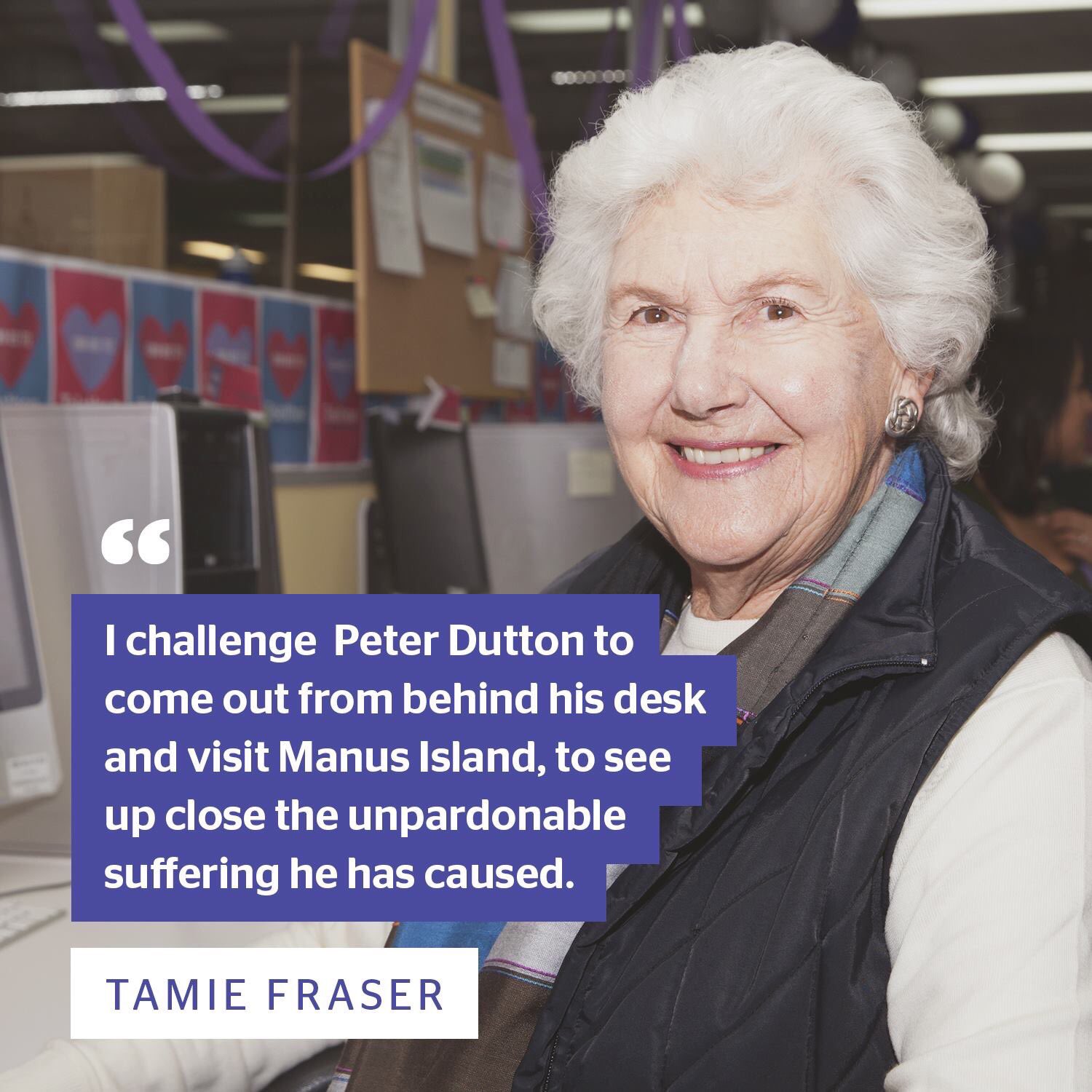
Tamie Fraser tweets a challenge to Peter Dutton over Manus Island
-
SOPHIE VORRATH. CBA challenged for “weakest climate policy,” dirtiest investments.
The Commonwealth Bank of Australia has made $6 billion worth of new loans to coal, oil and gas projects in the 20 months since committing to the Paris climate agreement, a new document has shown – more than four times the amount it loaned to renewable energy projects over that period. (more…)
-
ERIC WALSH. After Turnbull?
Will someone please provide Malcolm Turnbull with a fiddle; something to occupy our leader while his party and possibly his government burn. (more…)
-
RICHARD TANTER. The nuclear ban treaty, Pine Gap and the Nobel Peace Prize.
The world is worrying about nuclear weapons more than at any time since the frightening days of Reagan and Brezhnev, and with good reason. We are all hoping that Kim Jong-un is rational with no ambition for suicide. And at the same time, we are reduced to hoping that the American military will constrain Donald Trump’s impulses to reach for the nuclear launch button. Leading politicians in South Korea and Japan are talking up the need for their own nuclear weapons, and Donald Trump is not saying no. So, it’s hardly surprising that 122 countries voted at the United Nations in July to pass the Treaty to Prohibit Nuclear Weapons. Rather more surprisingly, but gratifyingly, the 2017 Nobel Peace Prize has been awarded to the Melbourne-born International Campaign to Abolish Nuclear Weapons (ICAN) for its work leading to the nuclear ban treaty. (more…)
-
PAUL FRIJTERS. Advance Australia Fair: ignore the other national histories on offer.
National history is the story that binds ‘us who make up the nation’ into a single entity with a collective memory. It has a purpose and as such we can choose what historical events and realities to put into that story, whilst forgetting the rest. Of the four main current contenders for our national history, I think we should pick ‘Advance Australia Fair’ as the only truly useful one. (more…)
-
JOSEPH E. STIGLITZ. America has a monopoly problem – and it’s huge. (from ‘Nation’)
We have become a rent-seeking society, dominated by market power of large corporations, unchecked by countervailing powers. And the power of workers has been weakened, if not eviscerated. What is required is a panoply of reforms—rewriting the rules of the American economy to make it more competitive and dynamic, fairer and more equal.
-
PAUL FRIJTERS. Why Blockchain has no economic future.
When Bitcoin went public in 2009 it introduced to the world of finance and economics the technology of blockchain. Even the many who thought Bitcoin would never make it as a major currency were intrigued by the Blockchain technology and a large set of new companies have tried to figure out how to offer new services based on blockchain technology. It is still fair to say that very few economists and social scientists understand blockchain, and governments are even further behind. (more…)
-
PETER YOUNG: Why Health Professionals in Immigration Detention should stop colluding and speak out
As the situation for hundreds of asylum seekers in the Manus Island continues to deteriorate the harmful consequences of Australia’s punitive immigration detention policies are obvious. Despite the secrecy surrounding immigration detention it is only the wilfully blind who avoid this conclusion. (more…)
-
GRAHAM FREUDENBERG says “Sorry”
I want to apologise for a failure going back to the Bicentenary in 1988. The very fact that 26 January continues to cause controversy is possibly the best reason for keeping it as the national day. The ambiguity of its meaning obliges us constantly to re-examine our modern origins. The new round of debate drew from Malcolm Turnbull the wisdom that it “stands for Australian values”. He managed to say much the same thing at Beersheba of all places. So we are to seek “Australian values” from Botany Bay to Beersheba. All this took place in the middle of the self-imposed fiasco in which his own Deputy Prime Minister (and by extension a huge proportion of us all) is in a legal limbo about his citizenship. (more…)
-
GOOD READING AND LISTENING FOR THE WEEKEND …
Sorry, but Medicare needs to change” writes Ross Gittins. A fee-for-service model fitted with the nation’s needs in 1974 when the Whitlam Government introduced universal publicly-funded health insurance, but over a half-century our needs have changed. We should be putting more resources to preventing and managing chronic conditions and reducing the need to call on specialists and hospitals, with a policy focus on patients rather than the interests of service providers.
Japan and North Korea may be arch foes but there’s a school in the Japanese capital for Koreans that have remained loyal to the North’s three Kim regimes to learn their language, culture and heritage. Another perspective on the same school system can be found here.
With Brexit, Britain seems to be embracing an introverted irrelevance, says Steven Erlanger in the New York Times International Edition.
There is nothing wrong with Catalonia becoming independent, says Colm Toibin in the Guardian.
Who bears the brunt of corporate tax cuts asks Kimberley Clausing
What next for the refugees and failed asylum seekers on Manus Island? asks Harriet Spinks
-
Letter from concerned Australians to Prime Minister Jacinda Ardern on the Manus Island disaster
9 November 2017
Rt Hon Jacinda Ardern Prime Minister Private Bag 18888 Parliament Buildings Wellington 6160 New Zealand
Dear Prime Minister
Warm congratulations on your election as New Zealand’s new Prime Minister.
We are writing to call upon the New Zealand Government to intervene in the entirely preventable humanitarian disaster unfolding on Manus Island. (more…)
-
EVA COX. The non-economic causes of political trust deficits – What is to be done. Part 2 of 2
It was not so long ago that the functions of more social democratic nation states were legitimated and visible because they represented wide public ownership of many physical resources and delivered many essential and community services. Whether that form has elements in it that would allay current problems and improve future governance needs to explored. What is clear is the need to reverse and reform the causes of deep distrust. (more…)
-
EVA COX. The non-economic causes of political trust deficits – The function of trust Part 1 of 2
Good democratic governance requires those in power to both be seen as both trustworthy and representing voters , effectively and fairly. Those ostensibly in control need to provide evidence that they are delivering, or ensuring access to those services and resources that are seen as public responsibilities. The disappearing common wealth and rising focus on individualised self-interest benefits need to be seen as causing the rising anti-elite, populist politics that undermine social cohesion, rather than just blaming the changes on limited economic flaws, e.g. the GFC. If we are to restore trust in good democratic processes, we need to recognise and address the social effects of citizens being redefined as customers in the shift to market models, as well as the increased invisibility of public good and goods. (more…)
-
ROBERT MANNE. A Symbol of Inhumanity: Australia’s Uniquely Harsh Asylum Seeker Policy – How Did It Come to This?
Robert Manne is Emeritus Professor and Vice-Chancellor’s Fellow at La Trobe University. An earlier version of this analysis was published a year ago, but Professor Manne has written a new postscript in light of some disturbing recent events on Manus Island.
If you had been told thirty years ago that Australia would create the least asylum seeker friendly institutional arrangements in the world, you would not have been believed.
In 1992 we introduced a system of indefinite mandatory detention for asylum seekers who arrive by boat. (more…)
-
RODNEY TIFFEN. The age of the mega-leak
The Panama Papers looked like the culmination of a new era for leakers — and then the Paradise Papers came along. But can we expect action to follow? (more…)
-
BOB SORBY. Of Pipes and Pipedreams
Life is an equation in hydrocarbons was a favourite aphorism of the late RFX Connor, Minister for Minerals and Energy in the Whitlam Labor governments of 1972-1975. The phrase belied a deep understanding by Connor of the Australian petroleum and natural gas industry at the time together with a suggestion of big ideas waiting to be explained. One big idea that Connor had was the need to develop Australia’s natural gas deposits to maximise their economic return in the international market and secure sufficient gas reserves to satisfy Australia’s domestic requirements, both domestic and industrial, for the foreseeable future. (more…)
-
MICHAEL LIFFMAN. Asylum seekers: what now?
In the face of the paralysing – and with the closure of the centre in Manus, accelerating – crisis in Australia’s asylum seeker policy, I propose the revival of an initiative I first suggested ten years ago, but which remains relevant and arguably adds further moral integrity to the call by Brennan/Costello/Manne/Menadue for the admission of those still in detention or banned entry to Australia…. (more…)