John Menadue
-
PETER DAY. Is western civilisation bored?
Religion. The mob. Capitalism. Fundamentalism. Bad parenting. Racism. Materialism. Youth unemployment. Poverty. Thugs. Multiculturalism. Rich vs poor …
Take your pick; even add to the list, as we collectively grapple to decipher the root causes of the violence and the mental illness that pervades our world – be it terrorism, random shootings, war, suicide.
‘Man’s inhumanity to man’ shakes us to the core. We start to question what it means to be human. We apportion blame. We want answers. ‘Gosh’, we ask, ‘what just happened?’ (more…)
-
Catholic Bishops – It Is Time To Bring Them Here
Statement in support of offshore detainees
By Archbishop Denis Hart, President, Australian Catholic Bishops ConferenceOne of the greatest crises of our day is the plight of people forced from their own countries by war, persecution or poverty and forced to live without a home, without safety and often separated from their families.
Pope Francis has called on Catholics to welcome such vulnerable people as our brothers and sisters. In Australia, we do not have to directly meet the responsibilities that many other nations bear. But we do bear the shame of the expulsion and harsh treatment of the people who sought our protection only to be detained on Nauru and Manus Island. (more…)
-
LYNDSAY CONNORS. Cometh the hour, cometh the man?
Is the Hon. Simon Birmingham, Federal Minister for Education and Training, the man?
In his recent appearance on the ABC’s Q&A, Senator Birmingham announced that there are private schools that are ‘over-funded’.
This came as the Turnbull Government is under pressure to commit the Commonwealth to meeting its share of the funding required to achieve the Gonski resource standards. The Coalition Government will have, reluctantly, funded only one-third of the transition towards those standards by 2017. For schools that are yet to reach the appropriate standards under the formula developed by the Gonski Review in 2012 the Commonwealth bucks will stop there. The Coalition budget commitment of only $1.2 billion over four years will not do much more than cover the effects of inflation. It falls far short of the $3 billion needed to bring all schools to the Gonski standards in 2019 according to the timetable foreshadowed by the previous Labor Government. (more…)
-
JIM COOMBS. “CIRCLE” Bail Hostels
One of the common reasons for incarceration of Aboriginal children is failure to appear at court and breach of bail conditions (often a residence condition). One way to overcome this is to establish “bail hostels” like those in the U.K. Too often ignorance of the need to comply, losing court papers, illiteracy, and homelessness militate against compliance with the requirement to appear at Court on the appointed day. This often leads to an arrest warrant being issued, arrest, incarceration, and often refusal of renewed bail. This is both costly and administratively time consuming, when the infraction that led to it would rarely lead to a prison penalty. Research by the NSW Bureau of Crime Statistics (BOCSAR) shows that this is so for persons before the courts generally. (more…)
-
ROBERT MANNE. Oh, No Jim, No Jim, No Jim, No
As readers of John Menadue’s blog might be aware, I believe that Australia ought, on the one hand, to find homes in the next months for the 1,700 or so refugees and asylum seekers on Nauru and Manus Island who we are allowing to be destroyed in body and spirit and, on the other, retain the policy of naval interception and return to point of departure so as to avoid a return to the situation of 2009-2013 when 50,000 asylum seekers reached Australia by boat and 1,000 or 1,200 drowned.
Accordingly, my position on the question of how Australia should now respond to the asylum seeker issue is close to Father Frank Brennan’s and, roughly speaking, equidistant between the position of two other panellists on Monday night’s Q & A, the legal idealist Professor Jane McAdam, and the military realist, the architect of the Operation Sovereign Borders policy, General Jim Molan. While however I disagreed with several of Jane McAdam’s ideas, I was appalled and angered by both the tone and content of several of Jim Molan’s remarks. (more…)
-
PETER YOUNG. Unlike Jim Molan, We must not look away from the harm we are causing.
Monday’s Q&A gave a good insight into the philosophy and principles behind Australia’s Sovereign Borders Policy as described by one of its chief architects Jim Molan. Most telling was his argument that the means of maintaining tight border control and supposedly saving lives at sea justified the ends of indefinite cruelty, suffering and mental harm. He showed no empathy towards the suffering imposed by the policy he authored and did not have the courage to acknowledge the overwhelming evidence of the mental harm it produces resulting in mental illness, self-harm and suicide. It was clear that from the perspective of the Sovereign Borders that the continued punishment and suffering of the people in Nauru and Manus, as well as those in Australia with temporary protection visas is seen as a necessary part of the policy. (more…)
-
Gough Whitlam and Blue Poles.
Blue Poles is in the news again. It was purchased for $1.3 million and is now valued at $350 million. The disparaging nature of the campaign against the purchase is reflected in Molnar’s cartoon (below) of 5 April 1974.
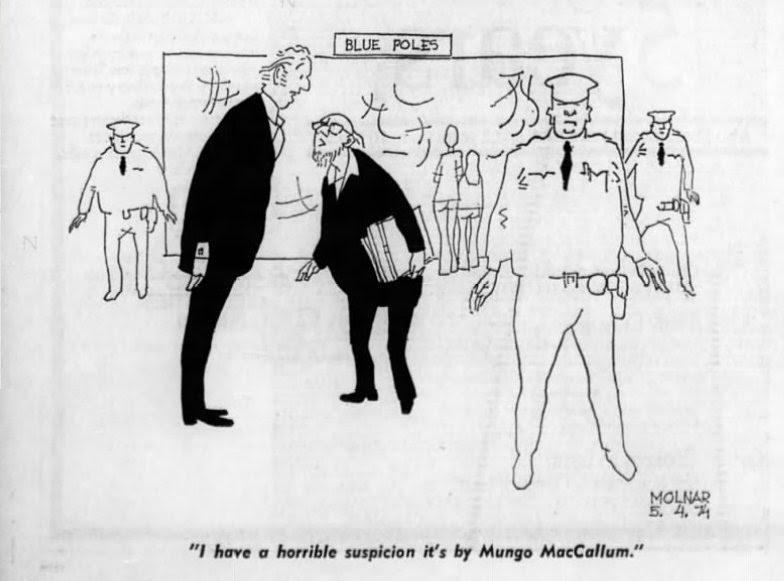
Mungo would be chuffed!
-
DAVID CHARLES. Venture Capital and Start Ups – Is Berlin an example for Australian capital cities?
During a visit to Berlin in mid September this year I was struck by the way the venture capital and start up scene in Berlin had shifted from being something of an exotic hothouse flower to one of the leading places for new business creation in Germany and indeed Europe. Ernst and Young in its 2015 study Liquidity meets Perspective: Venture Capital and Start Ups in Germany argues that Berlin is the new kid on the block and has already got some impressive milestones behind it. Between 2011 and 2015 17,000 jobs were created.
According to Ernst&Young, in terms of start ups and the mobilization of venture capital Berlin may have already caught up with London as the leading European location for tech based businesses. In 2015 Euro 2.9 billion of tech start up business took place in Germany. Of this over two-thirds was in Berlin with the lion’s share of deals being in IT and communications and E-Commerce. This placed Berlin ahead of London in that year.
The question is how did this come about given the special nature of Berlin and its complex post World War 2 history as an island economy which had lost much of its industrial base? Are there pointers that Australia (and indeed the major Australian capital cities) can learn from in developing our own start up eco-systems? (more…)
-
ROBERT MANNE. Rescuing 1700 marooned people.
At present the chief priority of those concerned about the refugee situation in which Australia is directly implicated is to save the lives of the 1500 or so on Manus Island and Nauru and the 250 or so at present in Australia on medical grounds.
When this is achieved the next priority will be to struggle to provide the present “case-load” of around 30,000 refugees and asylum seekers in Australia with full citizen rights—to be treated as refugees brought to Australia have been treated—so they can live decent human lives.
What is peculiar about the nature of the political problem posed by Nauru and Manus Island? (more…)
-
GRAEME ORR. Party Over? Reforming Australian Political Finance
After decades of halting debate, the momentum for political finance reform has never been greater. At a national level, this comes off a low base. Australia has the laxest political finance system of all our common law cousins: Canada, UK, US, New Zealand.
But don’t hold your breath. Any systemic reform faces two hurdles: one real, one more imagined. The real hurdle is political will. The perceived hurdle is constitutional. Let’s take them in reverse order. (more…)
-
TONY KEVIN. Shipwreck tragedy raises broad issues of duty of care in border protection
Last week saw three days of hearings (reported in The Guardian by Ben Doherty),adjourned on Wednesday 28 September until Tuesday 4 October as plaintiffs await key documents from the 2012 WA Coroners’ Court inquest into the disaster which drowned 50 people on 21 December 2010, when a SIEV boat crashed in heavy seas into low jagged cliffs at Flying Fish Cove, Christmas Island. Township-dwellers watched horrified from above as Australian Navy and Customs rescue crews in inflatable motor vessels arrived too late to tow the breaking-up boat off the rocks. Despite valiant efforts they were only able to save 39 people from the water. The class action is on behalf of families of dead victims, traumatised survivors and traumatised people involved in the SIEV221 rescue operation. (more…)
-
JOHN FITZGERALD. Beijing’s Guoqing versus Australia’s way of life.
Beijing’s role in the Chinese community media in Australia is increasingly in conflict with its own demand for respect.
Beijing is tired of foreign analysts criticising China simply for being what it is. A former Chinese ambassador to Australia, Fu Ying, made thepoint succinctly in her current role as vice–foreign minister: “The West is too arrogant and must stop lecturing us and trying to change China. Unless you can accept China as it is, there is no basis for a relationship.”
But what is China, exactly? Is it getting its message across overseas? In the case of Australia, what does China’s engagement with Chinese community and social media tell us about the Chinese party-state? If Australians were to take up Fu Ying’s challenge and accept her country for what it is, would China welcome a little more plain-speaking about what it is up to in Australian community media?
I raise these questions in the hope that a frank conversation about Chinese propaganda operations in Australia will help to build a more solid foundation for Australia–China relations into the future – a relationship that Australians need to get right if they are to ensure their national prosperity, security and way of life over the decades ahead. (more…)
-
NATALIA NIKOLOVA, ROBYN JOHNS, WALTER JARVIS. We need to change more than pay for executives to do better.
The pay of executives of a company, whether in salary, bonuses or other types of remuneration, is usually justified as an incentive to improve the financial performance of a company. This has led to ever more complex performance packages with increasing percentage of variable, performance-based payments.
But what is increasingly evident is that this definition of a role of an executive needs to change, as do the incentives, to act not only in the best financial interests of the company but to focus on how it serves the wider community. (more…)
-
JULIE WALKER. Australia should compare CEO and average worker pay like the US and UK.
Australia should follow the lead of the United States in requiring public companies to disclose how much their CEO makes each year directly compared to an “average” rank and file employee. Ballooning executive pay contributes to income inequality and the CEO pay ratio provides a measure of the extent of the pay gap between the top and bottom income levels in the economy.
US companies will be required to disclose from 1 January 2017 the ratio of pay of a CEO’s annual total remuneration to the median annual total remuneration of all company employees. UK companies are also subject to a variation of the CEO pay ratio rule, with relevant regulation requiring disclosure of the CEO’s remuneration compared to their employees. In Australia companies don’t have to disclose this ratio, although companies do disclose information about remuneration for executives. (more…)
-
DYLAN McCONNELL. Was the SA blackout caused by wind or wind turbines?
It has everything to do with wind – because that’s what blew over the transmission lines. But it has nothing to do with South Australia’s wind turbines. Transmission lines are large power lines that take electricity from generators to the smaller distribution lines that bring power to our homes.
South Australia’s energy generation mix is mixture of wind, gas and some solar, and as of this year, zero coal. The state is connected to the rest of eastern Australia’s electricity market through two inter-connectors, one of which is down for service. (more…)
-
BOB KINNAIRD. The Coalition’s Backpacker tax and work rights package
The Coalition’s backpacker policy announcement yesterday focussed on tax rates but also includes a significant expansion of work rights under Australia’s working holiday maker program (WHM or 417 and 462 visas). …. The Coalition’s main aim is to provide an increased supply of cheap and captive foreign labour to the agricultural sector on a long-term basis. But the new policy applies to WHMs in all sectors. (more…)
-
JAMES GERRAND. Cambodia Crackdown. Part 2 of 2.
Part 2 Hun Sen’s Red Brotherhood
Hanoi cannot be seen to be interfering in Cambodian affairs but the Vietnamese military has cemented close ties with the Hun Sen regime – none closer than with the Prime Minister’s personal Bodyguard Unit (BHQ), their go-to-man being the Deputy Commander Dieng Sarun. General Sarun’s shadowy Senaneak Youth League (read pro-CPP thugs) mounted the street protest that led to the brutal beating of two opposition MPs by several of his BHQ soldiers outside the National Assembly in October last year. (more…)
-
JAMES GERRAND. Cambodia Crackdown – part 1 of 2
Part 1 ‘Kill a Chicken to Scare the Monkeys’
Around my regular haunts in Phnom Penh are daily reminders of Cambodia’s enduring capacity for political violence: in Kabko market my favourite street restaurant was the scene where political adviser Om Radsady was shot dead in 2003; in a similarly blatant daylight execution, trade union leader Chea Vichea was gunned down in 2004 among the news stands at the end of my street where I buy the Cambodia Daily each morning; and now whenever my tuktuk driver pulls in to the Caltex station on the corner of Mao Tsetung Boulevard, I suppose I’ll be forever reminded of Dr. Kem Ley’s body sprawled dead on the floor of the Caltex convenience store. (more…)
-
LINDA JAKOBSON. Beware the China alarmists out there
The quandary over what to do about People’s Republic of China government influence in Australia has burst on to the political scene. For the past months there has been ongoing media commentary about the consequences of political donations by businessmen with Chinese connections; and a piece in The Australian Financial Review claimed that hundreds, if not thousands, of Chinese citizens in Australia are gathering information for Chinese authorities.
These are contentious issues, ones that cause unease within the government, among public servants and citizens at large. (more…)
-
RICHARD WOOLCOTT. Australia’s Shambolic Policy on Syria – Up Shi’ite Creek Without a Paddle.
We must get out of Syria.
The war in Syria is extraordinarily complex. It really began in 2011 with the failures of the so-called Arab Spring.
Now the core conflict is between forces loyal to President Bashar al-Assad and the rebel groups which oppose him. Both sides have split into several militias, which have attracted foreign fighters, including a number of Australians. (more…)
-
GREG DODDS. Australian sacrifice in Vietnam, it’s time to rethink the way we memorialise
Mines are terrible weapons. They can still blow the leg off an innocent trespasser years after a conflict has ended. Dan Tehan, the Minister for Veterans Affairs demonstrated that, figuratively speaking, last month when he snarled at the Vietnamese that their cancelling the 50th anniversary service for the battle of Long Tan was “no way to treat mates”.
The Vietnamese were ruthless, competent and game enemies but we’re now all mates? (more…)
-
PETER WHITEFORD. The $4.8 trillion dollar question: will an ‘investment approach’ to welfare help the most disadvantaged?
Social Services Minister Christian Porter on Tuesday released a report on the lifetime costs of the social security system for the Australian population, putting it at close to A$4.8 trillion.
The report was an initiative of the 2015-16 budget, when the government allocated A$33.7 million to establish an Australian Priority Investment Approach to Welfare based on actuarial analysis of social security data. (more…)
-
JOHN NIEUWENHUYSEN. Rising hostility to refugee movement.
The inspiring poem by Emma Lazarus carved on the Statue of Liberty clearly reflects the ethos and caring spirit of a bygone era:
“Give me your tired, your poor,
Your huddled masses yearning to breathe free,
The wretched refuse of your teeming shore,
Send these, the homeless, tempus-tost to me…” (more…) -
The era of American global dominance is over.
In The World Post of 15 September 2016, Graham E. Fuller spells out
‘the declining American influence. He says that the more Washington attempts to contain or throttle Eurasianism as a genuine rising force, the greater will be the determination of states to become part of this rising Eurasian world. … China is moving in stunningly ambitious directions in creating the new Asian Infrastructure Investment Bank. … The new Eurasianism is no longer about 19th century land and sea power. It is an acknowledgment that the era of western – and especially US – global dominance is over.’
Graham E. Fuller is former Vice Chairman, CIA’s National Intelligence Council.
John Menadue.
-
The creeping Americanisation of Australian healthcare.
In this blog, I have repeatedly posted articles about the threat to Medicare in the $11 billion pa. subsidy which the Australian government provides to support private health insurance companies in Australia. We are sleep walking into the destruction of Medicare unless we reverse this trend. The US health system dependent upon private health insurance is the most expensive and inequitable in the world. (more…)
-
RICHARD RIGBY. Japan steps up military activity in the South China Sea.
The announcement in Washington, in the context of last week’s visit by Japanese Defence Minister Tomomi Inada, of stepped up Japanese Maritime Self-Defence Force activities in the South China Sea, including exercises with the US Navy, has to be one of the more ill-judged decisions taken regarding this contested area in recent times. It will do nothing to alter China’s claims or diminish its presence, but will provide oxygen to precisely those forces in China who see it being subjected to a campaign of encirclement and containment. It will further fire nationalist extremism, and not only add to existing tensions in the South China Sea, but almost inevitably lead to China escalating its activities in the East China Sea around the Diaoyu/Senkakus. (We’d better get used to not calling them islands, if we follow the logic of the Hague Tribunal concerning the nature of Taiping Island/Itu Aba. The latter clearly has more of the features necessary to be classified as an island than Diaoyu/Senkaku and yet was denied this status by the Tribunal. Still less can Japan’s absurd claims regarding Okinotori-shima (shima-island) be given any credence.) (more…)
-
GRAHAM FREUDENBERG: On the Irish and other undesirables.
Australia sometimes seems to suffer a mysterious case of multiple-amnesia over immigration.
We are a nation built on migrants, but we have forgotten that almost every new wave of immigrants has been resented and resisted by those already here, especially those who were migrants themselves. It started around the 1820s when the convicts hated the first free settlers ‘taking our jobs’. We have forgotten that, without exception, each wave of immigrants has been successfully absorbed to national and individual benefit. We have forgotten that particular groups aroused special animosity, yet integrated so completely in one generation that it would scarcely occur to them to regard themselves as being of migrant origin. Such is Australia’s perhaps unique capacity to integrate and be enriched. (more…)
-
Nauru and Manus – the costs of detention.
In this blog, we have drawn attention many times to the inhumanity of our policies towards refugees and asylum seekers in Nauru and Manus.
In addition to our immoral conduct, there is also the extraordinary cost of keeping asylum seekers in detention. In the link below, Peter Martin in the SMH yesterday, estimates the cost at $573,000 for each asylum seeker, each year.
-
China and the South China Sea
Last weekend Geraldine Doogue interviewed Richard Woolcott and Geoff Raby on the recent controversies about Chinese influence in Australia. Richard Woolcott was formerly Head of the Department of Foreign Affairs and Trade, and President of the UN Security Council. Geoff Raby was formerly Australian Ambassador to China.
In this interview, both Richard Woolcott and Geoff Raby pointed to the need for a more balanced consideration of Chinese growing influence in the world. They highlighted that China is reacting to the declared US ‘pivot to Asia’ and to provocative US naval activities.
Sam Dastyari may have been unwise in many things, but I think he was correct in pointing out that we should not involve ourselves in the dispute between China and the US over the South China Sea.
See link ABC Saturday Extra interview: https://radio.abc.net.au/programitem/pgml6mQJb6?play=true
John Menadue