
Pearls and Irritations provides quite the best daily analysis of issues in world affairs and Australia’s foreign relations of any media in Australia (more…)
Stephen FitzGerald
-

Will Albanese and Wong repudiate this war hysteria?
In the name of all the good and honourable politicians who have gone before them in crafting a relationship with our giant and, yes, challenging neighbour and partner, I ask Anthony Albanese and Penny Wong to call out this rubbish, repudiate it, and forcefully assert that it is wrong. (more…)
-
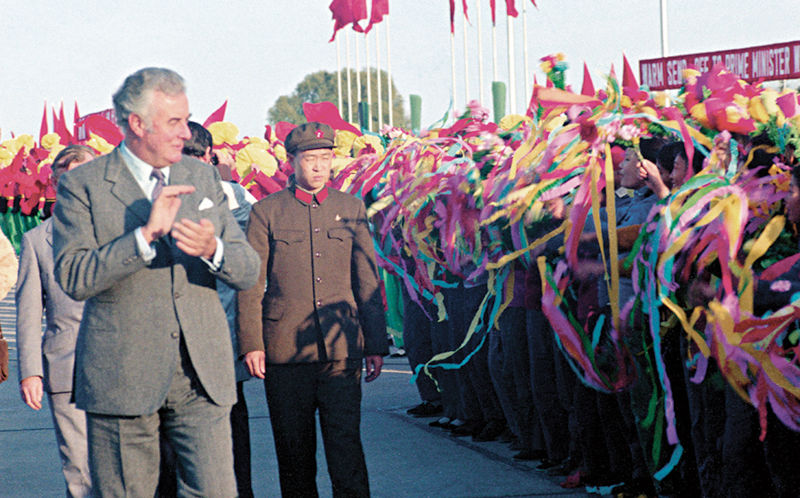
Best of 2022: Pivotal Moment: Albanese and Xi in 2022 mirror Whitlam and Zhou in 1971
The meeting between Anthony Albanese and Xi Jinping put me in mind of the public reaction in Australia when Whitlam met Chinese Premier Zhou Enlai in 1971. (more…)
-
“Opening the Australian mind”: 50 years of Australia-China relations
I’d like to offer a reflection on where we started out, Australia with China, and what I think we need to do now. (more…)
-
Pivotal Moment: Albanese and Xi in 2022 mirror Whitlam and Zhou in 1971
The meeting between Anthony Albanese and Xi Jinping put me in mind of the public reaction in Australia when Whitlam met Chinese Premier Zhou Enlai in 1971. (more…)
-
What a contrast in professionalism and civility. The 7/30 Report
You have to admire the PRC Ambassador, Xiao Qian. After the uncivil behaviour, and gotcha questioning, and the visible personal animus journalists gave him at the National Press Club four weeks ago, he’d have been forgiven if he declined to make himself available to speak to Australian media for a while. Or at least, if he did so, only on agreed terms of civility. (more…)
-
The Chinese Ambassador and our ignorant and hostile media
We should be alarmed, if not ashamed, at how some of these journalists behaved and reported. (more…)
-
Getting the Australia-China Relationship back on track
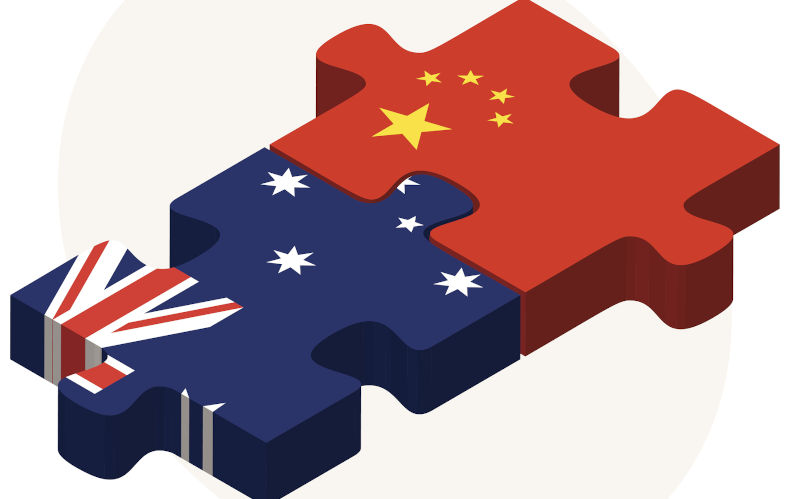
While we should not yet abandon hope for a more realistic, nuanced and sophisticated China policy under the Labor government, Prime Minister Albanese’s initial statements from Tokyo in response to an overture from PRC Prime Minister Li Keqiang are not encouraging. (more…)
-
We have lost our way on immigration and multiculturalism
On this question of the settlement of newcomers into Australia it’s pretty evident that we’ve lost the plot.
-
STEPHEN FITZGERALD supports Pearls and Irritations.
Pearls and Irritations provides quite the best daily analysis of issues in world affairs and Australia’s foreign relations of any media in Australia – traditional or online. (more…)
-
STEPHEN FITZGERALD. At ‘Espionage in Australia Exhibition’ at the The Whitlam Institute (8 March 2019)
The Whitlam Institute mightn’t seem an obvious place to have an exhibition about spies. But I think it is. Not that it’s a spy agency (if it were, it would have a budget many multiples greater than it has), but because of the driving idea in what it does: democracy, in our society and our history. And spies have a lot to do with democracy – defending it, sometimes perverting it. And there’s more, connected with the Whitlam story. Whitlam wasn’t a spy, either. He was in fact a man more spied against than spying. But, more than any other Australian Prime Minister, he took on the spy agencies, ours and the Americans’, in the service of democracy and good governance. (more…)
-
KARL WILSON with Steve FitzGerald – Opening-up: The view from down under (China Daily 12/07/18)
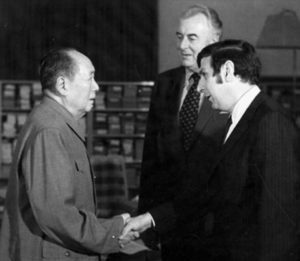
Stephen FitzGerald (right) and former Australian prime minister Gough Whitlam meet Chairman Mao Zedong on Nov 2, 1973, in Beijing.
Australia’s first ambassador to the People’s Republic of China reflects on decades of transformation
Editor’s note: This year marks the 40th anniversary of the launch of China’s reform and opening-up policy. China Daily talks to some people from overseas who have experienced or witnessed the important drive. (more…)
-
STEPHEN FITZGERALD AND LINDA JAKOBSON. Is there a problem with Australia’s China narrative?
Australia’s China policy is flawed. Diplomatic relations between Canberra and Beijing are strained, to the extent that Australia’s prime minister and foreign minister have not been welcome to visit the People’s Republic of China (PRC). Yet at a time when Australian leaders have been frozen out, leaders from countries experiencing far more serious issues with the PRC than Australia have been visiting Beijing. The poor state of the relationship is a result not so much of what Australia has done as what Australia has said and signalled.
-
STEPHEN FITZGERALD AND LINDA JAKOBSON. Engaging with China does not mean being an agent of China
[A letter published in the Sydney Morning Herald on 27 February 2018]
Clive Hamilton conveys a message which must be challenged, namely the insinuation that any person who engages with the Communist Party of China (CPC) should be viewed with suspicion or as belonging to a CPC fifth column (“Powerful relations raises a red flag”, February 24-25). It is wrong and indeed damaging to Australia’s interests if people (Hamilton refers to unnamed powerful corporate figures) who have dealings with the CPC are to be looked upon as untrustworthy. (more…)
-
STEPHEN FITZGERALD. Donald Trump. Seizing the opportunity to strengthen relations with countries in Asia.
Kim Beazley, as shocked as anyone by the election result, has said: “We do have one advantage going for us with a Trump presidency, and that’s this. We are a member of the only American alliance that the Trump people unreservedly approve of. So at least we’ve got a basis of a discussion with them.” Kim seems to believe this is some kind of plus. But I think it is frightening. The favoured client of the Trump people! If that is true, what does it say about us, and the expectations of us in regional and international affairs as the Trump presidency gets into stride?
Bob Carr said to his fellow panellists on ABC News 24 on Wednesday that they must stop ‘normalising’ Trump, the Trump phenomenon and the coming Trump presidency, stop saying well we’ve had this kind of thing before, like Reagan for example. You can see this ‘normalising’ already in the first responses of Malcolm Turnbull and Julie Bishop. But as Bob said, you have to understand that Trump’s win expresses a complete shift in the US political scene and it’s not going to change after Inauguration day. (more…)
-
China’s deepening engagement in Australian society: is it a concern?
The PRC government’s influence in domestic Australia – long active but not altogether visible or much remarked – is now emerging as a big, contentious and potentially disruptive issue in the relationship, and a thorny one for policy-makers. In some respects, it may be more challenging and more pressing than other more prominent issues like the South China Sea. Unlike PRC actions in the South China Sea it is difficult to ascertain what precise actions the PRC is taking within Australia and what influence these actions are having. (more…)
-
STEPHEN FITZGERALD. Security in the region. (Repost from Policy Series)
Paul Keating and Gareth Evans used to claim, with justification, that by the mid-1990s Australia had become ‘the odd man in’ in Asia. This was in significant part because of the headway they’d made in Southeast Asia, with ASEAN countries, in gaining acceptance of Australia as ‘one of them’. This was no slogan. Behind it lay a geostrategic idea of Southeast Asian countries as natural partners into the long term future, in a world dominated by competing great powers, and offering the entree to what Keating called ‘finding our security in not from Asia’. Keating and President Suharto’s Agreement on Maintaining Security was a first stage in that direction, flanked by the initiative for a Ministerial Forum with Indonesia. Evans, encouraged by the response of Southeast Asian colleagues, floated a geopolitical definition of Asia that included Australia as a logical component of what he called the East Asian Hemisphere. (more…)
-
Stephen FitzGerald. Security in the region.
Fairness, Opportunity and Security.
A policy series edited by Michael Keating and John Menadue.Paul Keating and Gareth Evans used to claim, with justification, that by the mid-1990s Australia had become ‘the odd man in’ in Asia. This was in significant part because of the headway they’d made in Southeast Asia, with ASEAN countries, in gaining acceptance of Australia as ‘one of them’. This was no slogan. Behind it lay a geostrategic idea of Southeast Asian countries as natural partners into the long term future, in a world dominated by competing great powers, and offering the entree to what Keating called ‘finding our security in not from Asia’. Keating and President Suharto’s Agreement on Maintaining Security was a first stage in that direction, flanked by the initiative for a Ministerial Forum with Indonesia. Evans, encouraged by the response of Southeast Asian colleagues, floated a geopolitical definition of Asia that included Australia as a logical component of what he called the East Asian Hemisphere.
Through this closeness with ASEAN, Keating and Evans had developed an ability to see how policy thinkers in Asian countries viewed the world from their side of the fence, and to take their views seriously. To do this is challenging in any circumstance but quite unusual between countries of such different backgrounds, and it was important in assisting these two leaders to strengthen their framework for thinking about our own foreign relations and their narrative of an independent Australia, distinguished from the interests of the major powers. It was as though they’d gained access to a Southeast Asian think tank that could challenge and balance, if not necessarily always alter, their strategic view. Alexander Downer had something of the same inclination, but it was explicitly and strongly rejected by John Howard, and it’s been absent from the thinking of all prime ministers since Howard.
Evans has said recently that our relations with ASEAN now seem far removed from the time when as Australia’s Foreign Minister he had no counterparts anywhere in the world with whom he felt more close and comfortable. ‘ASEAN doesn’t feature as largely in Australia’s collective consciousness as it should or (Indonesia perhaps excepted) get the policy attention it should; Australian politicians don’t go out of their way to forge personal relationships with regional counterparts as they should; students don’t study the region’s languages anything like as much as they should, and indeed used to; and — compared to other countries — there is a really striking lack of Australian financial investment in the region.’
Twenty years on from when Evans was Foreign Minister, Southeast Asia and Australia are objects of rivalry between a China intent on restoring what it sees as its rightful and historic place in the sun and a United States intent – in what it does, not what it sometimes says – on blocking or containing China’s ambition. US resistance to China’s proposed Asia Infrastructure Investment Bank is but one, non-defence or military, example. This gargantuan contest challenges Australian policy thinkers to ask how we should respond strategically, in our interests. The government claims a kind of even-handedness, citing for example economic relations and the recent FTA with China, and the strong political, and (not too loudly) defence and intelligence relationship with the United States. This is also said to be ‘hedging’, which is a giveaway to its real position.
But the government has offered no framework, and no honest narrative, about how it thinks we can manage ourselves successfully and securely into the next ten to twenty years. If it did it would have to admit and defend the fact that it’s a witting part of the US intent to try to deter and contain China, through alliance arrangements and Australia’s more-intimate-than-ever intelligence and defence enmeshment with the US including our participation in US military command arrangements and military manoeuvres in the Pacific. And it would have to concede the dangers this carries for us. Its position has the complete acquiescence of the Opposition, so there’s no debate from that quarter. And neither side discusses it frankly with the Australian public. Australian independence is crippled by this subordination to the national interests and great power purposes of the United States.
Among the many blinkers on this policy is that Australia looks from the US side of the fence at China’s assertion of political and strategic influence. As also Asians’ reactions to the shift in power relations. Every move by a Southeast Asian country to deepen relations with the US or stand up to China is hailed as one-way traffic towards supporting, and justifying, the US challenge to China’s bid for regional supremacy.
Not necessarily so. Take a Southeast Asian view, George Yeo for example, former Foreign Minister of Singapore. ‘Historically, in East and Southeast Asia — until the Western arrival — there has only been one major power rising and ebbing: China. When it rises, it is best to accord it some respect in return for which one derives considerable economic advantage. Over the centuries, a rich China invariably brought prosperity to all of East and Southeast Asia. Therefore, while Asian countries might value the U.S. as a friend, no one wants China as an enemy. There is a spot that is sweet for everyone. If the U.S. moves closer to China and to other countries of Asia, all will benefit. If the U.S., in response to China’s rise, moves too close to some as a move against others, everyone is caught in a lose-lose situation.’
The US, in its ‘pivot’ or ‘rebalancing’, has in fact already moved ‘too close to some as a move against others’. We’re there with them, and the situation’s drifting towards a lose-lose situation.
And a big danger about the US and China, to which Australian politicians on both sides seem oblivious, is that their contest is not simply that of the re-emerging world power challenging the existing one, already volatile enough. It’s that each is driven by an idea of itself as exceptional. We’ve long lived with American exceptionalism, although we don’t always recognise it or raise the awkward question of just how completely that idea puts American interests above all others including its allies. But China too is a similarly exceptionalist power, and the contest between these two is not just about power and influence relative to each other, it’s also about who has the exceptional ‘right’ to determine the rules by which the world is run. It’s by no means assured that China’s hegemonic rules will be worse, or better, than America’s. But a clash of two exceptionalisms is ideological, and particularly hazardous, and this is no time for Australia to be picking winners, it’s a time to stand clear of their fight lest some of the blows land on us.
Assuming there was an Australian government that wanted to return to an independent foreign policy, viewing the world through the Australian prism and serving Australia’s interests, there has to be a strategy for moving to that position. And one effective strategy would be to re-invigorate the relationship with ASEAN, revive the idea of Australia being a part of Asia, re-energise the project of closer regional integration, think creatively of Southeast Asia as our critical geostrategic region, and find our security in not from Asia. Gareth Evans suggested something of this in that recent speech.
It would have many advantages. It would be welcomed in ASEAN countries as an Australian re-dedication to regional partnership. Neither the US nor China could object and it wouldn’t entail repudiation of them. As a strategic move it would give us collective company in balancing between the two and resisting when necessary both their blandishments and their importunities and pressures. It would give us collective weight in seeking to influence and moderate their more high-risk behaviour. And it would encourage us to plumb the varieties of Asian thinking on regional affairs and power politics rather than discount or dismiss them as we often do, and this would be of immense value for us in developing a long term framework, more predictable policy-making and a more Australian narrative for our foreign policy. There’s also a host of economic and pressing transnational issues on which we can only benefit from much closer cooperation with ASEAN countries, not least the question of asylum-seekers. And domestically, it would help Australia re-focus and re-imagine the positives of our Asian engagement. Who knows, we might even see a diminution in the negative view of our most important neighbour Indonesia, and perhaps even a resurrection of Indonesian language learning!
This is not to suggest there should be anything but the closest and most constructive of relations with China and the US. Or neglect of other Asian regions or partners. A strategy of this kind should seek also to enhance our independence through closer identification with the ROK and Japan, and engagement with regionalist arrangements in those two countries and their many networks of association with Southeast Asia and with the strong currents of thinking in both that want to avoid being skewered by the China-US trap. It’s to say Southeast Asia is our immediate habitat, and in today’s shifting and dangerous power relations it’s more central for us geostrategically than it was even when Keating and Evans recognised it two decades ago. And it’s achievable, if we could really put our minds to it.
What about pulling back from the client relationship with the US? How achievable is that? You can’t be too optimistic about today’s political leaders because they have no foreign policy framework and seem frightened of big ideas. They don’t even feel able to debate critical policy decisions, like going back to Iraq with the US.
But it could be done. When Whitlam took on the fear of China by going to Beijing as Opposition Leader, he also took on the fear of being independent, of offending the US, of daring to see the world through a prism other than that of the US, of taking issue with it on foreign policy. He went to Beijing before the US surprised the world with its reversal of China policy. As Prime Minister, when he publicly condemned the 1972 Christmas bombing of Hanoi this initially infuriated Nixon and Kissinger, but like it or not, in the end America accepted his re-framing of relations. What Whitlam had done was open out the relationship, to one of independence without repudiation of the alliance, and that later became the position of Malcolm Fraser and his two successors.
What about China? Doesn’t it see Southeast Asia as its pond? China views both Southeast Asia and Australia as coming within the sphere of what it calls its peripheral country diplomacy. This is a mixed blessing. It seeks to reward obliging peripheral countries, for example the FTA with Australia (if you believe that’s a blessing). But periphery supposes a centre, and the doctrine of China’s peripheral diplomacy is aimed at co-opting peripheral countries in the cause of the centre and China’s recovery of the position it once had as the great power of our region. As in Chinese chess, you secure the corners of the board in order to secure the centre. The FTA and President Xi Jinping’s 2014 visit to Australia were first moves, not the last, in our particular corner of the board, to co-opt us into the ‘Chinese dream of the great renewal of the Chinese nation’. Being China’s potential adversary as a client of the United States is dangerous. But being hugged by this panda would be uncomfortable, even painful, and not without its own perils.
So, Australia part of a more integrated Southeast Asia, caucusing for the common interest, where necessary in resistance to a Chinese interest? Why not? If we could have the fortitude to believe we could stand up to America without damaging our long-term relations, why shouldn’t we do the same with China? It depends on your prism. If you see China through the US or Western prism you’ll tend to believe China’s intentions in Southeast Asia are at best not benign and at worst inimical to our interests, and fear to provoke it and cleave to the United States. Its intentions may at times be both of these, but equally they may not.
With our own prism, and those of our Asian partners, an independent foreign policy can be had. But to have it, with a strong and strategic bilateral relationship with both these great powers, you have to have politicians who’ve worked hard at the ideas part, done their own hard thinking not farmed in some person or committee to do it, leaders in ideas, not afraid to lead, not afraid to take on the fear of the US or China. I’m waiting.
Stephen Fitzgerald was formerly Australia’s Ambassador to China.
-
Stephen FitzGerald. Abbott’s relations with China.
Can you believe the Abbott government has any idea where it’s headed on relations with China? Whatever you think of China’s politics, you can’t just take sides against China or meddle in the tense and volatile issue of China-Japan relations without there being some consequence for our bilateral relations. But the government doesn’t seem to care. From what you can divine from the little it says publicly, it thinks the Chinese will back down under Australia’s glare, and “get over it”. Like the Indonesians will get over it. But the Indonesians, whose thinking we know more clearly, aren’t going to get over it. Abbott and Morrison are so untutored in foreign relations and diplomacy, or so deaf, or both, that they don’t understand something has snapped in Jakarta. It’s not about our policies it’s about the language the Abbott government uses and the lecturing, patronising and racist attitudes they convey. A strong, independent, democratic and regionally influential Indonesia is not going to put up with that any longer and relations are never going back to the way they were before.
And the risk is that at the same time relations with China will be pushed back to at least where they were before Julia Gillard secured agreement for a regular high-level strategic dialogue with Beijing in April last year. This is not only harmful to our bilateral relations and restricting in our scope for managing them in our own interests. It will limit Australia’s capacity to be an effective player in regional affairs and a useful voice in the balancing of US China relations.
The fact is the government doesn’t have a China policy, in any coherent, strategic, long-term sense, and it has laid out no narrative in any speech or document that would give the lie to this assertion. Its handling of the issues with China over the last few months has been in the service more of a neoconservative confrontationist US view of China than an Australian view or Australian interests.
At the US-Japan-Australia Trilateral Strategic Dialogue in the wings of the APEC ministerial summit in Bali in October 2013, Australia put its signature to a communique which “opposed any coercive or unilateral actions that could change the status quo in the East China Sea”. The problem is, it’s the very status quo itself which is in dispute between Japan and China, and by some interpretations the Chinese case is by no means weaker than Japan’s. Whatever the rights, Australia needlessly and recklessly took sides in a complex dispute in which we have no part, and Beijing of course reacted.
And there’s a bit more. The final wording agreed in Bali was reportedly different from the draft prepared by DFAT, bearing the stamp particularly of the two drafting officials from Tony Abbott’s Australia and Shinjo Abe’s Japan (Tony Abbott’s ‘best friend’ in Asia). The Australian official was Abbott’s Senior Advisor on National Security, Andrew Shearer, allegedly in Bali to ride herd on the neophyte Foreign Minister Julie Bishop and an advocate of bludgeon diplomacy and hairy-chested confrontation of China.
In November, China declared an Air Defence Identification Zone, ADIZ, in the East China Sea. This may be a matter of concern to Australia, but it’s not immediately proximate for us, and it’s one for us that demands skilful diplomacy not confrontation. Australia had a range of possible responses, but Julie Bishop went straight for a public slap down, carpeting the Chinese Ambassador to Australia Ma Zhaoxu to denounce Beijing’s move, and rubbing the Chinese nose in it by talking it up in language that suggested ‘Look what I’ve done!’ The concerning thing about this is that it was bound to achieve nothing other than provoke a tougher, uncompromising position from the Chinese, and so it did. “Irresponsible”, said Beijing. But worse for us, it put diplomacy out of play, again to the detriment of our relations and any role in whatever diplomatic potential there might be for amelioration of the tensions surrounding the issue.
Julie Bishop then made a scheduled visit to Beijing, and we saw on television the famous prelude to her meeting with Chinese Foreign Minister Wang Yi. It’s the first time I’ve seen a senior Chinese, during the photo opportunity that precedes such bilateral meetings, vent a disagreement in this way with any country, even with the Japanese at difficult times in their relations. Wang Yi’s body language alone would have been a fairly blunt signal, but his sharp words in front of the media amounted to an official Chinese declaration that relations with Australia were in bad shape. In the history of our diplomatic relations, apart from the Tiananmen massacre we’ve not had such a stand-off. This, at a time when what we need most is to get closely alongside the Chinese and do whatever we can diplomatically to help defuse regional tensions and work on the development of a new order in the Pacific that peacefully accommodates Chinese as well as US power.
Yet in December, when Prime Minister Abe visited the Yasukuni Shrine and other countries in the region with an interest in Japan’s wartime record immediately objected and even the US cautioned Japan, Australia said nothing. This is a deeply emotional issue for both China and Korea, who interpret a prime ministerial visit to this shrine as an intentional denial of Japan’s wartime atrocities. And whereas on the two earlier issues the Australian government spoke out when it might to greater effect have chosen a diplomatic response and a public reticence, on this issue it didn’t even refer to it till a month later, and then only en passant in a Bishop interview with the Financial Review, when the incident was well out of the way.
With China, as with Indonesia, disagreements and policy differences can be managed, but it’s the way we’ve gone about it, and the language, and the idea from colonial times that if you speak English to these people loudly and clearly enough they will understand and do what they’re told. And for Beijing, there’s the unmistakable message that on matters it regards as vitally affecting its sovereignty, we stand with a particular US view that doesn’t want to accommodate Chinese power.
Beijing has not got over it. But what will it do in response? So long as it sees benefit for China, it’s unlikely to want to disturb economic relations or derail the FTA negotiations. What’s more likely is downgrading the importance it gives to political and strategic dialogue. But political and strategic dialogue is the one element of our relations we can least afford to lose. It took years to persuade an Australian government to understand this, and when finally it was taken up by Julia Gillard it took a huge effort to get the Chinese government to come to the party.
This is serious. It’s not a case of being pro-China or seeing Asia through a Chinese prism, which is what the proponents of the US policy of denial pretend. To lose that dialogue or have the Chinese not take it seriously would be a major setback for us. And make more difficult the management of our economic relations. And deny us opportunities to resolve through diplomacy and dialogue the many challenging issues we’re going to face directly with China as a Great Power in our external habitat and a force in our domestic politics.
What will happen, if the Indonesian government turns to China to supply or even directly assist its navy in the protection of Indonesia’s sovereign borders? And China obliges? And they turn to Abbott, Bishop and Morrison and say: “you, of all people, ought to understand”?
If you meddle in someone else’s issues by taking sides when you’re not a party principal, can you really believe they might not meddle in yours?
Dr.Stephen Fitzgerald was former Australian Ambassador to China
