Category: Arts

  • SUSAN RYAN. Book launch. ‘Jesus the forgotten feminist’ by Chris Geraghty.

    The Catholic Church here and globally faces a crisis of loss of support arising especially from its deeds and omissions in relation to appalling sexual abuse of children.

    Our secular societies are experiencing a massive epidemic of allegations and charges of sexual harassment and violation of women in their workplaces, be they on film and television sets, in the training of medical specialists, on university campuses, in major corporations, within churches, just about anywhere where men dominate women’s employment prospects.

    The Catholic Church’s failure to protect children, and our first world societies’ failure to protect women, are connected in ways that makes Geraghty’s book highly relevant.   (more…)

  • CHRIS GERAGHTY. Jesus – The Forgotten Feminist.

    I have long been interested in why the officers of the catholic church have been so reluctant to consider involving women in the governance of their institution and in its sacramental ministry. So I decided to write a book about it. (more…)

  • GREG HAMILTON. Not much ado about a helluva lot.

    A stage play that wouldn’t make it into an Australian theatre today caused a helluva stink back in 1962 and said some wise and courageous (aka shocking) things about the ‘most sacred day’ in our national calendar. The reasons it wouldn’t make it today say something tragic about us as a society of people. (more…)

  • KIM WINGEREI. Book review of “Churchill and Orwell: The Fight for Freedom” by Thomas E. Hicks, Pulitzer Prize winner.

    At first glance they may seem like an odd couple, but their influence on the seminal events and the thinking of the 20th century is equally profound. Winston Churchill defined and led the resistance against the tyranny of Adolf Hitler; George Orwell understood and explained the nature of totalitarian regimes. They were both men who were prepared to change themselves in order to change the world.

     Pulitzer Prize winner Thomas E. Ricks has written an insightful account of these two men whose paths never crossed and came from opposite ends of society and ideology. The book focuses on their life and deeds from the late thirties until after the Second World War. Ricks does not eulogise either man, he recognises their flaws and earlier failures, yet puts them both in the historic perspective that they deserve. (more…)

  • RAMESH THAKUR. Incorrigible Optimist by Gareth Evans, a Political Memoir – A review-Part 1of 2

     Gareth Evans’ memoir makes clear his vision of good international citizenship would have foreign ministers pursuing national self-interest within the ennobling vision of global moral purposes.

    (more…)

  • JOHN TULLOH. Through the Iron Curtain to Moscow and across Siberia 50 years ago.

    Earlier this year, Pearls and Irritations ran an account of the 50th anniversary of my first major foreign news assignment, the Six-Day War. This is about another 50th anniversary assignment, the Russian Revolution. The centenary is next month.  (more…)

  • EVAN WILLIAMS. Dunkirk – film review.

    We all know the story – or do we?  It was one of Britain’s great wartime triumphs.  With the British Expeditionary Force driven back to the French coast by advancing German armies, thousands of Allied troops were stranded on the beach at Dunkirk, and the call went out from Winston Churchill to rally the little ships and bring them home.  Countless small craft – fishing boats, launches, dinghies, even rowing boats –  crossed the Channel  to gather survivors and ferry them home for joyful reunion with their families. (more…)

  • RAWDON DALRYMPLE. A personal link to World War One.

    All of us who have a stake in understanding the Great War should be grateful to Joan Beaumont for her magisterial history of Australia’s involvement in that terrible conflict (Broken Nation: Australians in the Great War). (more…)

  • JUDITH WHITE. Risks of gallery expansion

    The NSW Coalition government has allocated $244m towards a major new building at the state Art Gallery. But questions are being raised about its ongoing funding and its mission as a public institution. (more…)

  • KIERAN TAPSELL. ‘The Attachment’ by Ailsa Piper and Tony Doherty.

    The subtitle to this book is Letters from a Most Unlikely Friendship, and it consists of a series of letters with some occasional background comment between a “lapsed” Catholic (although none of the authors use that word) turned “agnostic with pantheist leanings” and a well known Sydney Catholic priest, Tony Doherty.  (more…)

  • JUDITH WHITE. Arts policy and the need to counter the undermining of public cultural institutions

    Writing a book is a solitary occupation, but with this one I’ve been constantly aware of the hosts of people – staff, members, volunteers, benefactors – who are concerned about what is happening to our public institutions. And they are public institutions: they belong, by Acts of Parliament, to the people.  (more…)

  • MARK COLVIN. “Four Weeks One Summer” by Nicholas Whitlam

    In the summer of 1936, over just four weeks, it all went wrong – for democracy and for Spain, even for the British royals. Politicians failed, and Hitler was emboldened to plan a new European war, and more.  

    When some army generals sought to overthrow Spain’s elected government Francisco Franco quickly emerged as their leader; Nazi Germany and Fascist Italy supported him with men and matériel; pusillanimous politicians in Britain and the United States, even in France, turned a blind eye – and the Spanish Civil War was on. Edward VIII took a scandalous holiday cruise with Mrs Simpson, Berlin staged the greatest sporting event of modern times, the alternative Peoples’ Olympiad never came to be, and Barcelona was transformed into a unique workers’ paradise. All this in four weeks. It was an incongruous, at times brilliant, juxtaposition of events.   (more…)

  • ALISON BROINOWSKI. What Australian Foreign Policy?

    Insider, analyst and adviser Allan Gyngell finds that Australian defence and foreign policy are more bipartisan than ever. But even as Australia’s national security agenda metastesizes, we have more to fear from an unreliable ally and an increasingly lawless world.   (more…)

  • SUSAN RYAN. Book review. The Dark Flood Rises: Margaret Drabble.

    As our sort of societies experience the demographic revolution, most of us are living much longer than ever before, in cultures that have not responded well to this increased longevity. We also find ourselves living in cultures that so far have failed to develop dignified and helpful practices and values for dealing with the inevitable.  
    (more…)

  • RICHARD LETTS. National Opera Review: propping up the 19th Century


    The National Opera Review has reported. Instigator George Brandis is probably well enough satisfied.

    The Terms of Reference are pure Brandis. The name is National Opera Review, the game is a review of the four larger companies funded by the Commonwealth. Excluded are the Victorian Opera and the numerous small companies that are the growing edge of opera in Australia. (more…)

  • Gough Whitlam and Blue Poles.


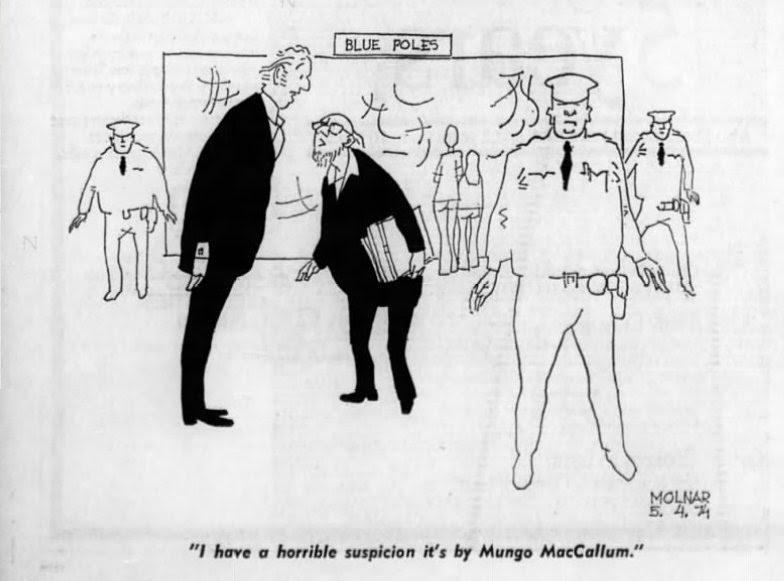
    Blue Poles is in the news again. It was purchased for $1.3 million and is now valued at $350 million. The disparaging nature of the campaign against the purchase is reflected in Molnar’s cartoon (below) of 5 April 1974.

    Mungo would be chuffed!

  • ALISON BROINOWSKI. Your laptop is watching you: ‘Snowden’ the movie.


    Before Snowden comes on, there’s a short film of Oliver Stone, the director, warning cinema audiences that they can be surveilled, so please turn off their devices. Even as a humourless joke for geeks, it sets the sombre tone of the movie to follow. This is a feature version of Linda Poitras’ Citizenfour (2014), that adds political and personal narratives to the story of the young intelligence employee who exposed America’s mass surveillance of the world’s communications. (more…)

  • EVAN WILLIAMS. Film review: Truman


    Directed by Cesc Gay, Truman is a wonderful Spanish film about a couple of old buddies saying goodbye for the last time. One of them is dying of lung cancer, and the film traces their last four days together in Madrid. The good news is that Truman isn’t nearly as miserable as it sounds. In some reviews –and in the ads – I’ve seen it described as a “comedy-drama,” though the comic elements are often hard to discern. (more…)

  • MILTON MOON. Waiting for Godness -a narrative poem

    by Milton Moon.©

    I’m due to die sooner rather than later.
    My wife of sixty-seven years has already gone,
    her mortal remains,
    in ashes waiting for mine.
    Together they’ll go, somewhere
    as part of the seasons
    or the tides ebb or flow.
    She is still with me,
    I talk to her often,
    burning incense twice a day
    and telling her
    “incense is dispersed for the soul
    of the young girl.” (more…)

  • EVAN WILLIAMS. ‘Money Monster’. Film Review

    It occurred to me watching Money Monster that George Clooney is Hollywood’s Malcolm Turnbull. Think about it. Both are rich and famous. Both are smart, good-looking and smooth-talking. Both exude confidence and charm. Like Malcolm, George has no difficulty persuading us that in any unforeseen emergency he’s the one who can save us from chaos or disaster, even a budget deficit or a dreaded hung parliament. But Clooney is something more. He’s one of that rare species – the old-style Hollywood leading man. A generation ago we had Cary, Gregory, Charlton, Spencer, Burt and the rest, all in their prime. Now we’ve got George. And we’re lucky to have him. (more…)

  • EVAN WILLIAMS. Chasing Asylum. Film Review.

    I rate it among the best Australian documentaries ever made

    If you want to see Chasing Asylum, Eva Orner’s brilliant new Australian documentary, my advice is to hurry along. At last count it was showing on just two screens in Sydney, and when I went along to the Dendy in Newtown on a recent Sunday afternoon – usually a good time for ticket sales – I was directed upstairs to a little cinema at the end of a long corridor to find the place half full. The ads are promoting it as “The film the Australian Government doesn’t want you to see” – and that I can believe. But does anyone want us to see it? Not the distributors – there’s barely a mention in the ads. Not, apparently, the ABC or SBS, who should be seizing it with both hands for prime-time screening during the election campaign. Perhaps that’s the problem – the film is politically explosive, and everyone seems to be running scared, including, of course, our political masters. (more…)

  • Julianne Schultz. Australia must act now to preserve its culture in the face of global tech giants. Brian Johns Annual Lecture


    At the first Brian Johns Annual Lecture, Julianne Schultz spoke of the challenge to Australian culture by the global tech giants. In the summary of ‘what can be done’ she said:

    So what can be done to join the dots in the Age of Fang?

    We need to become better advocates of the value of cultural investment. We need to find new ways to put the case so we can win political and bureaucratic supporters with hard headed and sustainable arguments.

    We need to find ways to embrace the particularity of being Australian in a global context and find new ways to express that.

    We need to be willing to challenge the market if it is not delivering – adding our voices to those demanding that the Fangs pay their taxes, and not allowing them to unfairly distort the market.

    We need to be prepared to use the legal and other means at our disposal to demand that laws are not broken.

    We need to use the leverage we have as the generators of 2% of global GDP to get returns and opportunities to participate that are our due – a digital news initiative here for instance, or a major contribution to the digitisation of cultural assets without giving up the copyright.

    We need to leverage 50 years of cultural investment to ensure our stories are told not only to ourselves, but the world.

    If, as the scholars have identified, the dominant companies in the Age of Fang have the power to command attention, communicate news, give voice, enable collective action, hold power to account and influence votes, we need that to be done on our terms.

    This power needs to be institutionalised so that it is civically accountable. The smartest Fangs understand that playing a civic role brings extra kudos and wealth, but there is a need for vigilance to sustain this.

    Getting the settings of this institutionalisation will be challenge of the next decade. It will require a carrot and a stick.

    Some Americans are suggesting a royalty should be paid on data mining of personal information, as is done with the mining of minerals, and returned to the country of origin.

    Europeans are challenging antitrust and privacy. G20 is renewing attention on tax to examine ways to ensure that the wealth generated is spread appropriately, and not left to a few rich dudes to distribute to suit personal philanthropic ambitions.

    The market alone won’t do this. We know from the process of creating cultural institutions that there is a role for the state – a place where in the words of Robert Menzies, the future and past can connect in the present.

    Even in this rapidly globalising age, the nation state remains the best organising principle we have. I am not alone in feeling uneasy about the proposition we should give it over to a new oligopoly that is present every moment of our lives.

    The purpose of cultural investment in the Age of Fang needs to be reiterated and maintained. As a nation, we need to take this seriously now if we are not to become an asterisk. The purpose of cultural investment in the Age of Fang needs to be restated, funding maintained and opportunities to innovate and export enhanced.

    Otherwise we will become invisible at best and tribal at worst. If that happens we will be reduced as citizens and countries to passive consumers in a digital marketplace that values us only for our ability to pay.

    The Brian Johns lecture was presented by the Centre for Media History at Macquarie University and the Copyright Agency.

    A fuller version of Julianne Schultz’ address can be found at:

    https://theconversation.com/australia-must-act-now-to-preserve-its-culture-in-the-face-of-global-tech-giants-58724

    Julianne Schultz is Editor and Professor, Griffith Review.

  • Kim Williams. Fair use does not mean free: Copyright recommendations would crush Australian content

    As someone who has spent my life running organisations that take risks, invest billions and innovate to provide the best of local and international content to Australian consumers, reading the Productivity Commission’s draft report into our intellectual property arrangements was profoundly dispiriting.

    I cannot think of another recent report that so seriously misses the main drivers of its area of inquiry – namely innovation and the incentives to produce new work. At the same time, the report treats Australian creative content and its production with a disdain bordering on contempt, and that is surprising for any economic statement.

    The commission makes recommendations which would have such a deeply detrimental impact on the ability of film and TV makers, writers, artists and journalists to tell Australian yarns, and make a living doing so, as to be worthy only of rejection.

    Take the commission’s conclusions on what drives innovation. The draft report claims our intellectual property and copyright settings inhibit investment and innovation. Really? Most people who run businesses and invest money know that what really drives innovation is a clear operating framework which enables companies and entrepreneurs to manage their risk appetite and capital investment, as well as access to highly skilled people.

    In the creative landscape, the bedrock of production is copyright – the Copyright Act provides the critical framework for ensuring returns from investment.

    The Prime Minister recognised the drivers of innovation in a statement last year. He committed over $1 billion to ensure the right incentives to innovation were in place; to encourage risk-taking; and to promote science, maths and computing in schools. There was no mention of intellectual property in his statement, given there is already a clear protection framework in place.

    So, having spent considerable amounts of time answering the wrong question, the commission then demonstrates what can only be described as a breathtaking disregard for the creativity of Australians. It dismisses concerns that its recommendations would lead to less Australian content, with this response: “most new works consumed in Australia are sourced from overseas and their creation is unlikely to be responsive to the changes in Australia’s copyright (laws).” So, that encapsulates the commission’s thinking – American and British material will suffice and Australian original work doesn’t really count for zip.

    But make no mistake, if the commission’s recommendations to implement “fair use”, for instance, were implemented, there would be less Australian content on our screens, on our bookshelves (real and virtual), and in our schools and universities.

    “Fair use” is an American legal principle which would allow large enterprises to use copyright material for free, which, under Australian law, they currently have to pay for. PwC recently estimated that introducing “fair use” in Australia could result in a loss of GDP of more than $1 billion.

    PwC’s report (provided to the commission) outlined three reasons for this collapse. First, “fair use” would strip millions away from Australian storytellers and content creators because governments, companies and large education institutions who now pay to use content, would stop paying as much or stop paying at all.

    PwC examined what happened in Canada when similar changes were made in 2012. Universities and schools refused to pay for the educational content they used. This led to a 98 per cent reduction in licensing revenue,  the closure of many publishers and a loss of jobs. Oxford University Press stopped producing Canadian textbooks for schools.

    The Canadian Writers Union’s John Degan described the effect this way: “We are headed back to the bad old days of 40 or 50 years ago, when everything you read in Canadian schools was produced in the US or Britain.”

    Second, “fair use” would permanently lift legal costs in Australia. US copyright cases are almost five times the volume of cases in the UK, whose law is comparable to ours. Good for lawyers, bad for creators and consumers.

    Third, fair use would undermine the effective and fit-for-purpose licensing system that has evolved here allowing Australian teachers to share and copy almost every book, magazine, image or journal published in the world, with their students, for less than the cost of a single book each year. This fee is paid by school departments, not students.

    None of this means that we shouldn’t continue to update our Copyright Act. Industry-led reforms to the Copyright Act are already well advanced in an unprecedented collaboration between rights holders, libraries and education institutions. They deliver on a promise by the Attorney-General George Brandis to review the Act in the government’s first period in office.

    So let’s aim for sensible reform which balances the incentives and protections for creators with the rights of consumers to access wide ranging material on fair terms.

    But remember, fair does not equal free, and no one needs a manufactured revolution driven by armchair economists who want to blow up Australia’s content sector – as this disappointing report proposes.

    Kim Williams is chair of the Copyright Agency and Viscopy. He is a former CEO of NewsCorp Australia, FOXTEL, Fox Studios Australia, the Australian Film Commission, Southern Star Entertainment and Musica Viva Australia.
  • Evan Williams. ‘A Month of Sundays’. Film Review

    I went to see A Month of Sundays, Mathew Saville’s new Australian film, expecting a comedy about real-estate agents. It was the impression I’d gained from a careless reading of publicity handouts and other usually unreliable sources. And sure enough, the film has some witty lines and one or two moments of gentle satire at the expense of the real-estate profession. But Saville’s film isn’t really a comedy – unless you get your laughs watching lonely old widows coping on their own, grieving teenage boys pining for parental love, divorced husbands pining for lost wives, and other unhappy souls. (more…)

  • Evan Williams. Rams. Film Review


    Rams is a strange and beautiful film from Iceland. And we don’t hear much about Iceland these days. As a child, I pictured a place of endless glaciers and permanently frozen lakes, and was surprised to discover that it was also a place of gentle hills and verdant summer grasslands, with streets and houses and a capital city whose name I could never remember. Iceland was in the news the other day when their prime minister, Sigmundur Gumlauigsson, was revealed to have hidden large stacks of money in an overseas tax haven and forced to resign. I was reminded of another prime minister in a similar predicament – attacked in parliament for investing a chunk of his personal wealth in a tax-free haven in the Cayman Islands. His name escapes me, but I’m pretty sure he hasn’t resigned.

    As its title would suggest, Rams is a film about sheep. And that’s another surprise. Sheep have never figured much in movies. We’ve seen any number of films about dogs, cats, horses, lions, birds and fish; even the humble pig landed a starring role in Babe. But Rams must be the first film in which sheep have made it to the big screen. With their mild little faces and general air of ungainliness, they must have rated too low on the Disney cuteness scale to clinch a spot in Fantasia or The Jungle Book or Snow White and Seven Dwarfs. Yet sheep have a sacred place in western culture. When we remember the Good Shepherd, the Lamb of God, the parable of the lost sheep and many other biblical allusions, it’s surprising that Hollywood hasn’t given us a suitably reverential epic in honour of the humble bleater.

    Rams was written and directed by Grimur Hakonarson, and more than one reviewer has described it as a comedy. It’s a “charmingly understated comedy” according to Variety, and “a marvel of deadpan comedy” in the opinion of the Wall Street Journal. I agree that its comic elements are understated, since I was never remotely aware of them while watching the film. But if Rams is a comedy, so is Romeo and Juliet. For me it’s one of the saddest films in a long time – delicate, poignant, profoundly humane, and immaculately photographed in some weather-beaten Icelandic outpost where blizzards, bleak skies and occasional bursts of sunshine mirror the moods of the characters.

    It’s the story of two brothers – a pair of stout, rugged, well-bearded old codgers who look so alike that I had difficulty telling them apart. This proved a little confusing at first, but the underlying message of the film is so transcendentally simple that after a while it hardly seems to matter which brother is which. Gummi (Sigurour Sigurjonsson) and Kiddi (Theodor Juliusson) – and no more of these funny Icelandic names, I promise – are sheep farmers, living a stone’s throw from each other in separate houses. Both are unmarried – where are the women, we wonder? – and as a result of some long-standing family feud they haven’t spoken to each other for 40 years. If communication is unavoidable, Kiddi’s dog carries a handwritten note from one brother to the other. (And that, come to think of it, is rather a funny idea, so Rams may have some comic elements after all.)

    When a deadly sheep disease is identified in the valley, the local authorities order that all sheep must be slaughtered, threatening financial ruin for the farmers. Gummi, the more tender-hearted of the brothers, is reluctant to comply. He treats his sheep as pets, giving them names and fondling and cuddling them as others would a much-loved dog or cat. Under pressure from his neighbours and a no-nonsense local vet, he comes up with a plan of his own.

    I’m making it sound like a bit of a tearjerker, but Hakonarson steers clear of sentimentality. Aided by two finely nuanced performances and a strong supporting cast, he delivers a rich moral fable of love and redemption, illuminated by a warm eye for the beauty and grandeur of the natural world. I liked the scene when Gummi rescues his comatose brother from the ravages of a snow storm and transports him to the nearest hospital in the scoop of an earth-moving tractor. (Another understated comic touch? Just possibly.) It’s hardly a surprise when the brothers are finally reconciled – we sense that from the beginning. The surprise is that Hakonarson’s film, with its odd mixture of realism and improbability, works with such effortless grace. Rams has won many awards, including a major prize at last year’s Cannes festival. All sheep – and countless filmgoers – have cause for celebration.

    Four stars

    Rams, rated M, is in limited release.

    Evan Williams reviewed films in The Australian newspaper for 33 years. He is a Life Member of the Film Critics’ Circle of Australia for services to film criticism and the film industry.In 2015 he received the Geraldine Pascal Lifetime Achievement Award for critical writing.

  • Evan Williams. ‘The Daughter’ film review

    The ads for the new Australian film The Daughter are proudly informing us that the film comes from the same producer who gave us The Piano and Lantana. And that’s some pedigree. Lantana and The Piano were both distinguished Australian films (though the Kiwis shared some credit for The Piano), but what’s this about the “producer”? With all due respect to Jan Chapman, the producer of The Daughter, producers don’t make films. They raise the money for them, hire the main players, acquire all the rights and turn up to collect any best-picture gongs on Oscar night, but they don’t make the movie. Sam Goldwyn was one of the great Hollywood producers, but he didn’t make The Best Years of Our Lives (that was left to William Wyler), and who remembers Goldwyn anyway for Roseanne McCoy or The Adventures of Marco Polo?

    I make this rather obvious point to make the equally obvious point that whatever we may think of The Daughter, credit or blame for the finished film must lie with Simon Stone, the director (who also wrote the screenplay). It’s a visually stunning work , finely acted by a remarkable cast, and set in an unidentified region of rural Australia. So full marks to the cinematographer, Andrew Commis, and actors of the calibre of Sam Neill (who starred in The Piano) and Geoffrey Rush (who starred in Lantana). Stone’s screenplay was “inspired” by Henrik Ibsen’s play The Wild Duck, which Stone adapted for a production at Sydney’s Belvoir St Theatre in 2011. Based on my dim memories of that occasion, the stage production departed freely from Ibsen’s play and the film version departs from it even further – which pretty much absolves Ibsen from any responsibility for the movie.

    There are some resemblances, of course. Put crudely, this is a film about a daughter and a duck, in which both have prominent roles and can be seen as complementary elements in the fabric of the story. The daughter is 16-year-old Hedwig (Odessa Young), whose mother Charlotte (Miranda Otto) teaches at the local school. The duck, which we meet in the opening scene, has been wounded by a bullet fired by Geoffrey Rush’s character, Henry, who owns the local timber mill and is about to marry his much younger bride and former housekeeper (Anna Torv). Everyone is gathering for a fancy wedding. The duck, meanwhile, is rescued and nursed back to health by Walter (Sam Neill), the father of Oliver (Ewen Leslie), who is married to Charlotte.

    I confess that the details of these relationships eluded me at first (narrative lucidity isn’t the film’s most obvious virtue), but we are left in no doubt that Walter is a nice guy. He lives in a splendid mansion that looks more like a colonial palace than a country homestead, and runs a sanctuary for wounded animals – a sort of “unofficial RSPCA”, as he calls it. (I doubt if Ibsen would have thought of that.) Hedwig, incidentally, is the only character whose name remains unchanged from Ibsen’s play, though I suppose it would seem odd if the horny-handed, bush-dwelling Aussies in the story went around with names Knut, Lars or Thor.

    Without trying to summarise all the film’s emotional conflicts, it’s fair to say that nearly everyone is miserable for one reason or another. The plot is replete with disappointments, infidelities, thwarted passions, buried secrets and skeletons in closets. All good, steamy stuff, well matched by the gloom of the surroundings. A mood of desperation is established early on when the timber mill is closed and hundreds of workers find themselves out of a job (timely echoes of recent events in Queensland, though Sam Neill comes across as a more sympathetic boss than Clive Palmer).

    Stone made his cinema debut with a miniature piece called Reunion, one of a compilation of 17 short films – or fragments of short films – that made up The Turning, based on a book of stories by Tim Winton. Written by Andrew Upton, Reunion was about a Christmas Day family gathering that gets absurdly out of hand. Praising it at the time, I called it one of the best pieces in The Turning and the only one of the 17 stories with a touch of light-heartedness. And how I longed for a touch of light-heartedness in The Daughter. Stone’s colour palette is unrelievedly dark, his cameras dwelling on rows of deserted shops, empty streets and grim forests of brooding trees, with more than one scene shot in a derelict factory.

    The acting honours must go to Odessa Young, who gives a performance of lacerating honesty and pain as the daughter. As for the duck, who is given the name Lucky, I think she shows great promise, and there is no more moving moment in The Daughter when she soars into the sky at the end, as if eager to escape the cauldron of misery and confusion engulfing the rest of the cast. A lucky duck indeed.

    Three stars.

    The Daughter, rated M, is in national release.

    Evan Williams reviewed films in The Australian newspaper for 33 years. He is a Life Member of the Film Critics’ Circle of Australia for services to film criticism and the film industry.In 2015 he received the Geraldine Pascal Lifetime Achievement Award for critical writing.


  • Evan Williams. The Lady in the Van. Film Review


    Alec Guinness is remembered for playing seven different roles in the classic English comedy Kind Hearts and Coronets. In Nicholas Hytner’s film, The Lady in the Van, Maggie Smith goes one better. At different times she’s a crazy old woman, a street beggar, a nun, a belligerent suburban mischief-maker, a well-to-do motorist, an incarcerated lunatic, a kindly old biddy and an aspiring concert pianist – all embodied in the person of Mary Shepherd, the film’s formidable central character. It’s an acting tour de force for which Dame Maggie has received awards and much critical acclaim. It seems a pity to strike a critical note.

    The film is adapted from a play by Alan Bennett. Many consider the play a classic, but it’s well to remember Bennett’s own definition of a classic book – “one that everyone is assumed to have read and often think they have.” I won’t assume that everyone has seen Bennett’s play, but audiences love it and I have warm memories of the late Ruth Cracknell playing Miss Shepherd on the Sydney stage. But Maggie Smith has made the part her own: she was in the original London production in 1999 and in a radio version Bennett adapted for the BBC. Her character can be described as a seriously deranged version of the imperious countess and family matriarch she played in Downton Abbey. And everyone, of course, remembers Downton Abbey. To judge from early box-office returns for Hytner’s movie, especially in the US, Downton Abbey fans are flocking in great numbers to The Lady in the Van.

    As an opening title informs us, it’s “a mostly true story.” One day in 1984, a woman calling herself Mary Shepherd drives a battered old van into Gloucester Crescent, a street of grand Georgian houses in a posh part of north London. Filthy, unwashed, and clad in soiled rags, Miss Shepherd makes it clear that she intends to remain in her van and leave it parked in Gloucester Crescent for as long as she wishes – a prospect that hardly appeals to Bennett’s hoity-toity neighbours , who include a certain “Mrs Vaughan-Williams” (Frances de la Tour), who may or may not be the wife of the composer. Bennett (nicely played by a wonderfully look-alike Alex Jennings) feels a little sorry for the old girl and lets her park her van in his driveway. And here she remains for the next 15 years, venturing out for short walks, rides in a wheelchair, encounters with bemused strangers and one enforced visit to a local doctor.

    Like the play, the film is an uneasy mixture of comedy, pathos and sentimental kitsch. There are plenty of clever lines (this is an Alan Bennett script, after all), but the comedy consists largely in the spectacle of Miss Shepherd behaving like a graceless old ratbag. Much is made of her bodily odour. People are constantly recoiling from her presence with a disdainful twitch of the nose or wave of the hand, and there’s a brief moment in a cathedral when Miss Shepherd, apparently a regular worshipper, crosses the floor while a priestly voice intones: “The air freshener is behind the Virgin.” She may be a pious soul, but she isn’t above stealing holy water from the church to put in the radiator of her van. All reasonable requests from other s are parried with one of two impatient lines: “I’m a busy woman” (hardly believable), or “I’m a sick woman” (probably true). No thanks are offered for casual courtesies or even for the Christmas gifts brought to the van by neighbourhood children. Miss Shepherd is very hard to like, and for the film to work I think we need to like her rather more than we can bring ourselves to do.

    With a little research Bennett discovers that Miss Shepherd’s real name is Margaret Fairchild, a pianist and former pupil of the great Alfred Cortot, with whom she has studied in Paris. Committed by her brother to an asylum for the insane (as mental hospitals were once known), she somehow manages to escape, and while driving her van on a country road collides with a motorcyclist, who is badly injured in the crash. Fearing she will blamed for the motorcyclist’s injuries, she flees the scene, only to be blackmailed by a crooked cop (Jim Broadbent), who has discovered her secret and agrees to keep silent for a price.

    All very strange – and no doubt “mostly true.” But there are too many loose ends to the story. What happens to the motorcyclist? What has brought on Margaret’s illness – the trauma of her accident or the encroachment of age and dementia? She acts like a pauper but surely she has a source of income – how else to pay her blackmailer and afford to own, not one van, but two or three (the original being replaced by a gleaming and much bigger new model)? Bennett might have done more to enlighten us. Yes, it’s a comedy of sorts, if you enjoy seeing a devout young woman succumb to illness and the rigours of penury and squalor.

    Unlike Alec Guinness, Alex Jennings plays only two roles. He is both Bennett himself and Bennett’s identical alter ego – and often they’re together in the same frame. One of them, we are told, is the “real-life” Bennett, the other the writer tapping away on his typewriter while he tells the story. It’s an unnecessary gimmick concocted for the movie, but Bennett is such a mild and self-effacing character that his double-sided presence never feels overbearing. It’s just as well we don’t get two Maggie Smiths playing two Miss Shepherds. That would be overdoing things in a film already overdone.

    Two-and-a-half stars

    The Lady in the Van, rated M, is in national release.


  • Evan Williams. Oscars and other frivolities

    My vote for best performance by an actor in this year’s Oscars goes to Leonardo DiCaprio – not for his much-touted appearance in The Revenant, but for his rousing speech at the presentation ceremony. I don’t know if he scripted it himself – if he did he deserved a screenplay Oscar as well – but I rate it the most powerful contribution to the climate debate delivered from a public platform in recent memory. His passionate plea to “save the planet” drew cheers from the crowd. Yes, I know showbiz luvvies tend to be self-indulgent lefties and climate alarmists, but what an audience he had! By all accounts he was heard by 80 million people around the globe. What politician could wish for more?

    Speaking of politicians and great performances – and digressing for a moment – TV audiences the same evening witnessed rare footage of Malcolm Turnbull shedding tears on camera while recalling an encounter with an indigenous woman. It may not have been Oscar-winning material, but at least it showed Malcolm has a heart (as I suspect it was meant to do), and put Malcolm in the same lachrymose company as Bob Hawke, who famously shed a prime ministerial tear before the cameras while speaking of problems in his family. Cardinal George Pell made another TV appearance on Oscar night – this one from Rome – but I rate it the least impressive of the night’s offerings. No tears from George. Not yet.

    Getting back to the actual ceremony, I found DiCaprio a much more impressive performer than Chris Rock, the black comedian who hosted the evening and treated us to a seemingly endless harangue on the vexed issue of white actor bias in the Oscars. It’s not the first time the disparity has been noted. But could the reason simply be that, like it or not, more parts are written for white actors than black ones, or as we now say, for people of colour? It’s fanciful to suggest that the imbalance has anything to do with conscious racial prejudice. When actors of colour are called for, actors of colour are cast – witness In the Heat of the Night (1967), Gandhi (1982), The Last Emperor (1987), Slumdog Millionaire (2008), and 12 Years a Slave (2013) – all featuring great performances by actors of colour, and all of them Oscar-winning films. So there, I’ve had my say.

    What else? My vote for best costume design goes to Cate Blanchett for the frilly blue number she was wearing on the red carpet – the one with the non-existent neckline – which may be some consolation, I trust, for missing out on a best actress Oscar for Carol. Which brings me to the high point of the evening – those six gongs for Mad Max: Fury Road, a wonderful boost for the local industry. Admittedly they were only “technical” awards – best sound mixing, best hairdressing, makeup and the like, which most audiences couldn’t care less about – but when the film is revived soon in Australian cinemas, as it surely will be, “Winner of Six Academy Awards” is going to look great in the ads. It was the biggest Oscar haul by an Australian film since Jane Campion’s The Piano in 1993, which picked up best picture as well.

    Whether Mad Max deserved the best picture Oscar that many were hoping for is another question. Technical tour de force it may be, but for my money, The Big Short and Carol were both better films. And much as I hate to say it as a loyal, movie-going Australian, Mad Max: Fury Road strikes me as the apotheosis of today’s debased, spiritually exhausted, action-ridden cinema in which plot, character and dialogue are subservient to the hyper-kinetic demands of stuntmen and special effects designers. The film has almost no dialogue – though, as The Artist beautifully demonstrated in 2014, it’s possible for a silent film, even a silent film in black-and-white, to win the Oscar for best picture.

    But whatever you think of Mad Max: Fury Road, you have to feel sorry for George Miller. Six Oscars and he couldn’t crack it for best director. Bruce Beresford met a similar rebuff in 1989 with Driving Miss Daisy, which picked up four Oscars, including best picture and best screenplay, but no director’s gong for Bruce. And it was noticeable this year that Spotlight – of which more later – won both best picture and best screenplay but no prize for the director, Tom McCarthy.   All of which raises an old question: if you have a great script, how important is the director’s contribution to the final product? Well, of course, it’s important – some would say all-important – but not perhaps in ways that audiences care about. Alfred Hitchcock directed some the best films ever made, and no director in the 20th century was more widely admired and imitated. But Hitchcock never won an Oscar for direction. A few years before he died he was given an honorary one for lifetime achievement.

    And so to Spotlight – a fine film, an important film, though not, I think, a great one. To many people’s surprise it beat The Revenant for the best picture award. Reviewing it a few weeks ago, I wrote that it consisted of little more than a series of low-key conversations – which put it well outside the Mad Max class as an action movie. But it’s unfailingly gripping and well-crafted. This is the one about a team of reporters on the Boston Globe uncovering evidence of child sexual abuse in the Catholic Church in Massachusetts. The parallels with the church’s crisis in this country are obvious enough, which is no doubt helping at the local box-office.

    Tragically, clerical paedophilia has become a hot-button issue, and I suspect that Spotlight got its best picture Oscar at least partly on the strength of its topicality. When the Academy members were casting their votes, George Pell had yet to give his latest round of evidence to the Australian royal commission, but the scandal that rightly or wrongly surrounds him was already widely known abroad. Is it possible that George helped swing a few votes in Spotlight’s favour, perhaps clinching the Oscar for it? No doubt he would hate to think so, but at Oscar time, never underestimate the power of a cardinal.

    Evan Williams reviewed films in The Australian newspaper for 33 years. He is a Life Member of the Film Critics’ Circle of Australia for services to film criticism and the film industry.In 2015 he received the Geraldine Pascal Lifetime Achievement Award for critical writing.


  • Evan Williams. Film review ‘Spotlight’

    Evan Williams recently reviewed Spotlight. This film has now won the Best Film at the recent Oscars. This review is reposted below. Evan Williams will soon also write on the Oscar awards in general.  John Menadue.

    The other night I watched a DVD of Foreign Correspondent, Alfred Hitchcock’s wonderful thriller about a newspaperman on the trail of a secret spy ring. Nostalgic as I am for the glory days of print journalism, I love the moment when the paper’s editor yells from his desk: “Hold the front page!” You don’t hear that any more. Films about newspapers – those who own them and those who work for them – tend to be either very funny or very serious.

    And a surprising number are cinema classics. Lewis Milestone’s The Front Page was one of the wittiest comedies of the thirties. In Citizen Kane (still considered by many the best film ever made), Orson Welles brilliantly captured the power-hungry paranoia of his ambitious media baron. And two years after Richard Nixon resigned, Hollywood gave us All the President’s Men, recounting one of the great feats of modern investigative journalism – the unmasking of the Watergate scandal by two dogged reporters from the Washington Post. The film collected four Oscars and set a benchmark for the genre.

    Tom McCarthy’s Spotlight (rated M, on general release) is in the same exalted company. It’s gripping, it’s sordid, and it’s desperately sad. In 2001, four journalists from the Boston Globe were assigned by their paper’s newly-appointed editor to investigate allegations against a defrocked priest, John Geoghan, accused of molesting more than 80 boys in Massachusetts. After months of work, the Spotlight team – as they were known – uncovered a pattern of rampant sexual abuse within the Church and a systematic cover-up by senior prelates. It’s a familiar story. A closing title for Spotlight lists scores of cities around the world where similar evidence of abuse has been revealed. And here in Australia, thanks to Julia Gillard, a seemingly endless royal commission continues to enliven evening news bulletins with reports of sleaze and depravity in holy places, though in fairness it must be stressed that the horrors aren’t limited to the Catholic Church. Other religious denominations, high-profile schools, sporting bodies, the armed services – all have endured their share of ignominy. Our latest prime-time penitent was the hapless Peter Hollingworth, former governor-general and archbishop of Brisbane. making a ritual mea culpa for the TV cameras.

    With a screenplay by McCarthy and Josh Singer, Spotlight is little more than a series of conversations. There’s nothing you’d call action – except, perhaps, when some character or other breaks into a run while crossing the newsroom floor. That’s as fast as things get. All is slow, plodding, painstaking – and wholly engrossing – much, as I imagine, like the investigation itself. And what a frustrating business that must have been – with every possible difficulty encountered along the way – legal constraints, reluctant witnesses, ecclesiastical obstruction, privacy laws, confidentiality agreements, the Massachusetts statute of limitations (“That was years ago – these victims were kids!”), not to mention timidity and vacillation in the upper reaches of the Globe’s editorial hierarchy. No one wanted to take on the power and prestige of the church, especially in a city where 54 percent of the population (and no doubt a majority of Globe readers) were Catholic.

    In Spotlight, the Peter Hollingworth character – or dare I say, the George Pell character – is Cardinal Bernard Law (Len Cariou), head of the Boston archdiocese. There’s a telling early scene when Law is in intimate conversation with the Globe’s editor Marty Baron (Liev Schreiber), newly arrived from the Miami Herald. Baron has gone to the rectory to brief the cardinal on the Globe’s inquiries, and Law’s reaction – not surprisingly – is to urge caution in the interests of Boston’s good name and reputation. “The city flourishes,” says Law, “when its great institutions work together” – in other words, when church and press collude in keeping things quiet. Baron politely disagrees.   There are higher values than civic harmony – truth and justice among them. Challenging entrenched authority and tradition is never easy, but the Globe will stick to its guns.

    There’s an excellent cast at work here, even if everyone seems a bit downbeat, oddly colourless and subdued. There are no charismatic heroes in Spotlight, no dynamic crusaders, no star turns – just a bunch of hard-working, preoccupied journos doing their job – hitting phones, pouring over ancient church files and library records, searching through press cuttings and door-stopping interviewees while juggling pens and notebooks ( surely there were miniature recording devices in 2001). And everyone looks a bit scruffy. But it rings true. Years ago, when I started as a journalist on the Sydney Morning Herald, reporters were required to wear suits and ties and beards were verboten. Not on the Globe. To complicate things, everyone on the Spotlight team seems to have a Catholic background, including Robbie, the team leader (Michael Keaton), who is very much a part of Boston’s Catholic establishment. Working with him are Mike Rezendes (Mark Ruffalo), Sacha Pfeiffer (Rachel McAdams) and Matt Carroll (Byron D’Arcy James), all bothered by mixed feelings and divided loyalties.

    In a telling scene, an ex-priest, door-stopped at his home, readily and calmly admits to having abused boys, but insists that “I got no pleasure from it.” It’s an odd form of self-absolution. Audiences, I suspect, will get little pleasure from Spotlight, a shocking and angry film and a unique combination of detective thriller and modern morality tale. It is hard to know which is the greater calamity – the evil of paedophile clergy or the existential tragedy now engulfing the Catholic Church, if not the whole of Christendom. Perhaps, in the end, all great institutions survive. As Cardinal Law wryly observes: “The Church deals in centuries.” But what if it doesn’t survive? Can we imagine the headline,” Pope Quits And Shuts Down Vatican”? Hold the front page!

    Four stars.

    Evan Williams reviewed films in The Australian newspaper for 33 years. He is a Life Member of the Film Critics’ Circle of Australia for services to film criticism and the film industry.In 2015 he received the Geraldine Pascal Lifetime Achievement Award for critical writing.


  • Laurie Patton. Pirates of Perchance: How “site-blocking” could force up Internet fees but do little else

    Last week both Village Roadshow and Foxtel finally launched court actions under the eight months old Copyright Amendment (Online Infringement) Act designed to deal with Internet “piracy”.

    The first thing that needs pointing out is that downloading video and audio content over the Internet is a not a crime as such. It is, however, in breach of the intellectual property rights of the producers and distributors.

    The so-called “site-blocking law” was passed by Parliament in the middle of last year, following a concerted lobbying campaign on behalf of the content rights holders who claimed it was a problem requiring urgent action. So it is curious, to say the least, that it took nearly nine months for anyone to make a move. You’d have thought that if unlawful downloads are such a problem and are costing the rights holders serious money they’d have had their lawyers burning the proverbial midnight oil when the Bill was introduced into Parliament so that they were ready to proceed immediately it came into force.

    International experience has found site-blocking is more effective as a PR stunt than a real solution. You close them down and they reappear in no time on another site and/or with another name. What’s more, serious offenders with a modicum of technical knowledge can always find a way to access what they want, lawfully or unlawfully.

    Another practical issue is there are more than 400 ISP’s in Australia. As I have noted elsewhere, [Data Retention: How not to introduce complex legislation.https://publish.pearlsandirritations.com/blog/?p=5315] no-one knows how many ISP’s there are and so, of course, no-one knows who many of them are even or how to contact them. So how do you ensure that “pirate” sites are effectively blocked if you only target a small proportion of ISP’s?

    Graham Burke of Village Roadshow told Fairfax media“the high profile case helped educate people about the threat that piracy imposes on the creative industry to those who didn’t realise or understand the implications”. This perhaps belies what could be the ultimate motive for heading to the courts now. That and the embarrassment presumably caused to the government by not rushing to use a law lobbied for with such gusto. Others have reported that pressure was brought to bear by the government to finally see some action.
    So we are going to inconvenience ISP’s and probably see everyone’s Internet access fees increase as a consequence of the costs of implementing site-blocking, all for a bit of PR?

    This is purely conjecture, but you have to also wonder if these court cases aren’t designed to create a legal precedent in Australia that could be used in other jurisdictions where “piracy” is a serious problem.

    It’s not just the site-blocking idea that is problematic. Last year the government ordered the rights holders and the ISP’s (represented by the Communications Alliance) to develop a process for sending out warning letters to alleged offenders. A code was developed and lodged with the Australian Communications and Media Authority.

    Coinciding with the launch of the site-blocking actions last week came news that the code has been abandoned because the parties couldn’t agree on how to fund the operations of the scheme. If the rights holders were serious and unlawful downloading was really costing them big bucks in Australia they’d surely foot the bill for the so-called “three strikes” warning notice scheme? Or could it be that they just don’t think it will work? In which case, why did they spend so much time working on the code? More PR?

    Actually, there is scant evidence that these notice schemes are effective and they are somewhat expensive to administer. New Zealand has had one for some years but it is apparently little used. Understandably, then, why would either party want to bear the costs of running something that isn’t going to achieve much?

    A recently released report from the International Intellectual Property Alliance showed that Australia hasn’t been on their global watch list of worst offenders since the late nineties. Internationally we are not seen as a major part of the copyright infringement problem.

    The best way to reduce unlawful downloading is to make content available and easily accessible at reasonable prices comparable with similar markets overseas. This view is supported by Prime Minister Turnbull who, according to ZDNet, said last year that“Rights holders’ most powerful tool to combat online copyright infringement is making content accessible, timely, and affordable to consumers”.

    Australians have been price-gouged for decades through “geoblocking”. Countless Australians have come back from the United States with much cheaper DVD’s only to find that they wouldn’t work on top-line DVD players (often produced by companies that are also content rights owners). Anyone who legally downloads music will tell you it is much more expensive here than if it were purchased via the same delivery platforms in America.

    It would be in the best interests of content creators, perhaps as opposed to local content distributors, if we all accepted that the main reason why most people unlawfully download is that they can’t get what they want through legitimate channels. There is ample research evidence that people are willing to pay if they can get the content they’re after. Some surveys have shown that the people who “pirate” are also among the most active legal downloaders.

    Netflix has enjoyed considerable success since entering our market last year, and two local SVOD platforms – Presto and Stan – are both signing up reasonable numbers of subscribers. This tells you that there is pent up demand for the very content that, otherwise, is unsurprisingly subject to “piracy”.

    We’ll see how these new court cases go, but it is worth noting the very recent failure of the Dallas Buyers Club case, where the distributors of this film sought to identify and force downloaders to pay a retrospective fee for use plus damages.

    Internet Australia is committed to effective protection of intellectual property rights, as an important incentive to innovate and create.  However we are opposed to the “site-blocking” law and have argued that the government should conduct a formal review of its effectiveness two years after its enactment, in 2017, if not sooner.

    Internet Australia maintains it is time to accept the pointlessness of current strategies to deal with unlawful downloading of video and audio content. And, just as airlines are not held responsible for the ‘knock-off’ DVD’s their passengers bring home from their holidays, we don’t believe that making ISP’s liable by using the Internet to block content is appropriate.

    Laurie Patton is CEO of Internet Australia, the NFP peak body representing Internet users. As a former television producer he is personally committed to the protection of intellectual property rights through effective methods.