Category: Politics

  • FRANK BRENNAN SJ. Malcolm Turnbull’s defence of Nauru.

    This is Frank Brennan’s most recent post of Facebook.

    When interviewed by Fran Kelly this morning, Malcolm Turnbull suggested it was a simple binary choice: strong border protection including the cruel, endless warehousing of proven refugees (including children) on places like Nauru OR deaths at sea.  It’s not a simple binary choice, and he knows it is not.  If the government’s priority were safety at sea they would be transparent with us in how they intercept boats and send the people back to Indonesia, being so concerned about the safety of those very people on the boats. But that’s not their main priority.   Their main priority and their main concern is stopping people coming to Indonesia and then leaving Indonesia heading to Australia seeking asylum.

    There are three options: 1. Stopping and turning back the boats AND warehousing refugees on Nauru and Manus Island; 2. Stopping and turning back boats AND resettling the proven refugees on Nauru and Manus Island in a timely manner; and 3 NOT stopping and turning boats back.  Option 2 deserves consideration by our major political parties when they are satisfied that those on the boats are not fleeing persecution IN Indonesia and when they provide through UNHCR and IOM adequate processing and security IN Indonesia.  Government, the Opposition, and refugee advocates should do more work on Option 2.  By positing a choice only between Option 1 and Option 3, we are either positing the impossible objective of a hermetically sealed border or making the perfect the enemy of the good.

    Fr Frank Brennan SJ
    Professor of Law

    Australian Catholic University

  • JAMES ROSE. From Tampa to now: how reporting on asylum seekers has been a triumph of spin over substance.


    Spin designed to dehumanise and demonise asylum seekers.

    This year marks the 15th anniversary of one of the most divisive national election campaigns in Australia’s recent history: the Tampa affair.

    Coming just weeks after the September 11 terror attacks, the pitched battle between John Howard and Kim Beazley drew heavily on fear and panic. The divisions of 2001 are not only still with us, but they are far deeper today.

    The September 11 terrorist attacks in the US were given a sharp-knife twist here in Australia. The country was still entangled in the issue of the MV Tampa and its cargo of more than 400 desperate asylum seekers. And there was a public outcry over the events surrounding the interception of the SIEV-4 and its 223 asylum seekers – some of whom, politicians claimed, had thrown their children overboard.

    The way the media frames public debate on asylum seekers and their impact on Australia was forged in this time. Three key strategies helped achieve this. (more…)

  • HUGH MACKAY. The days of political stability and vision are gone.

    From 1949 to 2007, Australian federal governments were defeated at the polls on only five occasions. Voters’ reluctance to rock the political boat over those six decades was not necessarily a reflection of great satisfaction with politics. Rather it was a symptom of their desire for, at least, stability.

    A one-term government was unthinkable then. Governments were generally regarded as committed to nation-building and governing in accordance with a set of transparent political values. Leaders were not embarrassed to talk about their sense of vision and purpose; political idealism was expected. (more…)

  • MUNGO MacCALLUM. Brandis vs Gleeson.


    Our Attorney General George Brandis states as an unviolable credo that a barrister must give fearless and impartial advice at all times.

    This is a legal ideal, and perhaps one that he believes in, but the fact is that he, like all his predecessors in the office, faces an irreconcilable conflict of interest.

    Certainly he is a lawyer, and a very important one: he is the first law officer of Australia. But he is also predominantly a politician; a senior government minister. And as such, he has an obligation to both prosecute and defend the decisions of the cabinet and the party room, even if – indeed, especially if – he disagrees with them. (more…)

  • MUNGO MacCALLUM. Malcolm Turnbull’s problem in the parliament.


    Another week, another stuff up. Once again Malcolm Turnbull’s year of delivery has delivered a parliamentary prat fall.

    This one was unprecedented, but not actually serious: for the first time ever, the government voted against itself. The mistake was quickly corrected, but there was considerable embarrassment in the process, an embarrassment compounded when the offending minister, Kelly O’Dwyer, was unable next day to explain the legislation of which she was in charge during the fiasco. (more…)

  • ANDREW FARRAN. The legal spat in Canberra – more serious than we may think. 


    Legal advice on a government decision to go to war.

    The legal spat between the Commonwealth Solicitor-General and the Attorney- General is potentially more serious than it might appear.

    It is not uncommon that certain actions or proposed actions by governments raise either constitutional or international legal issues of questionable validity. In this context the Governor-General, the Parliament, the bureaucracy,  the military and others in the official sphere may seek assurance that what they or the country are being committed to do is legal. Should it not be legal there may be serious personal consequences for them.

    (more…)

  • NICHOLAS FARRELLY. What is King Bhumibol’s legacy?

    New Mandala co-founder Nicholas Farrelly reflects on a remarkable and contentious reign.

    The 70-year reign of Thailand’s King Bhumibol Adulyadej started and ended inauspiciously. It was a family tragedy that unexpectedly brought Bhumibol to the throne. He went on to become the world’s longest serving monarch but, in death, his formidable legacy is deeply tarnished by the ambitions of those who fought hardest to defend him.

    In 1946, the untimely and mysterious death of his older brother, King Ananda Mahidol, catapulted the young Prince Bhumibol into a role for which he was unprepared. King Ananda died violently in Bangkok’s Grand Palace. He was found in bed with a pistol shot to the head. To this day, nobody knows who pulled the trigger. Forensic reports suggest that neither suicide nor an accident were likely. Whispered speculation about regicide has continued ever since. (more…)

  • DAVID JAMES. It will take more than a royal commission to tame the banks

    The recent appearance in parliament of the chief executives of the Big Four banks was notable for its well orchestrated apologies, which were about as convincing as a life insurance ad that promises only to pay out to the immortal.

    (more…)

  • JOHN MENADUE. Privatisation and the hobbling of Newcastle Port.


    The downsides of privatisation are becoming clearer.

    A recent example, which has received little publicity in the mainstream media is the hobbling of Newcastle Port for the benefit of Port Botany.

    In this blog on 5 September 2016 ‘JOHN AUSTEN. How port privatisation will hobble Newcastle’ John Austen pointed out that in the sales of Port Botany (2013) and Newcastle Port (2014), the NSW Government hobbled the development of Newcastle Port and the Hunter Region. (more…)

  • LYNDSAY CONNORS. Cometh the hour, cometh the man?


    Is the Hon. Simon Birmingham, Federal Minister for Education and Training, the man?

    In his recent appearance on the ABC’s Q&A, Senator Birmingham announced that there are private schools that are ‘over-funded’.

    This came as the Turnbull Government is under pressure to commit the Commonwealth to meeting its share of the funding required to achieve the Gonski resource standards. The Coalition Government will have, reluctantly, funded only one-third of the transition towards those standards by 2017. For schools that are yet to reach the appropriate standards under the formula developed by the Gonski Review in 2012 the Commonwealth bucks will stop there. The Coalition budget commitment of only $1.2 billion over four years will not do much more than cover the effects of inflation. It falls far short of the $3 billion needed to bring all schools to the Gonski standards in 2019 according to the timetable foreshadowed by the previous Labor Government. (more…)

  • ROBERT MANNE. Oh, No Jim, No Jim, No Jim, No


    As readers of John Menadue’s blog might be aware, I believe that Australia ought, on the one hand, to find homes in the next months for the 1,700 or so refugees and asylum seekers on Nauru and Manus Island who we are allowing to be destroyed in body and spirit and, on the other, retain the policy of naval interception and return to point of departure so as to avoid a return to the situation of 2009-2013 when 50,000 asylum seekers reached Australia by boat and 1,000 or 1,200 drowned.

    Accordingly, my position on the question of how Australia should now respond to the asylum seeker issue is close to Father Frank Brennan’s and, roughly speaking, equidistant between the position of two other panellists on Monday night’s Q & A, the legal idealist Professor Jane McAdam, and the military realist, the architect of the Operation Sovereign Borders policy, General Jim Molan. While however I disagreed with several of Jane McAdam’s ideas, I was appalled and angered by both the tone and content of several of Jim Molan’s remarks. (more…)

  • SPENCER ZIFCAK. First Law Officer v Second Law Officer: George Brandis and Justin Gleeson in Conflict (Part 2)

    In a previous article in these pages (SPENCER ZIFCAK. First Law Officer vs Second Law Officer: George Brandis undermines Justin Gleeson), I set down the core principles at stake in the present conflict between the Commonwealth Attorney-General, George Brandis, and the Commonwealth Solicitor-General, Justin Gleeson. The conflict concerns the extent and limits of the Solicitor-General’s powers to provide high-level legal advice to the Government and to its departments and agencies.

    More particularly, it relates to the Senator Brandis’ present attempt to introduce a new rule that the Solicitor-General may only provide a legal opinion to a government department or agency if the Attorney-General’s consent is first obtained. (more…)

  • JOHN MENADUE. Cars, submarines –costs and jobs and a likely disaster.


    Last week we saw the end of car manufacturing in Australia by Ford. It was a sad day for many people. Toyota and General Motors will be gone next year.

    Joe Hockey goaded our car manufacturers to leave Australia. He obviously thought Australia would be better off without them. Instead this government which claim’s business and economic expertise has agreed to submarines being built in Australia at horrendous cost, at great risk and with few benefits.

    The closing of the three car manufacturers and the much hyped submarine building in South Australia, is an example of flawed industrial policy and outrageous protection. (more…)

  • JOHN MENADUE. Preferential treatment for private patients in public hospitals in NSW.

    See below a poster from NSW Health which is being displayed in public hospitals in NSW.

    Readers may be interested to comment.

    Two things interest me. The first is that the advertisement infers that if you have private health insurance you will get superior service in a public hospital. That surely attacks the principle that in public hospitals patients are to be treated according to their therapeutic needs and not on the basis of income or private insurance. The former CEO of Medibank Pte proposed that PHI members should have priority in Emergency Departments.

    The second is that there is an inefficient churning of public money. The Australian taxpayer provides $11 billion p.a. in a subsidy to private health insurance. This subsidy is apparently to be used in part to pay bills for private patients in public hospitals. How much more efficient it would be for the Federal government to abolish the subsidy and adequately fund public hospitals. This churning of money is a symptom of the division of responsibilities in health in Australia and in the inefficiency of private health insurance.. The administrative costs of PHI are three times higher than those of Medicare. PHI premium increases over the last decade have been double the rate of CPI.


    img_0188-4

  • ALLAN PATIENCE. Australia’s American Leadership Distraction

    Back in the 1960s, in his book The Lucky Country (a title he meant as irony), Donald Horne noted that Australia was a lucky country despite being run by second-rate people. Considering today’s leaders across Australia, we would have to conclude that Horne’s judgement is much too generous. The reality is that it’s mostly third-rate people who are now running the country. And they do so with impunity. The barely concealed contempt the four bank CEOs displayed towards their questioners at the recent parliamentary inquiry is a case in point. It appeared they couldn’t have cared less about their institutions’ responses to ruinous financial advice given to unsuspecting customers, unjustifiably high interest rates, and related grubby business practices. (more…)

  • John Menadue. Australia, the White Man’s Media and Donald Trump


    This article was first posted on 29 January 2016.  The situation has worsened since then!

    I am usually interested in politics but I am already sick and tired of the US elections and Donald Trump. And we have twelve months to go!. Forget about Indonesia, China, Japan and India. Our media does not think them important! They go instead for Donald Trump. Or the latest snow storm in New York.or a bombing at the Boston Marathon.

    But Donald Trump is easy copy at the moment  for our lazy and derivative media. (more…)

  • MUNGO MacCALLUM. Royal Commissions for Labor prime ministers and trade union officials, but not bankers.


    So the great inquisition is over, and the tycoons have laughed all the way back to their respective banks.

    As the gleeful business spruikers pointed out, the politicians did not lay a glove on them – they were lashed with a feather, flogged with a limp lettuce leaf. But did anyone seriously expect that it would be different – even (perhaps especially) Malcolm Turnbull? (more…)

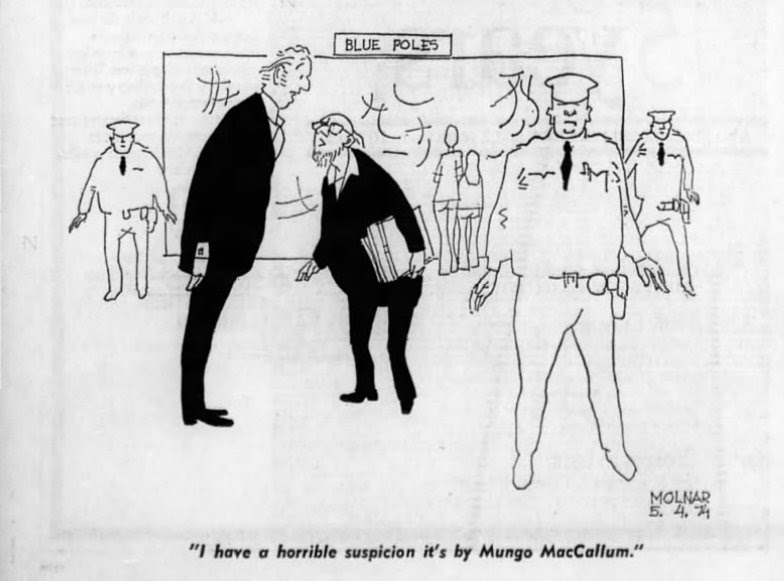
  • Gough Whitlam and Blue Poles.


    Blue Poles is in the news again. It was purchased for $1.3 million and is now valued at $350 million. The disparaging nature of the campaign against the purchase is reflected in Molnar’s cartoon (below) of 5 April 1974.

    Mungo would be chuffed!

  • MUNGO MacCALLUM. Honorary doctorate for John Howard.


    Let me join in the chorus deploring the honorary doctorate conferred on John Howard by Sydney University.

    And it’s not because I’m a Howard hater per se – although there was plenty to detest about the policies of our 25th Prime Minister. Iraq, Tampa, kids overboard, the Pacific Solution, the refusal to apologise to the stolen generations, the racist response to the Wik decision, WorkChoices, to name but a few; even the GST, that lazy and regressive boost to revenue while offering a sweetener of tax cuts for the wealthy. (more…)

  • LAURIE PATTON. Essentially, our NBN is just not good enough (but please don’t say so!)


    … And don’t tell Malcolm Turnbull, who was Minister in charge of the NBN.

    This week’s Essential poll found that dissatisfaction with the National Broadband Network is both widespread and pretty even across the political spectrum. Only 22 percent of respondents believe the NBN will adequately meet our future Internet requirements [http://www.essentialvision.com.au/future-internet-requirements].

    For those of us focussing on Australia’s potential to become an Innovation Nation and who’ve been watching the NBN debate with increasing despair this was no surprise. Although, as you dig deeper there appears to be a well-developed appreciation of the benefits of high speed broadband underlying peoples’ concerns. (more…)

  • JOHN MENADUE. Dental Care – Medicare – Private Health Insurance.


    Funding a Medicare dental scheme instead of the subsidy to PHI. 

    The PHI subsidy of over $10 billion p.a. would be much better spent on a Medicare dental scheme.

    In the following article Jennifer Doggett in Croakey, reports that about one third of Australians put off going to a dentist because of costs. (more…)

  • ROSS GARNAUT. The economics of the future energy system.


    How can we provide a high degree of energy security in Australia at the lowest possible cost, while contributing our fair share to the global effort to contain the costs of climate change?

    I take as my starting point Prime Minister Turnbull’s admonition that we put ideology aside as we seek answers to this question.

    (more…)

  • ROBERT MANNE. Rescuing 1700 marooned people.


    At present the chief priority of those concerned about the refugee situation in which Australia is directly implicated is to save the lives of the 1500 or so on Manus Island and Nauru and the 250 or so at present in Australia on medical grounds.

    When this is achieved the next priority will be to struggle to provide the present “case-load” of around 30,000 refugees and asylum seekers in Australia with full citizen rights—to be treated as refugees brought to Australia have been treated—so they can live decent human lives.

    What is peculiar about the nature of the political problem posed by Nauru and Manus Island? (more…)

  • HUGH MACKAY. A policy that diminishes us all


    Occasionally in a nation’s history, horror over past events triggers a kind of national shame. Germany went through it – is still going through it – in the wake of the Third Reich. South Africa has not yet healed the wounds of apartheid. The US continues to struggle with the evil legacy of white supremacism.

    In Australia, we haven’t had a Holocaust. We haven’t institutionalised racial discrimination (though we’ve come close). But there have been periods in our short history that have cast very dark shadows across our national psyche, evoking entirely appropriate feelings of shame. (more…)

  • GILES PARKINSON. Coalition’s stunning hypocrisy – and ignorance – on renewable energy.


    The Coalition appears to have abandoned all pretence that it supports renewable energy, now contradicting assurances by the grid owner and market operator – and now the biggest generator in the country – that the source of energy was not at fault for the massive blackout in South Australia last week.

    After Prime Minister Malcolm Turnbull and Energy Minister Josh Frydenberg used the opportunity to use the blackout to try to force the Labor states’ targets. They were joined by Industry, Science and Innovation Minister Greg Hunt on Monday.

    In an opinion piece written for the Australian Financial Review, reported as the front page lead, “SA blackout could have been avoided”, Hunt claimed that a coal fired generator could have kept the lights on in Olympic Dam and Whyalla and avoided much of the damage. He also chastised the states for chasing unrealistic targets. (more…)

  • The French submarine boondoggle

    Is DCNS’s imaginary Shortfin Barracuda submarine Australia’s biggest defence blunder?

    The Turnbull government’s decision on the future submarine (FSM) represents bad policy. It is bad for the Navy, bad for the taxpayer and bad for the future defence of Australia. Given the key role the FSM is meant to play in the future of the naval shipbuilding industry, it is also bad news for South Australia.

    The Navy’s requirement is for a uniquely large conventional submarine (SSK) that can undertake force projection missions far from home. This in itself raises important strategic questions. Is this an appropriate role for Australia? Does the US want Australian submarines to operate in the South China Sea? In practice, should only nuclear submarines (SSNs) undertake such missions? (more…)

  • GRAEME ORR. Party Over? Reforming Australian Political Finance


    After decades of halting debate, the momentum for political finance reform has never been greater.   At a national level, this comes off a low base. Australia has the laxest political finance system of all our common law cousins: Canada, UK, US, New Zealand.

    But don’t hold your breath. Any systemic reform faces two hurdles: one real, one more imagined. The real hurdle is political will. The perceived hurdle is constitutional. Let’s take them in reverse order. (more…)

  • MUNGO MacCALLUM. Malcolm Turnbull’s low road.


    So much for Malcolm Turnbull’s great fortnight in parliament, followed by his triumphant march through the marbled halls of New York and Washington.

    His claque of supporters raved, of course, but the paying customers – the voters – remained resolutely unimpressed.

    Newspoll, the bible on which our Prime Minister relied on when he made his grab for power, put his government behind on preferences, and the primary vote fell below 40 percent – where The Australian’s Liberal spruiker Dennis Shanahan used to gleefully describe as “the death zone” when it involved Labor. Now he is more reticent, as is just about every other conservative. (more…)

  • CHRIS BONNOR. School funding ‘overs’ and ‘unders’


    Last week was one to remember: one school funding revelation after another.

    It began the previous Friday at the Education Minister’s COAG gathering in Adelaide. One big problem, as Bernie Shepherd and I pointed out, was that the gathering wouldn’t begin to tackle the hard issues. They walked out at the end of the day, agreeing … on the need to walk back in at a later date.

    The next event was Q&A last Monday night, a forum where it isn’t easy to duck hard issues. To cut a long story short, the well-briefed Tony Jones pressed two issues with Federal Minister. Simon Birmingham acknowledged that some private schools were over-funded – and also said he was very open to the idea of a schools’ resourcing body to oversight funding. It has been this lack of oversight that has substantially created our current impasse. (more…)

  • MUNGO MacCALLUM. Cheering for East Timor.


    It may sound unpatriotic, but I could not help cheering when the Permanent Court of Arbitration in the Hague brought down its decision last week, and it was against Australia.

    After more than 12 festering years, this finally brings to a head a shameful and shameless exhibition of browbeating and exploiting our newest and poorest neighbour, Timor L’Este.

    John Howard claimed much of the credit for defending the independence of the nation, and so he should; but it has to be said that his motives were not entirely altruistic. (more…)