Blog

  • Tokyo postcard. John Menadue

    It is great to be back in Japan for cherry blossom. I first came to Japan almost 45 years ago and have been visiting regularly ever since. On our visits and residence in Japan, we stayed at scores of minshuku – Japanese B & B – across the country. It was a wonderful experience.

    Cherry blossoms have been early in Japan this year. Many locals say that it is due to climate change! I suspect that many Japanese are more concerned about their environmental pollution of dust out of China, soaring eastwards, first over Korea and then over Japan. A family member who recently stayed in Seoul for a couple of days said that the dust obscured the sun until about 2pm each day.

    We attended the Australian embassy cherry blossom celebration along with about 1,200 others last week. It is a great occasion for Australia to display its friendship and its produce. We established the first such celebration almost 35 years ago. It was then called a ‘wattle and cherry blossom day’. The cherry blossoms in the garden have always been beautiful, but in the early days we brought in wattle from the Commonwealth War Graves garden in Hodogaya.

    In the 1980s, the Australian government sold a large section of the embassy premises for $750 million to a large Japanese company. The capital gain was tax-free. Some of the money was used to erect a new chancery and staff apartments. I am yet to hear of anyone who admires what we built. The Canadians did it much better than we did. However, a lovely part of the garden was retained and is well used for embassy functions.

    I sense a much improved mood in Japan following the election of the Abe Government several months ago. After 25 years of stagnation, the Japanese are now much more optimistic. But time will tell whether the optimistic mood is justified. Major structural problems still face Japan – an ageing population and a refusal to seriously entertain immigration, a protected agricultural sector and serious governance problems whereby operators like TEPCO, the nuclear power operator at Fukishima, are much too close to government regulators. By flooding the economy with money and forcing down the Japanese yen, it is clearly causing difficulties for adjoining countries such as ROK. The depreciating yen will also increase prices of all imported energy and foodstuffs. But the mood has certainly improved, something I have not noticed for a long time.

    Knowledgeable Japanese that I have spoken to express admiration for the strength of the Australian economy – growth rates over many years averaging about 3%, inflation ranging between 2% and 3%, unemployment just over 5% and miniscule government debt compared with Japan with its very serious international debt problems. But Japanese express real surprise that with such a strongly performing economy, the Australian Government should be at such political risk in the coming September elections. I don’t think they quite understand when I tell them that so much of the damage to the Australian Government has been self-inflicted.

    John Menadue
  • Are most asylum seekers and refugees Muslims?

    Well, as a matter of fact, most asylum seekers and refugees are not Muslims.

    But I am sure that many commentators and a lot of the community believe that most are Muslim. The dog-whistlers like Scott Morrison feed on this assumption .According to Jane Cadzow in the Sun Herald he urged the Coalition parties “to ramp up its questioning … to capitalise on anti-Muslim sentiment”.

    Figures on this issue are extracted from the DIAC Settlement data base. One reason for the difficulty in analysing the figures is that a religious test is not applied to persons seeking refugee status, and neither should it. Ascertaining religious background often then depends on voluntary declarations.

    The Refugee Convention is blind to religion but the Convention recognises that religious persecution is a valid ground for claiming protection.

    But based on DIAC Settlement data the general picture becomes reasonably clear. For settlement purposes refugees are asked on a voluntary basis to declare their religion as it is likely to assist in settlement in the community.

    In the figures for the year from January 1 2010 there were 8,342 arrivals of refugees and other humanitarian entrants. The religious affiliations were as follows:

    • Christian 4,263 – 51%.
    • Muslim 2,223 – 26%
    • Hindu 1,125 – 13%
    • Other 731 – 10%
    • Total 8,342 – 100%

    In the period 1 April 2011 to 31 March 2012, humanitarian arrivals including refugees were as follows.

    • Christian 5,523 – 34%
    • Muslim 6,732 – 42%
    • Buddhist 445 – 3%
    • Hindu 1,089 – 7%
    • Other 2,255 – 14%
    • Total 16,044 – 100%

    These figures give a fairly reliable guide to the religious background of humanitarian entrants in recent years. The increase in Muslim arrivals in the year to 31 March 2012 is largely due to the persecution of Hazaras both in their own country Afghanistan and more recently in Pakistan. This trend is continuing.

    The pattern will vary from year to year, depending on the religious composition of the country where the persecution is occurring, and if a particular religious group is being persecuted.

    I would expect that the number of Christians currently facing persecution in the Middle East, particularly in Egypt and Syria, is likely to increase. Christians represent about 10% of the population in both countries the highest in the Middle East. If the Assad regime in Syria falls both minority Alawite and Christian communities are likely to be in jeopardy. Over a million Syrians have already fled to neighbouring countries.

    Christians in the Middle East, the birthplace of Christianity, have fallen from 20% in the early 20th Century to about 5% today.

    The religious pattern of asylum seekers and refugees is hard to predict. What is clear is that it is nonsense to assume that most of them to date are Muslim.

    John Menadue

  • The Asian Century – another smoko? John Menadue

    Chaired by Ken Henry, the White Paper, ‘Australia in the Asian Century’ was released five months ago, in October 2012. We have heard precious little about it since. Prime Minister Gillard appointed Craig Emerson, the Minister Assisting the Prime Minister on Asian Century Policy. I have not seen or heard anything from him that gives me confidence that an implementation plan has been drawn up and is being implemented.

    Will we go on ‘smoko’ again as we did after the Garnaut Report of 1989 on the challenge and opportunities we faced in North Asia and particularly Japan and Korea. (See ‘The Asian Century and the Australian Smoko’ which Greg Dodds and I wrote in April 2012 on my website publish.pearlsandirritations.com.)

    A key issue from the Asian Century White Paper is to ensure that the key institutions are keeping up with the modest bench marks that were set. The Henry Review of Taxation showed that policy and ideas are the easy part. The hard slog is implementation. We have not heard from Craig Emerson how the modest objectives spelt out are to be achieved. What are the bench marks along the way to 2025? Where are the champions of our engagement in Asia? Those champions will have to come from within our existing institutions, particularly in business, media and education. We have not heard from them.

    Commenting on PM Gillard’s pending visit to China, Minister Emerson said that in the White Paper ‘content is important, but even more important is the very existence of the White Paper’. I am not sure I understand what he means and I don’t feel the least bit reassured.

    The response of Minister Emerson was almost as unhelpful and ill-informed as the comment by PM Gillard when referring to the “Asian Century”, she said ‘we have not been here before’. That may be true for her, but she showed little knowledge of our history and what was set out for Australia in 1989 by Professor Garnaut. We have “been here before” but the Prime Minister obviously missed it.

    The barriers to our involvement in Asia are obvious. The first is our large companies with their Anglo-Celtic culture and clubbish directors who are failing to equip either themselves or their companies for Asia. The second is our media whose structure and coverage was laid down over a century ago. It is overwhelmingly focussed on the UK and the US. There is only token interest in our region.

    A central issue beyond these two institutional failures is our fear of Asia. The White Paper did not adequately address this issue. This fear of Asia has been with us since European settlement – a small white, fearful English-speaking enclave surrounded by large numbers of Asians. That fear of Asia is regularly exploited. The Liberal Party with its ‘stop the boats’ one-liners incites exaggerated fear of Asia. The National Party runs the same campaign against Chinese investment that Pauline Hanson ran in the past against Japanese investment.  The Greens bash Malaysia over its human rights. The Government gives lip-service to our relations with the region, but the effort is not there.

    So far the follow-up to the Asian Century White Paper is not encouraging. The Garnaut Report was influential for a number of years and then we largely forgot. Asian language learning in Australia today is worse than it was 20 years ago!

    Is anyone really driving the implementation of “Australia and the Asian Century”?

    John Menadue

  • Mea Maxima Culpa. Guest blogger Chris Geraghty

    If you are a pious, conservative member of the Catholic Church, stay away from any movie theatre showing the documentary Mea Maxima Culpa. You will be exposed to scenes of diabolical evil, revolting details of lives destroyed, to corruption, institutional ineptitude, chronic, sinful delay, ignorance, injustice and a disturbing misuse, no, an abuse of power – all in the name of Jesus. If you are a loyal member of the institution, a little person with a simple, delicate faith who wants to believe the best of those you call “Father”, “Your Grace”, “Your Eminence”, protect yourself from the agony of knowledge, cover your face, clench your fists and pretend that the characters of this documentary never existed.


    Mea Maxima Culpa – Silence in the House of God was directed by Alex Gibney and, in this 1 hour and 46 minutes documentary, he exposes the sexual abuse of little deaf boys who could not speak, by a clerical predator in the diocese of Milwaukee, and it records the lifelong battle of four of these boys to be heard, to be dealt with compassionately and justly. It is an horrific story interlaced with vignettes involving other priests, archbishops, cardinals, popes, and serial offenders from Ireland and Italy. We learn the dirty details surrounding the life of the Vatican darling, Marcial Marciel Degollado who founded the Legionaries of Christ, a friend of Pope John Paul II, a close associate of the powerful Cardinal Angelo Sodano, a gold-carded donor to the Vatican coffers, a serial pedophile abuser of his seminarians and even of his own illegitimate children. We meet Father Tony Walsh, a singing priest in Dublin who could entertain incredulous fans with his impersonation of The King, and who, among a large field of competitors, won the reputation of being the most notorious clerical pedophile in Ireland. We watch, with mouth agog, as his bishop, the effete Archbishop Connell, tells us that he was too busy, with too much to do, to follow up complaints about Father Walsh. We witness Marcial Marciel’s friend, the silly angelic Cardinal Sodano, advise the pope in solemn ceremony, not to concern himself about “the  petty gossip “ circling the world, involving clerical pedophilia and the quality of the Vatican’s response.


    But the documentary focuses its attention on Father Murphy. He was for almost twenty-five years, from 1950 to 1974, and in the face of serious complaints of criminal behaviour, in charge of a boarding school of little boys who were all profoundly deaf. He had been blessed with the special gift of communicating with his charges by sign language. Over the years, he selected his sexual victims carefully, making sure that he assaulted and raped those boys whose parents could not use sign language and therefore could not communicate effectively with their own sons. He was a monster. You will need a strong stomach and an unshakeable faith to endure this documentary to its conclusion. It is a powerful and damning indictment on the hierarchy, the clerical club and the Vatican. Watching the victims expressing their primeval, gut emotions through their eyes and hands was for me a transforming experience, beyond the world of written or spoken words. The images these men created were overwhelming.


    I came away with a feeling of profound shame at the depth to which consecrated men could descend; a sense of anger at the mafia sub-culture of God’s shepherds; a sense of horror at the thought of what young, innocent, vulnerable boys had to endure, and of the raw wounds they had borne throughout their lives; and a sense of wonder and admiration at the courage and determination profoundly deaf men have brought to their fight for justice and recognition. These isolated men put us all to shame. While ever people like them are alive and demanding to be heard, the Church and her illustrious message will never die. The cardinals, the archbishops and monsignors of the Church do not give us hope for the future. They must know that they have dropped the ball. Their credibility is in ruins. But these wounded men with their thirst for justice and their amazing, powerful and explosive sign language, and the ordinary, angry, scandalized little people of the local churches are the hope of things to come.


  • Hazaras in peril. John Menadue

    There are an estimated 50,000 persons of Hazara background living in Australia. Many of their relatives and friends are being intimidated and killed regularly in Pakistan. It is not surprising that they are fleeing and paying people smugglers to get to safety in Australia or elsewhere.

    The Hazara are a Shia group who have traditionally been persecuted in Afghanistan. Their physical appearance also makes them ‘different’.

    For decades, Hazaras have fled to Pakistan for safety and reside mainly in the Quetta area of NW Pakistan. That has now changed with the Hazara in Quetta being specifically targeted by militant Islamist groups.

    Ben Doherty in the SMH of 29 March 2013 reported that there has been ‘an alarming increase in the rate and severity of attacks on Hazara in Pakistan. In eight attacks (this year) 216 Hazara have been killed and more than 300 injured”.

    Given the peril that Hazaras face in Pakistan, it is ridiculous to suppose that any ‘deterrents’ that we can conjure up in Australia will have any affect.

    It is not surprising that in 2011-12, Afghan citizens accounted for more than 40% of boat arrivals who were granted refugee status in Australia. Most would be Hazara. With the increased targeting and killing of Hazara in Quetta recently, an even greater number will be seeking our protection.

    Action on our own borders will have only a marginal effect. That is why Arja Keski-Nummi and I proposed more than 12 months ago, that Australia establish an Orderly Departure Program with Afghanistan and Pakistan to provide alternatives and less-risky pathways for asylum seekers in peril in Afghanistan and Pakistan and particularly for the Hazara with family in Australia. It is clear that there will be security problems for Australian officials administering orderly departure programs in those two countries. But the risks are manageable. Further, the risks are small compared with the risks that the vulnerable Hazara are facing every day of their lives.

    In 1982 when I was Secretary of the Department of Immigration, with Malcolm Fraser as Prime Minister and Ian Macphee as Minister we established an Orderly Departure Program with Vietnam, a former enemy. Foreign Affairs and Immigration officials negotiated the arrangement. Under this program, 100,000 Vietnamese came to Australia without having to pay people smugglers or risk their lives at sea.

    There is no single ‘solution’ to asylum seekers seeking protection in Australia or anywhere in the world… We need to act in source countries like Afghanistan and Pakistan, and in transit countries like Indonesia and Malaysia. But whatever we do, people flows will always be messy. Some asylum seekers will continue to come irregularly to Australia. We need to grow up and live with the fact that in this world there are over 25 million asylum seekers, refugees and displaced persons. And the number is increasing as we live in comfort and security in Australia.

    We have a moral obligation to help people in peril. We also have a self-interest. The history of 750,000 refugees that have come to Australia since WWII is a success story. Highly motivated refugees worked hard and established families. In education particularly, their children show a clean pair of heels to the Australian-born.

    John Menadue

  • The Boat People Obsession. John Menadue

    The Australian Parliamentary Library has again pointed to our obsession with boat people.

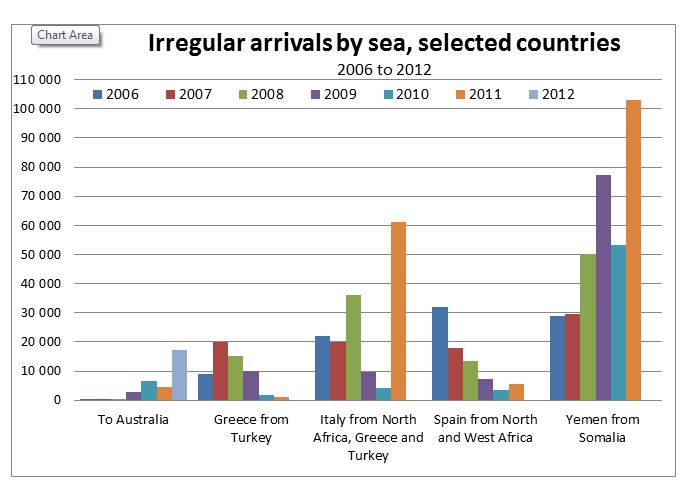
    In its 11 February 2013 Research Paper”Asylum seekers and refugees, What are the facts”, it highlights (p.8) that despite increases in boat arrivals in recent years, the number of ‘Irregular arrivals by sea’ to Australia is quite small compared with other countries.

    The chart below shows this quite clearly.

    Irregular arrivals by sea, selected countries

    Parliamentary Library, data source: UNHCR, All in the same boat: the challenges of mixed migration, UNHCR website.

    The chart shows dramatically that boat or sea arrivals in Australia are quite small compared with other countries. For example, in one weekend in 2012, more boat people arrived in Italy from Libya than came to Australia in the whole year. Yemen is one of the poorest countries in the world, but in 2011 it received over 100,000 boat people.

    We have lost any sense of proportion about boat arrivals in Australia.

    Despite all the evidence, the media has made no serious effort to counter the erroneous reporting that we are being ‘swamped by asylum seekers and boat people’. One-liners about the failure of ‘border protection’ are thrown around with little appreciation of the facts.

    The world is changing around us. Refugee numbers have increased dramatically from 1.5 million in 1951, to 15 million in 2011, with another 27 million people forcibly displaced from their homes. All borders are under pressure. We see this most dramatically today in people fleeing Syria and crossing the borders into neighbouring countries. Some will seek asylum in Australia probably coming by boat.

    But we have a phobia about boat people which is so easily exploited by opportunist political leaders and journalists who have little interest or knowledge of asylum issues and policies. Why is it that in the last ten years over 70% of asylum seekers to Australia have come by air, of whom about only 40% secure refugee status, but only 30% of asylum seekers have come by boat and with double the rate of successful refugee determination?

    I suggest there are several reasons for our phobia with boat people.

    • It is so easy for politicians to raise our fears of the ‘yellow peril’ when we see unkempt asylum seekers coming to Australia by leaky boat, whereas asylum seekers coming by air are more likely to be wearing suits, having made false declarations about their intentions in coming to Australia.
    • Lazy journalists find it much easier to tell their story with pictures of people on leaking boats than accessing airports and secure areas where asylum seekers come in dribs and drabs, all day, every day. The story is much harder to tell without pictures. Asylum seekers coming by air don’t provide easy photos.
    • The government has not seriously attempted to set the record straight by giving us a global picture of asylum seekers and the relatively small number that come to Australia. It has not tried to win the argument either based on fact or by appealing to our decency. I cannot recall Prime Minister Gillard ever putting a case for treating asylum seekers with dignity. She has responded to the prejudice that flows out of focus groups. She has left the field to the Alan Jones, Ray Hadleys and the Scott Morrisons of this world.

    Our obsession with boat people is out of all proportion to the problem we face, particularly if we consider the pressures on the countries set out in the chart above – Greece, Italy, Spain and Yemen

    The mode of arrival of asylum seekers is not important What is important is the total number. Countries with land borders will have asylum seekers coming on foot, by train, bus or car as in Syria today. Island countries like Australia will have asylum seekers coming by air or boat.

    John Menadue

  • The Pacific Solution has failed. John Menadue

    The Government fell for a dud Coalition “policy” that suggested that by re-opening Nauru/Manus the flow of asylum seekers by boat would be reduced or even cease. We recall that many times Tony Abbott said that on becoming Prime Minister, the first thing he would do would be to get on the phone to the President of Nauru to re-open the Nauru detention centre.

    Following the Houston Report and in a spirit of political compromise, the Government foolishly accepted the Coalition policy to re-open Nauru/Manus as deterrents to boat arrivals. It was part of a larger package.

    The figures are now clear that Nauru/Manus are not working as a deterrent and that great hardship is being inflicted on vulnerable people who are detained on Nauru /Manus.

    The Government announced the re-opening of Nauru/Manus in August last year with the associated ‘no advantage’ test. In the three months October, November and December 2012, the number of boat arrivals increased to 6,170 from2139 in the same months of the previous year. In the first three months of this year, boat arrivals have increased to 3028 compared with 1,802 in the same months of the previous year.

    The return of Sri Lankans does seem to be having an impact but that that has little to do with the so-called deterrents of Nauru/ Manus.

    The Secretary of DIAC told a Senate Committee in October 2011 that even the meagre benefits of Nauru processing in the past could not be repeated. He pointed out that Tampa and Nauru in 2001 did confuse people-smugglers for a period and boat arrivals largely stopped, although asylum continued to come by air. Importantly almost 1,600 of the 1,637 asylum seekers who were sent to Nauru and found to be refugees finished in Australia or New Zealand. The well-informed people-smugglers know quite clearly that even if asylum seekers are taken to Nauru/Manus they are very likely to end up in Australia.

    The Government foolishly decided to adopt Tony Abbott’s and Scott Morrison’s one-line rhetoric about Nauru/Manus despite the view that the Government had expressly many times before that Nauru/Manus would not work in the future.

    But where is the public debate now when the “policy” which Tony Abbott has so consistently proposed been shown to have failed so comprehensively.

    What a tragic mess it is. The cowboys win again at the expense of fact-based policies and vulnerable people. What a mistake it is to think that Tony Abbott and Scott Morrison have serious answers. One-liners – stop the boats, re-open Nauru – are not serious policies.

    The other parts of the Coalition’s Pacific policy are Temporary Protection Visas and turn-backs at sea. Evidence shows that when the Howard Government introduced Temporary Protection Visas, the number of boat arrivals increased and hundreds of women and children drowned at sea… We also know that the Royal Australian Navy and the Indonesian Government have very serious reservations about the risks and dangers of turn-backs at sea.

    Arja Keski-Nummi and I have outlined ways to minimize Nauru/Manus. See www.publish.pearlsandirritations.com, click on ‘refugees’ and go to paper of 31.8.2012 ‘Asylum Seekers, a way out of the present impasse’.

    John Menadue

  • Judge Murphy and Sexual Abuse in Ireland. John Menadue

    The Australian Royal Commission on Institutional Responses to Child Sexual Abuse commences its hearings in Melbourne on April 3. If the experience of the four enquiries in Ireland is any guide individuals and intuitions in Australia face ordeals.

    Judge Murphy headed the ‘Commission of Investigation’ into sexual abuse in the Catholic Archdiocese of Dublin. Her report was released in 2009. Only a few months earlier, the Ryan Report was released which dealt with abuse in industrial schools controlled by Roman Catholic religious institutions in Ireland.

    Judge Murphy was recently in Australia and spoke at the University of Sydney Law School on her experiences in Ireland. Her speech can be found at http://sydney.edu.au/law/video/ (4 March 2013). Her presentation is disturbing but it is essential reading to understand what has happened in Ireland. She outlines many disturbing features-

    • The public outrage which followed her report and three others.
    • There was a tsunami of abuse
    • Ireland was ‘shaken to the core’.
    • There has been plummeting Catholic Church attendance.
    • Irish attitudes to such issues as contraception, divorce and abortion have changed beyond recognition.
    • The Catholic Church was more concerned to protect its reputation and assets than concern for the victims. The attitude of many in the Catholic Church was “don’t ask, don’t tell”
    • Boys were abused at a much greater rate than girls.
    • The Catholic Church was not ambushed as it suggested, as the Catholic Church took out insurance many years before in anticipation of the crisis becoming public and widespread.
    • The cover-ups by the Church were assisted by civil authorities.
    • Rome attempted to undermine the remedial actions which were finally undertaken by the Catholic Bishops.
    • The Irish enquiries went on for years.

    Ronan Fanning, a history professor at University College, Dublin, wrote an op ed on 6 December 2009 titled ‘The age of our craven deference is finally over … there are still rare events that not only deserve but demand to be described as historic. The publication of the Murphy Report is one such event; a truly historic landmark in the sad and squalid story of church-state relations in independent Ireland”

    All individuals and institutions need daily reform. The power brokers in the Catholic Church in Ireland badly failed the “lay faithful”

    Judge Murphy’s lecture is a very sober and sobering account.

    John Menadue

  • The Flow of Asylum Seekers to Australia follows world trends. John Menadue

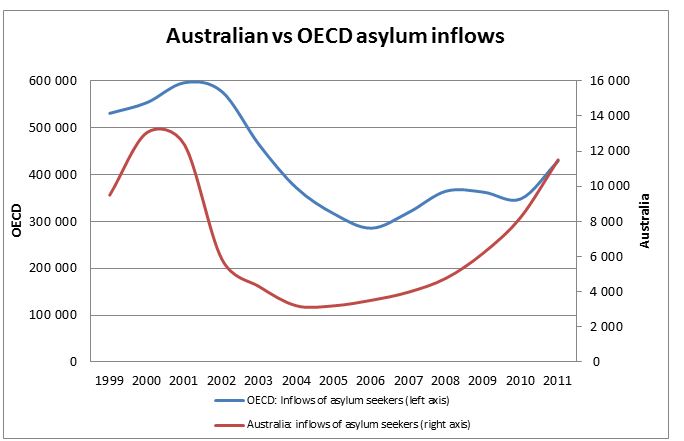
    The Australian Parliamentary Library has just released a Research Paper showing that the flow of asylum seekers to Australia since 1999 follows the trends of asylum flows to OECD countries generally.

    Reading the Australian media one would think that we have a problem with asylum seekers that no other country has.

    At the Centre for Policy Development, in a report we issued in April 2011, we pointed out that the trend of asylum seekers to OECD countries, including Australia, showed that civil unrest and persecution in source countries are the major influences in asylum movements around the world and far more influential than the deterrent policies of any one destination country  including countries like Australia.(p 32)

    That assessment has been confirmed by the Research Paper by the Australian Parliamentary Library dated 11 February 2013, ‘Asylum seekers and refugees. What are the Facts?’ The Canberra Press Gallery is so absorbed in polls and politics, it has yet to read this important document which is right under its nose.

    The APL report says ‘Although Australia’s global share of asylum applications is small compared to many other OECD countries, in terms of fluctuations in asylum applications, the trend since 1999 reflects similar patterns. (The figures are 1999-2011. 2012 figures are not yet available.)

    The chart below shows clearly that the pattern of flows is similar for Australia and OECD countries.

    Australian vs OECD asylum inflows

    APL has drawn data from OECD,International Migration Outlook 2012 and the OECD website, Inflows of Asylum Seekers

    The Coalition and Tony Abbott continue to cite the decline in boat people after the Howard Government introduced the ‘Pacific Solution’ in 2001. But what is important is the total number of asylum seekers coming to Australia and other countries and not their mode of arrival. Boat arrivals did largely stop after 2001, but air arrivals continued at about 4,000 p.a.

    What the chart shows is that the decline in overall asylum seeker numbers coming to Australia after 2001 was very similar to the decline elsewhere. The number of asylum seekers going to OECD countries roughtly halved from 2001 to 2006. In the same period the number of asylum seekers coming to Australia also roughly halved.

    The number of asylum seekers seeking refuge in all countries, including Australia, began to rise again in 2006. This was due to the state of emergency that was declared in Sri Lanka in 2005 and the US troop surge in Iraq in 2007. In 2008, the Sri Lankan Government withdrew from a ceasefire with the Tamil Tigers and in Afghanistan, the Taliban rejected peace talks. The figures in the APL chart show that in broad terms asylum seekers seeking refuge in OECD countries has been similar to the trends we have seen in Australia since 2006 .  It was not due to changes in refugee and asylum policies by the Rudd Government.

    Obviously in comparing trends there will be some differences in leads and lags. There will also be variations due to the location of the persecution and conflict. For example Australia is more likely to be affected by persecution in our region, eg in Sri Lanka or Myanmar, rather than events in the Middle East which are likely to affect Europe much more.

    The APL  Research Paper shows that the driver of asylum seeker numbers are the ‘push’ factors – war and persecution – and not the ‘deterrent’ policies such as the Pacific Solution that we mistakenly are told was responsible for the changes in numbers seeking asylum in Australia.

    The APL Research Report nails the propaganda which is carried by the media – that Australia has a particular problem with asylum seekers. The problems we face are similar to those of the OECD as a whole. Furthermore the number coming to Australia is small by comparison with many other countries.

    John Menadue


  • The Medicine Lobby. Vested interests win again. John Menadue

    Professor Stephen Duckett of the Grattan Institute has just reported that ‘Australians are paying too much for prescription drugs. The cost of this overpayment is at least $1.3 p.a.’

    This is another example of the power of vested interests in the health sector and their ability to extract economic rents from the community. The other privileged players in the health sector include doctors, particularly specialists, and the private health insurance industry that extracts a $3.5 billion annual subsidy from the taxpayer.

    The Minister for Health and her department spend much of their time placating and appeasing the vested interests in the health sector rather than developing policies and administering programs for the benefit of the community.

    The Pricing Authority for pharmaceuticals makes recommendations to the Minister for Health. The authority is a non-statutory body established by the Minister. Of the six members of the committee, two are industry lobbyists from Medicines Australia and the Generic Medicines Industry Authority. It is not surprising with a headstart like that that the pharmaceutical sector is able to secure the sorts of privileges that Stephen Duckett has outlined.

    The Australian Pharmacy Guild is also infamous in the privileges it extracts from Goverments. New pharmacies in urban areas must be at least 1.5 km from each other. One consequence of this restriction of competition agreed to by APG and Australian governments is that the number of community pharmacies has remained substantially unchanged at 5,000 since 1993, despite large increases in population and PBS prescriptions. The consumer organisation, Choice, in 2005 commissioned a study by the Allan Consulting Group on these location rules. Choice commented that ‘the location rules provide little consumer benefit and only advantage existing pharmacy operators’. The PGA has also successfully barred pharmacies from operating in supermarkets. Australians don’t have a great love for the Coles/Woolworths oligopoly but they would love to see more competition.

    Canberra has over 900 full time lobbyists, many in the health field. They are seriously undermining good government Their power is exaggerated but politicians fall over themselves to oblige them.

    The ministerial/departmental model in health is not serving us well. It provides a fertile hunting ground for vested interests – the health  providers- who hold all the important cards. They cling to the Department of Health like limpets. Even enquiries like the National Health and Hospital Reform Commission, are invariably timid and anxious to appease sectional interests. This Commission was chaired by a senior executive of BUPA.  After six years of the Rudd/Gillard Governments there is little to show in real health reform. The muddle continues.. But the sectional interests must be happy that their. position is secure.

    Because of the failure of health governance to counter the lobbyists and sectional interests in health, I have proposed on many occasions that the Commonwealth Government should establish a permanent, independent, professional and community-based statutory authority, an Australian Health Commission, similar to the Reserve Bank in the monetary field. The Reserve Bank’s governance structure has made it almost impervious to lobbying. It is respected for its independence and professionalism. Just as the Reserve Bank is subject to guidelines determined by the Government, so an Australian Health Commission should operate within guidelines determined by the Government.

    The power of vested interests in health must be tackled. The Grattan Report provides yet another example of why this must be done.

    John Menadue

  • Does Australia care about what happens on its doorstep in Sabah? Guest blogger: El Tee Kay

    Almost a month ago two hundred of the self styled Royal Sulu Army, some heavily armed, landed in a small coastal village in Sabah, Malaysia. They came from the nearby Tawi Tawi islands in the southern Philippines. Their objective was to “persuade” the Malaysian Government to recognize their “hereditary” claim to Sabah for the Sulu Sultanate.

    The Suluk or Tausag tribes have traversed this narrow stretch of water as traders and pirates for centuries and many settled along the East coast of Sabah. The influx increased during the Moro uprising in the southern Philippines. This most recent invasion, it seems, has all to do with the Philippine claim to Sabah and reminiscent of President Marcos’s “Operation Merdeka” which was an attempt to launch 160 army trained Muslim youth from Sulu and Tawi Tawi to foment an uprising in Sabah in 1967. This plot went horribly wrong when this commando unit called the Jabidah found out they were to kill fellow Suluks. They mutinied and were apparently eliminated by their handlers. Coincidentally, Benigno Aquino Jr the father of the current Philippines President blew the cover of this covert operation and massacre.

    The Philippines has not dropped its claim to Sabah and wants Malaysia to have the case adjudicated by the International Court of Justice. Malaysia dismisses this on the grounds of “effective” and “a’titre de souverain”.

    The Manila government has said that the intruders and the Sultan will be charged under Philippine law but the Malaysian Government wants them to be tried in Malaysia. The opposing stands taken by the two Asean countries and the extradition process will be drawn out which will result in more political posturing.

    The Philippines will hold its midterm elections in May. In an earlier election “Sultan” Jamalul contested a senate seat in the former President Arroyo’s Team Unity and lost. It is speculated in Manila that the “invasion” of Sabah is politically motivated by the opposition to embarrass President Aquino.

    Malaysia will also hold its 13th General Election soon and as Sabah emerges as a key to forming the next government, both the Barisan Nasional and the opposition Pakatan Rakyat are accusing each other of treachery for political gain.  The Malaysian government has become prickly about criticisms of this long drawn out conflict and of its alleged mishandling of the incursion by a handful of invaders and the loss of lives of civilians and security forces. There is also the question of Muslim voter reactions to the use of force in dealing with the situation. President Aquino also has to deal with the influx of refugees to Tawi Tawi fleeing the conflict and the loss of Filipino lives and alleged mistreatment of its citizens by security forces.

    Fortunately neither the Philippines nor the Malaysian Governments’ have upped the ante. This is in keeping with ASEAN’s collaborative approach but there are fears that this spat could escalate into retaliatory terrorist activities within Sabah by Suluks which could further strain relations with Manila. Some of the “invaders” are said to be veterans of the Moro National Liberation Front who have relatives and sympathizers in both countries

    But a recent look at the Australian media suggested greater interest in a New York Court decision on sugar in drinks and a former British MP and his wife jailed for a traffic lie. Does Australia have a real interest in Asia unless it is for economic advantage?

    El Tee Kay, Kuala Lumpur

  • Confusion and Contradiction on Asylum Seekers in the Community. John Menadue

    Arja Keski-Nummi and I have described the services and lack of them for the 12,000 asylum seekers living in the community as ‘Kafkaesque’. The policies and rules concerning these asylum seekers have no sense or logic.

    • Some are living in the community on bridging visas with work rights and some without work rights.
    • Boat arrivals between October 2012 and August 2013 and released into the community have work rights but boat arrivals after August 2013 have no work rights.
    • Some have access to Medicare, but many don’t.
    • Some are in detention because they came by boat, while those who come by air, the much larger number, live in the community from the beginning.
    • Some cases for refugee status are being processed, but under the ‘no advantage’ rule those who came by boat after August 2012 have no processing of their claims.
    • Those who came by air, continue to be processed.
    • Some have access to the Assistance for Asylum Seekers in Australia scheme (mainly financial) and the Community Assistance Support Program (for people with complex needs). Many don’t have access to either ASAS or CAS.

    It is a mess. The above are only examples and could be added to.

    We need an urgent review of support services for asylum seekers living in the community. An important first step while the review is being undertaken is to grant work rights.

    A good model for the review is the Galbally Review which reported to the Fraser Government in May 1978 on the services needed to support migrants and refugees in the community. That report highlighted the important principles that should underlie multiculturalism but it also proposed a range of programs to assist migrants and refugees in their settlement in Australia. High on the list was English language learning, the telephone interpreter service, employment advice and assistance for women in the home.

    That report laid the basis for the very successful settlement services that endure to this day. We need to build on what we have achieved and support asylum seekers both equitably and efficiently in settlement in Australia even while their claims are being processed. We know from experience how we can do this. But we need new programs that fit the needs of today.

    The present confusion of programs is a mess. We need a mini-Galbally quite urgently.

    It offends almost every principle of equity, efficiency and good administrative practices for the present Kafkaesque type arrangements to continue for another day.

    John Menadue

  • Could this be a John XXIII moment. Guest blogger: Monsignor Tony Doherty

    Announced in every news outlet, Jorge Mario Bergoglio, an Argentinian Jesuit who is the first in his order and the first from Latin America has been named as the bishop of Rome – Pope number 266.

    In these early hours of the announcement, we are left with the crumbs of his story. Theologically conservative, we are led to believe. Socially active and human – left his Episcopal palace and lives modestly, catches public transport, a seventy-six year old who loves to walk, and interestingly cooks for himself. Never underestimate a man who cooks.

    More significantly there is some evidence that he has held the socially active and more conservative sides of the church in Latin America together as a bridge builder. A striking credential in a continent which has been famous for the birth of Liberation theology, a movement which called for powerful critique of social injustice and the primacy of marginalised people.

    Many in the Catholic church today ache for the personality of a John xxiii to bring some healing and future direction to a deeply wounded church.

    There may not be many around who can remember the excitement, now fifty-four years ago, when Angelo Roncalli , the first day in his job as Pope John xxiii walked out of the Vatican city and on his first pastoral visit, went to the local goal.  ‘Since you couldn’t come to see me’, the pope said, ‘I’ve decided to come and see you.’

    The walk was unprecedented, or at least broke the 100 year tradition of Popes not leaving the confines of Vatican City. This visit became more than an expression of human compassion, it in many ways defined the way he saw his future ministry.

    Within 18 months John xxiii was asking the Church to throw open the windows and let some fresh air into this stuffy place, as he convoked a General Council of the Church. The Catholic church has never been the same since those heady days.

    What has this to do with Jorge Bergoglio, the 266th incumbent in the Papacy?

    A fact that is frequently forgotten is that Angelo Roncalli was never seen as anything but theologically conservative. Indeed, one of my personal memories was that in my last years of seminary training, a dictate came from John xxiii that all major theological studies, previously studied in one’s own language, were to be studied in Latin. We had been used to Latin, but to have such subjects as Scripture and History studied exclusively in Latin seemed to seriously restrict any proper research. This was an issue of language and words.


    For John xxiii actions spoke much louder than words.  To address the question of race, he simply appointed the first black Cardinal. To address the question of the Roman Curia’s hold on the Church he invited bishops from every corner of the world to Rome for a Council to reflect on the future.  To address the divide between people of different religious beliefs, he invited representatives from every faith to be present at the council. To address the issue of women in the church (one must admit in a muted fashion) he invited women to attend the council as auditors. One of the few women present at the Council was an Australian Rosemary Goldie.

    There were words, of course, plenty of them. But for John xxiii it was perhaps the actions that were more significant.

    Is it too much to hope that Pope Francis will be like his namesake, that breath of fresh air, that young spirit from Assisi, a person acutely aware of the power of the symbolic action?

    In a gesture of turning away from his life of entitlement, a young Francis of Assisi, so the story goes, divested himself of his rich clothes and handed them to his confused father. An embarrassed bishop standing by hastily covered his naked body with a simple peasant’s frock, a replica of which members of the Franciscan order still proudly wear to this day.

    It is interesting to speculate what significance our new pope places on the name Francis. Will the Pope bring the horizon of the mind and the spirituality of that free spirit of Assisi to his immense responsibilities – or will the weight of the administration be too great?

    While speculating, and that is probably all we can do on this first day of a new pontificate, what symbolic action would be sufficiently strong to send a coherent message to the victims of child sexual abuse whose lives have been so deeply wounded, or to the women who feel so sorely disenfranchised in the church, or indeed to the people of this planet who live in dire poverty and hunger?

    It remains to be seen if this new Pope, a smart and experienced outsider that he is, a modest man who embraces a simple life-style, is equal to the task of reforming this damaged church and employ the immense symbolic power at his disposal.

    Monsignor Tony Doherty


  • Next step for Pope Francis. Guest blogger: Michael Kelly SJ

    So Pope Francis said to himself when he was elected Bishop of Rome, as he told journalists in Rome on last Saturday, what about the poor? Bishop of Rome means Pope and his question was what does it mean to take the poor seriously as Bishop of Rome?

    That’s Pope Francis’s question. But it’s far from clear how Jorge Bergoglio is going to handle the practical consequences of becoming Pope Francis.

    The issues are clear: reform of Church governance, root and branch; giving voice and status to local churches in the governance of the Church that has been centralized in Rome with ever increasing magnetism for the last three decades; listening to the issues and concerns of everyday Catholics.

    But what might be most significant early on in his Pontificate and suggestive of directions is an answer to this question: how long can someone who walked out of the palatial residence of the Archbishop of Buenos Aires to find a home in an apartment near the poor want to live in the Borgia apartments where Popes have lived for the last 500 years.

    Festooned with wall paintings by Rafael and adorned with works by Michelangelo and other Renaissance masters, how long can a man espousing a Church of the poor for the poor last in such Renaissance glory? Pope Paul VI was the first to dispense with the elevated “gestorial” chair on which Pontiffs were carried. John Paul II did away with precious stones in episcopal rings, preferring a simple cross and unadorned rings for his own right hand finger, and many bishops have followed his lead.

    The next thing to go must be the titles introduced for bishops and Cardinals which are an invention of the 18th Century for Church officials to be able to match what the Italian aristocracy claimed for themselves – Excellency, Your Grace, Your Eminence, etc.

    Benedict XVI brought back the red shoes, the ermine adornment of his jacket and even the funny hat worn first by the Medici Popes. But that will be seen for the aberration it is.

    Now comes the simple man from Buenos Aires, the son of the railway worker.

    What does that mean?

    Plainly it means he’s his own man.  And that’s not surprising. His body language screams it.

    But as a Jesuit, his formative experience is the Spiritual Exercises of Ignatius Loyola. For good or for ill, the Exercises are a radically personal matter. They sheet home responsibility to the individual for the spiritual journey.

    Many have said that he carries baggage from his time during the reign of the military dictatorship in Argentina – 1976-1983 – when “disappearances”. Torture and all manner of inhumanity prevailed.

    The Jesuits have been quite open about his history then. He had nothing to do with the barbarians who abused their people but he could have done more to defend, advocate for and support the victims of that dreadful regime.

    Perhaps like us all, he’s learnt from his experience. Perhaps as a good practitioner of the Spiritual Exercises, he has learnt a lot more about what a sinner he is. Perhaps like a flawed human being who has recognised his flaws, he’s become more human.

    Certainly his early performance as bishop of Rome indicates that he has his theology right: he’s not the CEO of a multinational with braches around the world. He’s the pastor of a particular community – Rome – which has an added responsibility: presiding in charity with the bishops of the Church over all the Churches.

    But what is he to do about his living arrangements?

    The answer is simple really: stare down the security freaks concerned about him and the assassins who want to kill him, find an apartment in an appropriate area, commute to work like everyone else, even heads of State, operate out of an office like any other CEO, make the Borgia apartments into offices, appear for the two Angelus events each week from the window where he addressed the people of Rome, and get a life!

    Fr. Michael Kelly SJ

  • Francis I. An unpredicted but not unpredictable result. Guest blogger Michael Kelly SJ

    While everyone agrees that the election of Jorge Bergoglio as Pope Francis is unprecedented in many ways, it is not entirely a surprise. He was runner up to Joseph Ratzinger in the 2005 Conclave that saw him elected as Pope Benedict XVI.

    Bergoglio is the first Jesuit, first Latin American and first Pope from the South. He is of Italian migrant parents but not a “Romano” or a Curial Cardinal having had no time in his working life at the Vatican.

    He is considered a theological conservative but an informed pastor and especially attentive to the needs of poor, reflecting that commitment in the simplicity of his own life style.

    It is not so much his being a Jesuit that interests me. As one myself, I am certain that the stereotype of the liberal intellectual associated with membership of the Order does more to obscure than reveal the reality of its members’ views. The Society of Jesus offers a rich panorama of ideological, theological and ecclesiastical inclinations.

    What I find significant about the appointment of this Jesuit are the times and forces that have shaped him, the jobs he has done and the challenges he has had to face.

    Raised in the high time of socialist fascism – a political cocktail mixed uniquely for Argentina by Juan Peron – he joined the Jesuits in the 1950s. Quite unusually, he was made Provincial of the Jesuits in Argentina in his 30s – 1973 to 1979 – when the Jesuits in Argentina were in turmoil and the Jesuits internationally were reinventing themselves.

    The 1970s were years when the Jesuits in Argentina were riven with factions and conflicts, with many leaving the Order, The conflicts were as much about directions for the Order and the Church as Liberation theology burst upon the scene in Latin America as they were about local politics. Decades of political conflict over Juan Peron and his legacy followed by a military dictatorship divided Argentineans and the Jesuits there too.

    Holding the Jesuits together at that time in Argentina was no slight challenge but he was also fully engaged with the worldwide impulses for change in the Jesuits then. They received their decisive expression in 1975 at an extraordinary meeting of the highest level of governance in the Order – a General Congregation. Bergoglio was intimately involved in that process.

    For both Argentina and the Jesuits, the 1970s were a point of highly contested decisions about direction. The direction of the Jesuits incurred the wrath of the Vatican with John Paul 2  in 1981, setting aside the General of the time, Pedro Arrupe, proroguing the Jesuit Constitutions and imposing a Visitor to investigate and if needed correct alleged excesses during his time as General.

    Maggie Thatcher’s escapades in the 1980s over the Falklands began the process of removing the military dictatorship and the restoration of democracy.

    Bergoglio is criticized for his apparent fence sitting during the dictatorial regime in Argentina during this period but led public calls for the repentance of the Church for its silence over the “dirty wars” and “disappearances” during the military dictatorship.

    Bergoglio has been a bishop since 1992 and archbishop of Buenos Aires since 1998. While not the largest archdiocese in Latin America, that leadership experience gives Francis a solid 15 years in charge of something substantial and an experience of the political and, as an Argentinean, the economic games that are played.

    His time leading that archdiocese and the Jesuits during their turmoil in the 1970s should have led him to ask the right questions, appreciate the processes required for systemic change and insight into the sort of people he needs around him to effect change.

    He might also have a few others in mind – two Jesuits : the missionary Francis Xavier and the third Jesuit General, Francis Borgia, a widower, father of a large family and Duke of Gandia who joined the Jesuits in mid life and because of his administrative experience, quickly shot the top job in the Jesuits.

    It only remains to be seen if a smart and experienced outsider is equal to the task of reforming the Curia and bringing wider Church processes closer to what Vatican 2 invited the Church to become. In taking the name of Francis, Bergoglio is said to invoking the memory of Francis of Assisi.

    Michael Kelly SJ

  • Habemus Papam. Guest blogger Chris Geraghty

    The signs are hopeful, but the challenges are herculean.

    Jorge Mario Bergoglio is a good, simple man. As Cardinal Archbishop of Buenos Aires he used to cook his own meals and catch the bus to work with the other workers. These are good signs. His feet are on the ground, his toes in the dirt and his mind in the street. We can expect him to turn his back on Renaissance dress and Byzantine ceremonial, to take off the red shoes and cast aside the ermine and feathers, and return to the values of the Gospel – to simplicity, a marked preference for the poor and downtrodden, to justice for all, to healing and to a loving freedom from the harshness of the law. Francis I may even prove a force hostile to Wall Street, to the extravagances of greed and extreme capitalism, to corruption inside and outside the Vatican, and a champion of the fair-go for all.

    But the challenges are serious and the forces lined up against him are strong and entrenched. He will need to take an axe to the Vatican bureaucracy. The Curia will dig in as they did against Pope John XXIII and against the visionary programme the bishops of the world initiated at the Second Vatican Council. He should not underestimate the power of passive resistance and of the fiefdoms in Rome hidden under the cloak of clerical service to the Church.

    This new Pope will have to seek to restore the tainted credibility of a Church which has long resisted the values and processes of the modern world – accountability, openness, freedom, individual conscience, democracy and the breath-taking contribution of the sciences. This Church’s mind has been twisted out of shape over the years, particularly on issues of human sexuality, by some forms of pagan philosophy, by Gnostic teachings which have gained a foot-hold at various stages of her development, by the pessimism of Augustine as his teaching gained purchase down the centuries. The leaders of the Church have systematically railed against the French Revolution and the Enlightenment, preferring to support the ancient regimes, reactionary monarchs, dictators and repressive regimes. Once he has settled into the fisherman’s chair, Francis I will have to kick-start this huge institution. He will have to listen carefully to the world, step down into the marketplace and communicate with modern men and women in a common language.

    Many consider that the pedophilia scandal among the clergy will be the principal problem facing the new Pope. It is undeniably of major and immediate concern, a leprous disease eating into the flesh of the institution. Tough decisions will have to be made, but this is only one of many critical problems Francis will have to confront.

    Perhaps the most radical challenge to face the modern Church is to devise some way of involving women in its life and making them visible among the ranks of the hierarchical structure. Women have been treated disgracefully for centuries, both by the secular society and by the Church. While the world has changed and is changing, the Church has remained frozen in the past, and now this is a matter of justice. Women are not inferior to men. Their appearance on the earth was not a  tragic mistake. They are not less intelligent than men, or more prone to sin, of less worthy, or the source of evil in the world. Church leaders, men as well known as Augustine, Thomas Aquinas, Albert the Great, Tertullian, John Chrysostom and some Popes have spoken ill of women over the centuries and treated them with disdain. This has to stop. For the survival of the institution and in the name of justice, women have to become visible and powerful in the Church, whatever the cost to privilege and private power structures.

    While gathering the courage to involve women in the sacramental processes of forgiveness or marriage or anointing, in the full celebration of the Eucharistic mysteries, there are steps which can be taken without delay. The community and the Vatican can appoint women to positions of real authority in the Roman congregations, in diocesan, international and national bodies. There is no reason why cardinals have to be ordained as priests or consecrated as bishops. At least half the College of Cardinals should be women (and some young women), and available to advise the Pope and to elect the next one. Rome has to develop and announce as quickly as possible a radical policy of the position of women in its super-clerical and excluding masculine world.

    There is much to be done. The man chosen carries a heavy burden. The result of the conclave could have been considerably worse and, given the limited field of candidates, could hardly have been better. We wish him well.

    Chris Geragthy

  • Productivity and Skills. John Menadue

    For months, the Business Council of Australia and senior business executives have been banging on about the need to increase labour productivity. To achieve this, they have emphasised the need to amend the industrial relations legislation, ‘Fair Work Australia’ as essential to lift productivity. Many have seen it as an attempt by employers to rebalance the industrial relations framework in their favour and has little to do with productivity. Others would see it as political identification with the Coalition

    But this campaign by employers was not based on fact. Ross Gittins in the SMH 11 March 2013 has drawn attention to the most recent national accounts which showed that ‘Labour productivity in the market sector … (has) been improving at the rate of 0.5% or better for the last seven quarters … That represents an annualised rate of 2% a year … which compares with an average rate of 1.8% over the past 40 years.’

    The ABS has also released figures that show that labour productivity had improved 3.5 % in 2012 compared with 0.9% in 2011. The strong dollar appears to have forced many businesses to restructure and increase productivity in order to overcome rising costs

    More has to be done to lift productivity, but recent performance has not been too bad. Hopefully our major companies who spent so recklessly in the mining boom will continue to improve productivity by expanding output and reducing costs – starting with executive salaries. Marius Kloppers, the terminated CEO of BHP received a $75 m exit package!

    I have also spoken recently about the failure of Australian business executives to skill themselves and their companies for our future in Asia. At the most, there would be a handful of chairpersons or CEOs of any of our major companies who can fluently speak any of the key Asian languages. This failure is stark. It is obviously too late for them now, but it is not at all clear that they are recruiting executives for the future with the necessary skills for Asia. A recent survey by The Business Alliance for Asian Literacy, representing over 400,000 businesses in Australia, found that ‘more than half of Australian businesses operating in Asia had little board and senior management experience of Asia and/or Asian skills or languages.’

    Senior Australian business executives speak correctly about the need to upskill the Australian workforce. But they should start by setting an example by up skilling themselves.

    John Menadue

  • The Power of the Gambling and Liquor Complexes. John Menadue

    I remember speaking many years ago to an old friend, Justice Xavier Connor, after he had completed an enquiry for the Victorian Government on a possible casino in Melbourne. He recommended against it.

    He said ‘John, gambling and casinos everywhere in the world attract criminals and organised crime. It is like bees around a honeypot. Criminals are naturally attracted to gambling and casinos.’

    We have had warnings that the gambling industry has enormous power and influence. Look how easily it ran off the rails the attempts by Andrew Wilkie and Nick Xenophon to curb problem gambling in licensed premises in Australia.

    Only a couple of weeks ago, the brilliant young footballer, Ben Barba, withdrew from rugby league and admitted that he had serious personal problems with gambling and alcohol. The Canterbury Leagues Club was praised for the way it handled Ben Barba’s personal problems. But what of the culture of the Leagues Clubs, those pleasure domes of gambling and liquor, who cause so much damage not just to Ben Barba but also to thousands of others.

    We see saturation advertising of gambling and liquor in association with sporting events. We can get the odds for a bet on a game in progress from Sportsbet. Individuals are charged with match-fixing. Our Australian cricket team carries the logo of Victorian Bitter without blushing about the damage that liquor does in this country, way beyond the damage of illicit drugs.

    The liquor and gambling PR people work overtime telling us that they are committed to responsible drinking and gambling. Please spare us the hypocrisy! We are urged to forget the problem drinkers and gamblers who wreck their own lives and their own families.

    Fifty years ago, President Eisenhower warned Americans about the power of the military and industrial complex. Who in Australia is really concerned about the growing power of our gambling and liquor complexes?

    John Menadue

  • Asylum Seekers and Paedophiles. John Menadue

    In my blog of March 5 I spoke about the demonization of asylum seekers by Scott Morrison. He has variously alleged that they bring disease, wads of cash and jewellery. He has also called for the registration of asylum seekers moving into a residential area.

    But Senator Abetz has gone even further.

    He made it very clear that we should draw the inference that just as the public wanted paedophiles registered when they moved into a community, so there should be registration of asylum seekers.  He was not rebuked by Tony Abbott.

    Senator Abetz is a senior shadow cabinet Minister for Employment and Workplace Relations. He is the Leader of the Opposition in the Senate. Both he and Scott Morrison would be senior members of an Abbott cabinet. Throw in Christopher Pyne, Barnaby Joyce, Kevin Andrews and Bronwyn Bishop and it does not look very promising.

    As a migrant from Germany, Senator Abetz has no intention of extending the same hand of generosity that was extended to him as a “Stanger” when he came as a newcomer to Australia in 1961.

    He obviously finds it hard to accept that we have a particular responsibility to welcome and care for the stranger. It is closing off all possibility of empathy towards the stranger when he implies that they are a threat like paedophiles.

    Where are the churches in all these distasteful attacks on ‘the stranger’? The Catholic bishops are silent. The Anglican bishops are silent. The Lutheran Church which knew so much about the persecution of persons of German origin in Australia in WWI and WWII is also silent in the face of the new vilification. The Jewish community, which knows more about persecution than any other group on this earth, is silent. Perhaps this silence is due to a mistaken view that most of the asylum seekers are Muslims.

    When will significant religious groups in Australia stand up for ‘the stranger’. The tone of the debate is getting worse day by day in the lead-up to the next election.

    But despite the abdication of leadership by so many, hundreds of thousands of Australians are going out of their way to quietly welcome and help asylum seekers in small but important ways. Australians in the community are showing that we are a more decent country than our leaders suggest.

    John Menadue

  • Let them Work. John Menadue

    Last month, Bruce Kaye (guest blogger) and I wrote articles about the need for a change of government policy to allow asylum seekers to work. This is important for their dignity and self-respect and their integration into the Australian community. It would also be less costly to the Australian taxpayer and the Australian community.

    Today the Asylum Seekers Centre, Sydney, and fifty other organisations have joined together to call on the Australian Government to allow all asylum seekers to work, whether they came by air or boat.

    A press statement by the CEO of the ASC, Melanie Noden, follows:

    United call for all asylum seekers, regardless of mode or date of arrival, who are released into the community on a bridging visa to be granted the right to work.

    The Asylum Seekers Centre is proud to stand with over 50 organisations and 1200
    individuals across Australia who believe asylum seekers should have the right to
    work. The right to work is a basic and fundamental human right that we as a country
    should proudly and loudly uphold.

    CEO of the Asylum Seekers Centre, Melanie Noden, said finding work is of utmost
    importance to asylum seekers. “It restores their self esteem and provides them with
    the financial independence they so desperately need in order to start a new life. It
    also provides them with a connection to society and gives them the opportunity to
    contribute.”

    And it’s not just us who thinks so. ‘Not allowing people the right to work is a
    disgrace. We signed the Refugee Convention to protect people, not punish them.
    The only reason the Government has implemented this is to punish people. Asylum
    seekers are not illegal and should not be treated as such. Everyone should have the
    right to work,’ says former Prime Minister, Mr Fraser.

    As history has shown, having asylum seekers live on welfare, without any training or
    skill development for years, deliberately hinders their potential to gain employment
    when they do achieve permanent residency – and for boat arrivals 90.8% do become
    permanent residents.

    It is estimated that in 2013, 10,000 asylum seekers will be released nationally into
    the community without work rights. There is no guarantee of the level of support
    provided to these people. This will put strain on an already under resourced sector
    and will impact the mental health and self-agency of thousands of asylum seekers.

    John Menadue, Patron of the Asylum Seekers Centre, former diplomat and business
    leader says the present policy of denial of work is cruel, denies the dignity of people
    and does not deter future asylum seekers. “There is a persistent myth that refusal of
    work rights and other penalties will deter new asylum seekers and particularly boat
    people. But there is no evidence whatsoever that this deterrent works. In almost allcases asylum seekers are escaping appalling conditions, from the Taliban for
    example. Those situations are far worse than anything that we can throw at them.
    “But the burden on the individual is the greatest worry. Most asylum seekers have
    escaped from terror and violence and many are traumatised. To deny them work
    rights is likely to worsen their mental state. It makes it harder for others to help them
    if they are forced into idleness.
    “We need a breakthrough in this toxic political approach to asylum seekers.
    Australia can do better than this. We have shown it in the past.”

    The Government’s announcement in November last year prompted a group of
    concerned not for profit organisations, individuals, businesses and community
    groups to address the lack of right to work for asylum seekers. This includes those
    who have arrived post August 13, 2012 and are subject to the new policy and those
    who arrived prior to August 13, 2012 who have not been granted work rights.
    Today, we have sent letters to the Prime Minister, Julia Gillard and Minister for
    Immigration, Brendan O’Connor calling for the right to work for asylum seekers. As a
    group, the signatories to the united statement call for:
    • An undertaking from the Minister for Immigration to make a policy change
    extending the right to work to all asylum seekers released into the community
    on bridging visas, regardless of mode or date of arrival or stage in the refugee
    determination process.
    • The right to work is accompanied by the provision of basic employment
    support services to increase the asylum seekers chance of employment.

    To support asylum seekers and the work of the Asylum Seekers Centre, contact  http://givenow.com.au/asylumseekerscentre
    For a full list of agencies supporting the statement please see
    http://righttowork.com.au/take-action/supporters/

  • The Neverending Story. Guest blogger: Greg from Cottesloe

    Side show alleys have become smaller these days. They used to be the centre of attraction at the annual Royal Show with the boxing troupes, the bearded ladies and so on but even the shrunken lane of today still has a conjuror performing the old pea and thimble trick. The conjuror puts a pea under one of three thimbles then swirls them around with appropriate flourishes and invites a member of the audience to pick the one hiding the pea. Some honest but dim fellow steps forward and has a go but…no luck. He retires ruefully shaking his head and the conjuror’s patter goes on.

    Our bemused citizen here could well be the Australian Republican Movement. The Monarchist conjuror has in truth few assets to work with and he will exploit the plodding good nature of his adversary for all it’s worth. The conjuror’s first rule: NEVER accept the idea of a simple referendum question asking the people whether they want (some form of) a republic or to continue with the present structure. That would probably finish the game there and then. Those in the magic trade still gasp with admiration at the Howard/Minchin Flutter of 1999 which deftly avoided this core question but nevertheless convinced most people that the issue had been decided.

    After dodging that bullet, it becomes a bit easier for the conjuror. “It would be disrespectful to the Queen to hold such a referendum while she is still alive”. Fair enough, concedes our generous friend only to hear when he steps forward the next time that “We’ve got to do the Australian thing and give Prince (King) Charles a Fair Go”. Beyond that awaits Prince William and the radiant Kate protected by a slobbering media. Even our decent bloke is beginning to get the idea that he’s been had here, played for a complete mug.

    The political process could resolve this but the Prime Minister, in spite of Labor policy and her own professed position as a republican, has assured the country with a wagging finger that there’ll be none of this republic stuff during her term, as though describing distasteful behaviour by schoolboys behind the tennis shed. Has she won the Monarchist vote through this step into Liberal territory? Unlikely. As for the conjuror, he sits quietly in the background contemplating an untroubled future for the next decade at least.

    So what’s to be done? Upend the table? No, but let’s change games. A straightforward arm wrestle through a simple referendum would be a good start.

    Greg at Cottesloe


  • The Malaysian General Election. Will the fix be in again? Guest blogger El Tee Kay, Kuala Lumpur

    Australian Senator Nick Xenophon flew into Kuala Lumpur in mid-February. He was detained and deported back to Australia as he posed a “security threat” to the country. He was roundly condemned by the Malaysian Home Minister, the Election Commission and the media for his interference but received favourable support overseas and from the opposition parties, civil and human rights groups in Malaysia. He was blacklisted for participating in an illegal rally for free and fair elections in last April’s Bersih 3.0 rally and “tarnishing” Malaysia’s image. His summary deportation has cast further doubts about the fairness of the coming general election, probably in June this year.

    The government can usually ignore protests about unfair elections as it has great influence over radio and television channels. Many of the main English, Malay, Chinese and Indian newspapers are owned by supporters of the the Barisan Nasional (BN) the major governing party. The BN is a coalition of UMNO, MCA, MIC and some smaller parties.

    For 40 years, Malaysians have put up with rumors of election fraud but have been dismissed.  In 2004, the voters gave BN a strong mandate to support the new PM Abdullah Badawi after two decades of authoritarian rule.  Although the country was prosperous and peaceful, the ethnic minorities felt marginalized in government, business and education. Government affirmative action policies favored the Malays and Muslims and minorities felt deprived and discriminated against. The festering discontent was too strong to contain, and the Chinese and Indian partners in the BN, the ruling coalition, were blamed for not fighting for the rights of their constituents. UMNO (United Malays National Organization) too lost touch with the grass roots. It is alleged that UMNO Putras (the elite) got all the contracts and perks while the UMNO base was neglected.

    To try and beat back the opposition to its money politics the leader of Pakatan Keadilan Rakyat (PKR), Anwar Ibrahim was charged and later acquitted on what many regarded as trumped up sodomy charges.

    The opposition parties exploited this discontent in the BN. A large number of Chinese switched allegiance to the DAP (Democratic Action Party), and the Indians to PKR. PAS (Parti Islam Semalaysia) made inroads into the religious heartlands in the country where UMNO was strongest. The political advantage held by UMNO in gerrymandering in favor of Malay rural constituencies became less relevant as PAS mounted their challenge in these staunchly Muslim areas. In the 2008 elections, BN was devastated by the electoral swing to the opposition.  BN lost five States to the opposition and only strong support from Sabah and Sarawak saved them from losing the Federal Government.

    The next General Election has generated a tremendous interest .The opposition is optimistic about winning the Federal Government and several State governments. This will depend on whether the loosely knit coalition is able to stick together. Bickering over seat allocations, differences on religious and social issues, unless dealt with maturely, may cause an erosion of confidence amongst voters.

    Sabah and Sarawak still hold the key to success. They have 56 parliamentary constituencies and they have been loyal BN states. The predictions are that the BN will lose urban seats in Sarawak but the bulk of the rural seats are safe for the BN. This time Sabah is a problem. The presence of illegal immigrants in the State has been an open sore. For decades, the government has denied political gifting of citizenship to immigrants in exchange for their vote for the BN. Evidence presented at the Royal Commission of Inquiry recently confirmed that this occurred. In Parliament, it was alleged that about 700,000 immigrants were given citizenship and of these, about 200.000 were registered as voters. These numbers have changed the demographics of Sabah drastically and increased BN’s and UMNO’s dominance.

    The global scrutiny of the elections and pressure at home to deflect growing concerns of massive electoral fraud motivated the PM Datuk Seri Najib Tun Razak to sign the Transparency International (TI) Integrity Pledge on Wednesday 20 February declaring that the governing parties would uphold integrity and reinforcing his commitment to fight corruption. The Opposition parties did not participate in this pledge and continue to insist that all members of the administration declare their assets and wealth. It is unfortunate the   pledge comes at such a late stage of the election process, but it is a positive message from the PM that “money politics”, a euphemism for corruption, a long standing scourge in UMNO politics, will not be tolerated.

    Money politics in other parties also is common where the “frogs” (party hoppers) are enticed to switch camps after the elections for large sums of money betraying their parties and their constituents. There have been cases where State Governments have fallen due to these turncoats.

    Senator Xenophon’s deportation may not have been unexpected. The bungling officials may have scored an own goal. It has only attracted more international attention which will no doubt please Anwar Ibrahim the leader of PKR and more broadly the coalition of opposition parties (Pakatan Rakyat). He needs to win an additional 34 seats. It is a big ask but not impossible.

    El Tee Kay, Kuala Lumpur


  • Prejudice compounded by ignorance. John Menadue

    The Scott Morrisons and Ray Hadleys of this world have had a field day vilifying one asylum seeker living in the community who came by boat. The prejudice is bad enough, but their ignorance is just as appalling.

    In the last ten years, 65,000 asylum seekers came to Australia. 47,000, or 72% of them, came by air. The fact is that those 47,000 who came by air all went directly to living in the community on bridging visas. Scott Morrison and Ray Hadley showed not the slightest interest. There is no campaign against the much larger number of asylum seekers who have come by air although one would expect that some of them would have committed offences in the same way as offences occur in the general community.

    But talk of boat arrivals living in the community and the prejudiced and ignorant go ballistic. Air arrivals are not detained in Immigration Detention Centres but released immediately into the community until their refugee status is determined. Furthermore, boat arrivals have twice the rate of successful refugee determination as air arrivals.

    The ‘debate’ about boat arrivals living in the community is mired in prejudice and ignorance. When will our Prime Minister stand up and make a principled case for decent treatment of asylum seekers. I have never heard her do it. Where are the values that the ALP used to espouse?

    Ignorance can only be countered by facts and the government is failing to properly inform the community. Prejudice must be tackled head on with beliefs about the value and dignity of every human being. Tony Abbott leads with opportunism. Julia Gillard continually runs for cover.

    John Menadue

  • ‘I was a stranger and you took me in.’

    ‘I was a stranger and you took me in’ (Matthew 25)

     Well not really, according to Scott Morrison.

    In her article in the SMH on 3 November 2012, Jane Cadzow describes Scott Morrison as ‘a devout Christian who worships at Shirelive, an American style Pentecostal Church. The Shirelive website says its members believe the Bible is the ‘accurate authoritative word of God’.

    Formerly, Scott Morrison belonged to Hillsong. In his maiden speech to the House of Representatives in 2008 he said ‘from my faith I derive the values of loving kindness, justice and righteousness’.

    I am confused.

    The Torah, which is a key part of the Jewish/Christian tradition places great store on welcoming the stranger. The Torah repeats its exhortation more than 36 times. ‘Remember the stranger, for you were strangers in Egypt’.  This caring for the stranger is repeated more than any of the other biblical laws, including observance of the Sabbath and dietary requirements…

    As Leviticus 19 puts it, ‘When an alien resides with you in your land, do not molest him. You should treat the alien who resides with you no differently than the native born among you; have the same love for him as for yourself; for you too were aliens in the land of Egypt.’

    The Gospel of Luke asks ‘Who is my neighbour?’ and then tells us the story of the Good Samaritan. Matthew’s Gospel tells us about the Holy Family’s flight from the ‘slaughter of the innocents’ to safety in Egypt. They were indeed fortunate asylum seekers in that the Pharaoh was generous and did not play to public prejudice by calling on his subjects to ‘stop the donkeys’.

    Scott Morrison has been hostile to strangers and demonises asylum seekers and refugees at almost every opportunity.

    • He has said that they bring disease ‘everything from tuberculosis and hepatitis C to chlamidya and syphilis’. This assertion was rejected by an infectious diseases expert, Dr Trent Yarwood.
    • He told 2GB Talkback radio audiences that he had seen asylum seekers bringing in ‘wads of cash …and large displays of jewellery’. Desperate people will bring whatever portable assets they have.
    • According to leaks from the Shadow Cabinet, and according to Jane Cadzow, Scott Morrison suggested that the Coalition ‘ramp up its questioning to … capitalise on anti-Muslim sentiment’. He used the dog-whistling defence that he was only listening to what people are saying ‘we’ve got to listen to what their concerns are’. But please, lend me a megaphone!
    • In early 2011 he complained about the cost of holding funerals in Sydney for asylum seekers who died in a shipwreck off Christmas Island. An eight year old, whose parents had both died in the shipwreck, was one of 21 people flown from the Christmas Island Detention Centre to attend the funeral ceremonies. Scott Morrison said these were ‘government-funded junkets’ and that the relatives would be ‘taking sightseeing trips and those sorts of things’. He later apologised for the timing but not the content of his remarks.
    • Only last month, he called on the government to suspend asylum seekers being released into the community on the basis of a single violent attack. Fairfax Media pointed out that these people were about 45 times less likely to be charged with a crime than a member of the general community.

    Time and time again, Scott Morrison injects hatred towards the ‘stranger’.

    Perhaps he reads a different translation of the Bible.

    That other biblical scholar, Tony Abbott has supported him every step of the way.

  • The Candidate. Guest blogger Chris Geraghty

    It’s frightening, isn’t it? I saw Cardinal George Pell on television recently claiming that his election to the top job was not impossible. He explained that because he’s a Catholic, a bishop, and a member of the College of Cardinals, he was a chance. Is that all one needs to be pope?

    The applicants for the biggest job on earth are gathering in the Vatican to be assessed, to go through their interviews, to do some politicking and count the numbers. The successful candidate must of course be a member of the masculine branch of the human race. Being a paid-up member of the episcopal workers’ union and therefore both ordained as a priest and consecrated as a bishop, he must not be of illegimate birth, disabled physically or intellectually, or deformed, or suffering epilepsy whether caused by some form of insanity or by possession of the devil (Canons 983-987 of the 1917 Code of Canon Law). Slaves and soldiers are also ineligible, though Julius II proved to be a fierce warrior during his reign.

    The relevant cohort of papal applicants is extremely restricted and warped. It’s a very limited field. We are not engaged here on a global search for the ideal candidate. Those who are not men, not celibate, not old, not members of the most exclusive club on earth are not suitable. Of course, married fishermen need not apply.

    We all have an interest in the man who would be pope. Catholics especially, even the young, even women, have a stake in the outcome and should have some say in what they want and what they don’t want. Secrecy does not guarantee that the Spirit is at work.

    The next pope does not have to be a renowned theologian – probably better if he’s not. Theology has developed into a very arcane and complicated science. The Church has plenty of them, many of whom live with tunnel vision in an ivory tower. Some of them have never lived in the real world. I’d settle for a man of simple faith, one who has developed a rich interior life of prayer and reflection, one who has lived a life and who possesses a sense of fun. That’s important. Laughter, smiles, dancing and rejoicing. Senior clerics are far too serious.

    I would hope that, unlike his predecessors, our new pope would take the time to answer his mail. For preference, I would like him to write short, pithy letters to us rather than the long, boring epistles or encyclicals popes have come to send out in the last few centuries.

    I want a man who is not programmed to talk in Vatican papalese but who is able to listen to the world and communicate with us in a language which rings true.

    I want a man of the world who can return our Church to the values and insights of the Gospel – simplicity, hope, freedom, poverty and to the message of inclusion. I certainly don’t want anyone who thinks he can order us not to discuss important topics such as the place of women in our organization. The successful candidate might ask us respectfully to do something or to refrain from doing something, but to order us about like serfs is now so uncool.

    Give me a friendly, pastoral man who doesn’t take himself too seriously, humble and down to earth, able, like Jesus, to set his people free and to re-gain our respect and confidence.

    Chris Geraghty

  • Normalising Crime

    There is a tendency to normalize crime in our own group, church or community by saying that the rate of crime in our own group is no worse  than in other groups. It is a view I have heard expressed recently in the Catholic Church.

    Cardinal Ratzinger used this argument at a conference in Spain in 2002..”..the percentage of these (sexual) offences among priests is not higher than in other categories and perhaps it is even lower…less than 1%of priests are guilty of acts of this type. The constant presence of these news items does not correspond to the objectivity of the information or to the statistical objectivity of the facts”
     
    My reading of the facts that I have seen is that he was wrong as are others  who seek to normalize crimes against children to say nothing about the betrayal of trust.
    Professor Patrick Parkinson of the Faculty Law at the University of Sydney has just released a sobering Paper “Suffer the Teenage Children. Child Sexual Abuse  in Church Communities”. Twice he reviewed the Catholic Churches protocol “Towards Healing”. He was a key adviser to the Catholic Church on  sexual abuse issues. He is a remarkably well informed commentator. He has seen the problems close at hand and over several years.
     As he says in his Paper he terminated his work with the Catholic Church over the failure of the Salesians in Australia to address  sexual abuse issues. He then called for a Royal Commission.
     
    In his Paper he acknowledges the patchy data on sexual abuse but the information pointed in one direction. The Catholic Church has a special problem which is outside the “normal”.
    He noted that  that at “a particular (Catholic) seminary in Melbourne 4.75 % of priests ordained between 1940 and 1966 sexually abused children” . Drawing on  US data he concluded that “the rate of conviction ( of these priests ) is much higher than in the general population”.
     
    In comparing the Catholic Church with other churches in Australia he concluded,”When all explanations have been offered the rate of conviction of Catholic personnel does seem to be strikingly out of proportion with the size of  this faith community compared with other faith communities”.
    In a later blog I will examine the issues that Parkinson suggests could explain the much higher rates of abuse in the Catholic Church.    Go to ssrn.com/abstract=2216264 for the Parkinson paper 

     The Catholic Church often distresses me, but I love it.

    John Menadue

  • Health care reform remains a prisoner of Federalism. Guest blogger: John Dwyer

    The intractable problem that sees a very wealthy country unable to provide cost effective and equitable health care is a political one. We are the only OECD country in which the provision of health care is illogically and inefficiently divided between two levels of Government. The Federal government is charged with funding, but not providing, Primary and Community care. The State governments are both funders and providers of our public hospital system and endless arguments (“the blame game”) revolve around the adequacy or otherwise of the contribution to hospital care from the Commonwealth. So 22 million people are served by nine departments of health with duplication costing us about $4 billion a year!

    Our Health system is sickness and hospital centric and unlike much of the rest of the world we have not changed our Primary care system to provide Australians with a care model that focuses on prevention. Such a system provides the “Win Win” situation where Australians would be healthier and the demand for hospital services would be reduced. The Productivity Commission reports that each year 700.000 admissions to public hospitals could be avoided by an appropriate community intervention! The States cannot pull the leavers to improve Primary Care and so relieve pressures on their hospitals and the Commonwealth seemingly does not know how to do it. The Federal government has no experience in delivering health care.  At this time when health care should be patient focussed with the spectrum of care from the doctor’s office to the hospital totally integrated (seamless) how frustrating is it that COAG has actually enshrined the separation of Primary and Community care from Hospital care?

    It’s an election year and we should again be pressuring our politicians to embrace the only solution to all this inefficiency and inequity. The Commonwealth should be the single funder of health, providing our health dollars to a single agency with appropriate expertise that would contract with various providers to deliver the required integrated system characterised by the features described above. John Menadue’s suggestion for a trial of a similar approach at State level where an agency with pooled Commonwealth and State money delivers integrated cost effective health care makes sense but even this, perhaps less difficult option politically, currently has no traction around the COAG table. The Australian public would have applauded Kevin Rudd proceeding along these lines. That same Australian public must keep such health reform strategies on the election year agenda.

    John Dwyer


  • Another misleading story about hospital costs

    The head of Ramsey Health told us in the AFR today that the “Productivity Commission report on public and private hospital systems found that the private sector was 30% more efficient”  It did not.

    Last year the CEO of the Private Hospitals Association said that private hospital costs are 32% lower than public hospitals. The same old hoary untruths keeps being repeated.
     
    The Productivity Commission concedes (p83) that it is hard to compare the costs of the two systems. However it went on to say that at a national level public and private hospitals had broadly similar cost per case mix adjusted separation in 2007/08. (Sorry for the jargon but it means comparing like with like).It added that significant differences were found in the composition of costs.
     
    Private hospitals often choose to point out that in certain areas they are cheaper. That is true for about 60% of surgery. Private hospitals are specialised in certain areas, particularly minor surgery. We have always known that the harder and more expensive work is left to public hospitals.
     
    The ultimate test of whether private hospitals are more efficient is whether they jump to treat public patients in private hospitals  on a casemix basis. The fact is they don’t. Years ago Jeff Kennett made an offer to private hospitals to treat public patients in private hospitals. They declined and despite their bravado today about being more efficient, they will still not put their misleading propaganda to the test.
     The CEO of Ramsay Health received a salary package of $ 31 m in 2014. That would partly explain why the costs of his company are so high.!
     
    I wonder if there are any scalpel sharp health correspondents who will examine the spin put out by Ramsey Healthcare?
    John Menadue


  • The Darkening Shadow of Hate Speech in Japan. Guest blogger,Tessa Morris-Suzuki

    Japan’s new Prime Minister, Abe Shinzō, has proclaimed Japan a regional model of “democracy, the rule of law, and respect for human rights”. Indeed, Japan has proud traditions of free debate and grassroots human rights movements. But ironically – and largely ignored by the outside world – the rights of minorities and the work of those who fight hardest for human rights are under growing pressure in Abe’s Japan.

    Japan signed the UN Convention on the Elimination of All Forms of Racial Discrimination, but refuses to introduce anti-hate speech laws. One reason, according to the government, is that such laws are unnecessary, since Japan’s penal code prohibits group defamation, insult, threatening behaviour, and collective intimidation.

    But the limits of this approach have been on display in recent disturbing incidents. On 9 February, for example, a group of racist demonstrators –  including members of the best-known hate group, the Zaitokukai – marched through an ethnically diverse district of Tokyo, shouting incitements to violence and carrying placards with slogans such as “Kill Koreans”. A large police contingent was on hand, but despite abundant evidence of group defamation, threats and collective intimidation, none of the demonstrators was arrested.

    Matters were very different, though, when, around the same time, a Zaitokukai member lodged his own complaint of victimization. His claim, made more than four months after the event, was that he had been “assaulted” when refused entry to a September 2012 meeting organized by Japanese grassroots groups seeking apology and compensation for the former “comfort women” (women from throughout the Japanese empire coerced into serving in brothels run by the Japanese military during the Pacific War). Those who attended the meeting remember it as a peaceful event, despite the presence of a few menacing Zaitokukai protestors outside. Regardless of this fact, and of the curious delay in the complaint, police responded zealously to the Zaitokukai member’s claim, bringing in four members of the “comfort women” group for questioning and descending on members’ homes to search for incriminating evidence.

    Many in Japan work very hard for “democracy, the rule of law, and respect for human rights”. But there is no rule of law if the instigators of violence are allowed to peddle hatred, while those who pursue historical justice are subject to police harassment. Democracy is left impoverished when freedom of hate speech is protected more zealously than freedom of reasoned political debate.

    Tessa Morris-Suzuki 


  • The blame game in health continues.

    Some weeks ago Victorian hospitals announced bed closures, job losses and elective surgery delays because of a dispute with the Commonwealth Government over the hospital funding formula. In an election year the issue seems to have been temporarily resolved by the Commonwealth stomping up more money.

    But it highlights the continuing malaise with divided. funding and operational responsibility for health care. The commonwealth has major responsibility for the Medical Benefits Scheme, the Pharmaceutical Benefits Scheme, Veterans Health and Aged care. The states run hospitals but depend on commonwealth funding to do so. Broadly, the commonwealth provides 43% of health funding in Australia, the state and local governments 26% and non-government, including individuals, 31%.
     
    The divided  funding and responsibilities was described many times as a “dogs breakfast” by Tony Abbott when he was Minister for Health.
     
    One important objective of a good health service must be to keep patients out of expensive and often forbidding large hospitals – a state responsibility. But the funding of health services to keep patients out of hospitals is largely in the commonwealth’s hands – particularly general practice and aged care. If all services were better organized in the community there would be much less pressure on the emergency departments of public hospitals.
     
    Some improvements were made by the Rudd and Gillard Governments but most of it was muddling through. Kevin Rudd suggested a referendum for the commonwealth to take over state hospitals. Opinion polls suggested the public supported doing this, but Kevin Rudd backed down. My preferred option would be for the commonwealth to take over all healthcare from the states, but I canot see any prospect of this happening politically. The states remain poor but proud.  Neither can I see the commonwealth abandoning the field to the states.  That would be disastrous!
    A practical compromise, which I proposed six years ago, would be to establish a Joint Commonwealth State Health Commission in any state where the commonwealth and the state could agree, with the commonwealth providing financial inducements for any state that would sign on. 
     
    It is envisaged that the Joint Commission would have agreed governance arrangements with dispute resolution provisions. It would have joint funding from the commonwealth and the state and would be responsible for the planning of all health services in the state. The Joint Commission would buy health services from existing suppliers – commonwealth, state, local and private.
     
    If a political agreement with one state is achieved I am confident we would see a big improvement in the cohesion and integration in health services in that state. Once the benefits in one state are secured the model could hopefully extended to other states.
     
    Unfortunately, last year the commonwealth passed up an opportunity for long term reform in Tasmania.The Tasmanian hospitals were in a financial and operational mess.The commonwealth declined to use its financial leverage and handed out more money without  reform.
     
     
    John Menadue