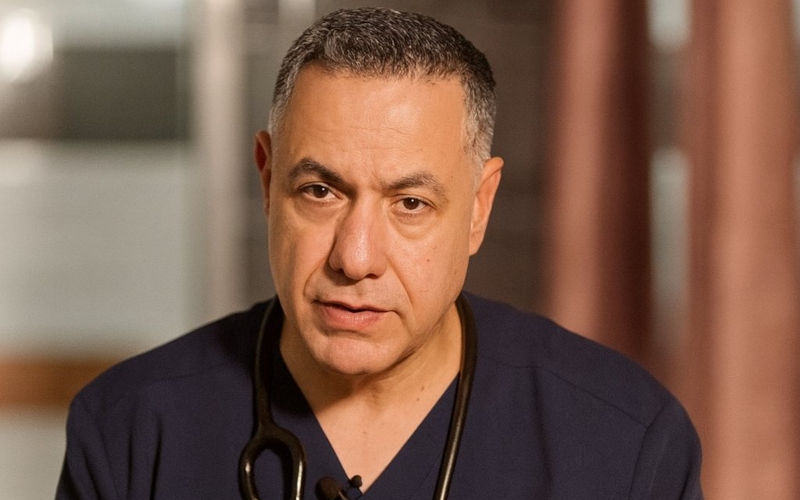
The imprisonment of Palestinian health workers without charge and new death penalty laws targeting Palestinians expose a detention system that disregards humanitarian law, due process and equality before the law.
There has rightly been a major outcry about the abusive treatment of people on the Global Samud Flotilla, whose “crime” was taking aid to Gaza. But it is important to also protest and advocate for the humane treatment of over 3,000 Gazans in the euphemistically titled “administrative detention” and 9,000 political prisoners in Israel.
During the years after the appalling attacks of October 2022, much prominence was given to the treatment and return of Israeli hostages, yet the imprisoned Gazan “administrative detainees” get less and less media attention. I am going to focus on two aspects that highlight the Israeli government’s complete failure to consider international humanitarian law – the imprisonment of health workers without charge and the recent legislation making execution the default sentence for Palestinians involved in deadly attacks.
Imprisoning health care workers
Since the start of the genocide in Gaza, Israel has arrested hundreds of essential medical workers, massively further damaging an already challenged healthcare system now under repeated attack and desperately short of even basic medical supplies.
According to the Physicians for Human Rights in Israel (PHRI), dozens of medical workers remain imprisoned, many being held for over a year without any charges against them.
Testimonies received from detained medical workers over the past two years describe dire conditions of incarceration. Severe medical neglect, starvation and abuse amounting to torture have become systematic across Israeli detention facilities, resulting in the deaths of at least 103 Palestinian prisoners, including five medical workers from Gaza known to PHRI.
Many of those imprisoned are specialists – pediatricians, orthopedic specialists, and surgeons – who cannot easily be replaced. This results in grossly inadequate health care, with major impacts on the number of deaths and disabilities of people living in Gaza.
There are well established special protections afforded to medical personnel under international humanitarian law. Yet Israel continues to flout these protections with impunity. Imprisoning desperately needed health care workers is also deliberately obstructing the recovery of a badly damaged health care system.
Increasing the use of the death penalty for Palestinians
Another clear failure to observe international humanitarian law is manifest in the new racially targeted death penalty. Earlier this year the Israeli parliament passed a law that permits the death penalty by hanging for Palestinians convicted of deadly militant attacks. Under this legislation, execution becomes the default sentence in Israeli military courts for Palestinian Arabs, marking a grave and dangerous escalation in punitive measures in occupied Palestine.
This law is far from neutral. By restricting the death penalty to acts intended to “negate the existence of the State of Israel”, the law creates a discriminatory standard that targets Palestinians, while excluding Israelis committing comparable acts of violence.
This is not justice. It is selective punishment. It directly violates the fundamental principle of equality before the law and exposes the hollow nature of claims that Israel operates under democratic norms.
The law also accelerates the path to execution. It requires that those sentenced be put to death within 180 days, drastically limiting the possibility of appeals or retrials. At the same time, it lowers the legal threshold for imposing the death penalty, allowing a simple majority of judges, rather than a unanimous decision by a jury, to determine whether a person lives or dies.
These provisions dramatically increase the risk of irreversible miscarriages of justice. That risk is magnified by the context in which many Palestinians are tried. Israeli military courts, which handle the vast majority of Palestinian cases, operate within a system marked by deep structural inequality. Palestinians in these courts face significantly fewer protections and diminished due process compared to Israeli citizens in civilian courts. In such a system, the introduction of the death penalty is more than unjust. It is dangerous.
This law represents a profound erosion of legal safeguards and a clear step toward institutionalised discrimination. It places lives at risk, entrenches inequality, and further undermines any credible commitment to justice or human rights.
Measures that expand punitive systems, such as the introduction of the death penalty within a context of unequal justice, further compound these harms. They heighten fear, destabilise communities, and reinforce conditions that erode both individual and public health.
Australia does not support the death penalty in any jurisdiction. Our government needs to make clear to the Israeli government that such a racially discriminatory law, which hastens processes, reduces appeal rights and will result in yet more deaths, is totally unacceptable.
Lasting security can only be achieved through upholding human rights, ensuring equality before the law, and putting an end to practices that undermine the health and dignity of populations living under occupation.

Dr Margaret Beavis OAM MBBS FRACGP MPH is a former GP. She is vice-president of the Medical Association for Prevention of War, co-chair of the International Campaign to Abolish Nuclear Weapons (ICAN) Australia and co-convenor of Quit Nukes. She teaches in the medical faculty at Melbourne University and has lectured on nuclear issues to MPH students.