In debates over repatriation, protest and politics, the real test is not what we say we value, but the virtues we are willing to uphold as a society.
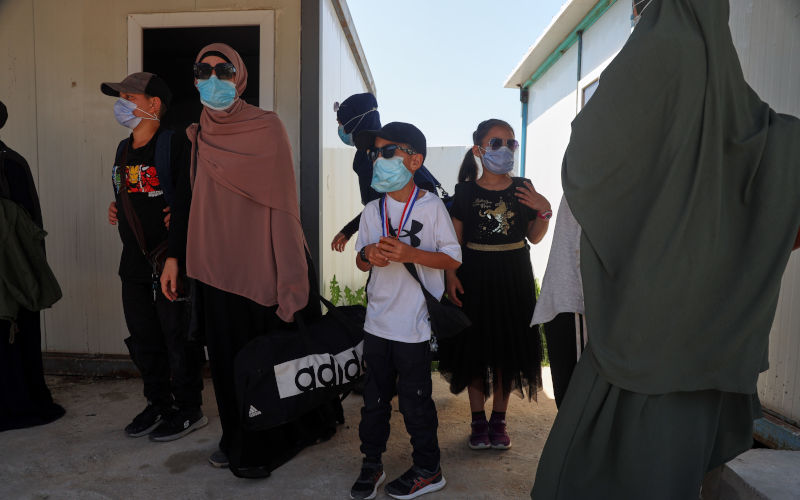
Four women and nine children are currently trying to negotiate a return to Australia after several years spent in the al-Roy camp in Syria. Help or hindrance afforded them will speak volumes about the character of Australians, as interpreted and asserted by strident political voices. What kind of people are we? What kind of people do we want to be?
Character will also be on display at the Farrer by-election, as people choose to vote out of perceived grievance or out of a desire for a more just, sustainable and more harmonious future. It will be on display in the May budget, when the treasurer chooses between reform that delivers greater equity and justice, or yields to voices which demand their advantage be protected. It will be on even greater display in the commentary made upon it. It was on display, for good, at the recent ANZAC celebrations with overwhelming condemnation of booing as First Nations speakers delivered Welcome to Country.
Let me come to the hub of the issue. Political discourse is increasingly focused on what are called values. Values are the principles or standards that individuals or groups consider important in life, such as family, freedom, keeping people safe, democracy, rules, or success. Values reflect what is prioritised at any given time, they shape decisions or actions.
Virtues speak to who we are. They are enduring qualities such as kindness, mercy, generosity, hospitality, courage. A civilisation will not endure because of its values but because of virtues. Values tend to become increasingly self-serving, especially in times of uncertainty or tension. An attempt to formulate a moral code, or legal manifesto, on values is misplaced, it must emanate from the treasuring of virtues.
It is the case that Christian virtues are increasingly mocked by the rich and powerful – as seen by the treatment of Pope Leo by the White House. Disdain was also clear for all to see at the inauguration of Donald Trump’s second term when the Bishop of Washington, Mariann Budde, held before the incoming president the virtue of mercy. He was both incredulous and affronted. Let us stay with this virtue, which according to the biblical Micah, along with humility and justice, are the three requirements of a moral life and of a sustainable civilisation.
Without mercy, scapegoating, resentment, and a cycle of violence, become inevitable.
The vile ideology of ISIS emerged following the absence of mercy accorded Sunni people and their remaining leadership, following the toppling of Saddam Hussein and the assumption of power by the Shia. Just War theory covers three components: conditions prevailing before war is declared that might justify intervention; the manner war is prosecuted (protection of civilian population, humane treatment of prisoners etc); and provisions which accord dignity and prevent humiliation when conflict is over.
As is often the case, there was abject failure when the war ended. Unless a cycle of violence is ended with mercy, it is perpetuated.
There are a variety of reasons why these Australian women joined the ISIS movement by moving to Syria. We will probably never know the reason that prevailed in each case. That some did so under duress is almost certainly the case.
Their return home, and especially that of the children must be facilitated. For it not to be is an indictment upon the character of Australia and Australians. We are not people who abandon any of our citizens, no matter how unlovely their actions may have been. They may need to be protected from themselves, or in some circumstance we may need to be protected from them. But they are our citizens, it is not the responsibility of others.
Of course, a huge responsibility of care and nurture will sit on the shoulders of family, neighbours and community at large. It will not be easy for them to reintegrate. If criminality needs to be addressed, then it should be addressed. It is most unlikely that an offence equal to that of David Hicks has been committed. It was right that in his case he was brought back into Australian life, it is even more right for these women and children.
Repatriation of these women and children should receive bipartisan support. We have the capacity to rehabilitate them. We have the obligation. We have the capacity to keep the community safe. As people, we should not be demeaned by the latest or loudest dog whistle.
Because the Liberal Party has lost so many votes to One Nation it is falling over itself to compete for the populous vote. The populous vote in democracies worldwide is fed by growing resentment. This is most unsuitable ground upon which to construct policy. The victims of resentment are most frequently not the cause of it.
We might expect resentment in autocracies, but why in democracies? In democracies we expect a fair go, a measure of equity, equality. There is a growing sense that this is not happening, clearly a small section of the community is not simply privileged but extraordinarily wealthy. Someone is to blame. Governments, institutions, ethnic, and religious difference, migrants, the choice of people to blame is somewhat arbitrary, as seen a few years ago by the singling out of the South Sudanese community.
In this environment it takes enormous courage to enact reform that protects our better selves. By its very nature reform means altering the balance of advantage that some have held in relation to others.
Some years ago, I was a participant in a debate at the National Library of Australia led by Philip Adams on the topic: ‘Does humanity have a future?’
Half the speakers were from the sciences, half from the arts, one from religion! The outcome was in the negative. It is difficult to summarise the arguments, but a simple summary is that values, which science exists to serve, provide little assurance for sustainable life in a world which prioritises them over virtue, the character of what it means to be truly human.
In contrast with the sciences, the arts, at their best, lay bare the character of humanity, our inner virtue – or not. It is telling that political prioritising, through the allocation of resources, favours the sciences over the arts. Even more telling, political discourse condemns artistic expression through music, poetry, writing, or design when it challenges contemporary political value systems.
All the gold which is under or upon the earth is not enough to give in exchange for virtue. Plato

George Browning was Anglican Bishop of Canberra Goulburn 1993 – 2008. He was President of the Australia Palestine Advocacy Network 2013 – 2022. He is now its Patron. He is also Patron of Palestinian Christians in Australia, and of the Palestinian ecumenical liberation theology centre -Sabeel.