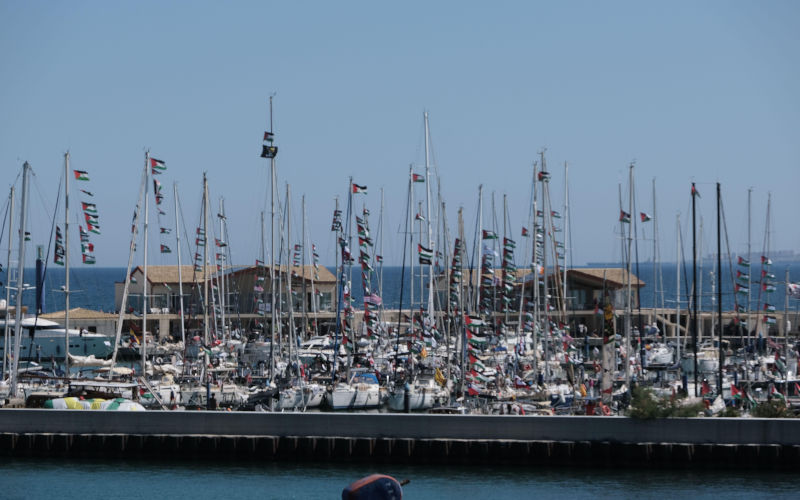
Israeli forces intercepted a civilian flotilla heading to Gaza in international waters. On board were hundreds of activists, including Australians. Reports say forces boarded the vessels, detained some people and cut communication with others. The incident raises urgent questions about what happened at sea and how governments respond.
For several hours, families did not know where their loved ones were. Phones went silent. Messages stopped. People simply disappeared from contact.
At sea, this was not just about stopping boats. It was about power and it was about silence.
Israeli forces intercepted a civilian flotilla heading to Gaza. Naval vessels surrounded the boats carrying humanitarian aid. Communications were disrupted and armed personnel boarded some of the vessels. For hours, contact with several people was lost and information is still incomplete.
This was not one boat. It was an international effort. Doctors, artists, aid workers and activists were among those on board, including Australians. Reports suggest that at least six Australians have been detained, while others from different countries were searched or held after Israeli forces boarded the vessels. There is still no full confirmation of how many people are detained or where they are. [ed. On 1 May, the ABC reported that six Australians detained by the Israeli military had been released on the Greek island of Crete. A Department of Foreign Affairs spokesperson was quoted as saying that consular officials are in Crete to “provide assistance to any Australians transferred there”.]
Some facts are clear. They were civilians. They were unarmed. They were carrying aid.
To understand why this matters, we need to look at Gaza. For years, Israel has restricted the movement of people and goods in and out of Gaza. This has affected access to food, medicine, clean water and healthcare. After a devastating war that left tens of thousands killed or injured, most of them civilians, and with signs of famine, people are still living under extreme pressure.
In this situation, flotillas like this are not symbolic. They are attempts to deliver basic supplies and break isolation. So, the question becomes simple. How does an act like this become a target?
A few weeks ago, Australian filmmaker Juliet Lamont asked a direct question. She asked if she would be punished simply for daring to return. She had been detained before and said she was denied medication and treated badly. Still, she chose to go back. She said what is happening in Gaza made it impossible to walk away. Now, after this interception, her question no longer feels theoretical.
From a legal point of view, some experts argue that intercepting civilian vessels in international waters may violate international law, especially if it blocks humanitarian aid. But the issue does not end at interception. Even when people are detained, international law does not allow inhumane or degrading treatment. Reports of mistreatment or denial of basic rights, such as medical care or communication, cannot be ignored. They go to the core of human dignity.
There is also a broader reality. Israel controls access to Gaza and civilian attempts to challenge that control are met with force. This raises a deeper question about who decides what is allowed in international space. Even humanitarian action does not seem protected. Power decides who moves and who is stopped.
The presence of Australians on board makes this an Australian issue. At home, Australia presents itself as a country that supports free expression and civic action. But when Australians act on those values abroad, the response can be very different. The key question is not only what happened at sea. It is how Australia chooses to respond.
In the past, the government has focused on consular support. But when citizens face detention or possible mistreatment, silence is not neutral. Silence is a choice, and in moments like this it has consequences. When governments say nothing, they are not outside the event. They do not observe power. They help define it.
What happens does not end at sea. The response, or the silence, becomes part of the story. Australian activists are asking for more than consular help. They want access to detainees, transparency about their condition, protection of their rights, pressure for their release, and an independent investigation if there are claims of mistreatment. The message is simple. Protecting citizens should not mean staying silent.
The flotilla may not have reached Gaza and it may not be the last. But what happened points to something deeper. When solidarity is treated as a threat, it is not only people who are being stopped. It is the idea that civilians have a right to act.
When solidarity is met with force and silence follows, the issue is no longer just about boats. It is about what the world is allowed to see and what it is asked to ignore.
Shamikh Badra
Shamikh Badra holds a Masters degree in Peace and Conflict Studies, University of Sydney and is a PhD candidate at the University of Wollongong where he researches Palestinian resistance, diplomacy and settler colonialism. His publications in professional journals cover appraisals of academic theory and activism to advance global solidarity for Palestine. His non-violent work includes a theoretical framework for the Great March of Return and leadership (2015) to foster Palestinian unity.’