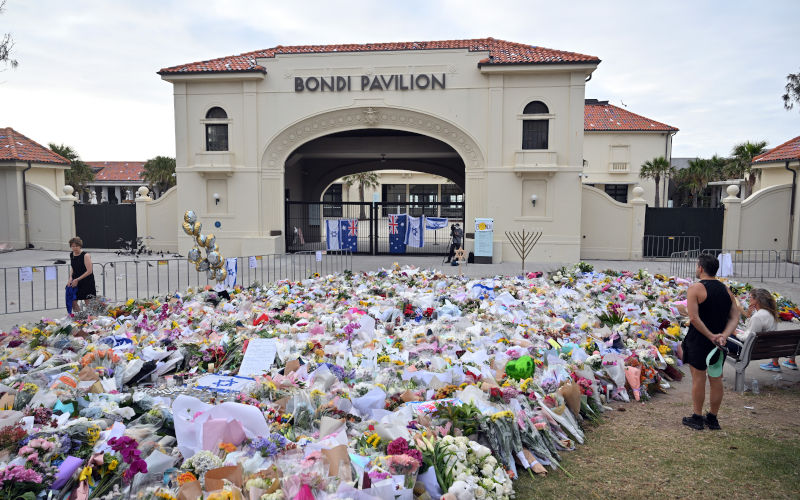
Here’s hoping that the royal commission into the Bondi massacre of last December does not turn into partisan point-scoring, least of all over whether the Albanese government effectively ’caused’ the tragic massacre by reducing its activity against antisemitism in the aftermath of the October 2024 Hamas attack on Israelis.
It’s an argument no one can really win, but which most of those with legitimate things to say before the commission can lose.
Discussion about the Bondi massacre is difficult, partly because some of the players are talking right past each other. Many Jewish Australians have spoken of a sense of siege and of having come to feel unwelcome in Australia over the past few years. There’s no mistake about it, from their point of view.
There has been no substantial change in the number of Australian bigots who want to destroy the Jewish religion, or to kill or disadvantage people because they are Jews. That there are too many such bigots is disgraceful, an anomaly of the much-vaunted western civilisation – and primarily an artefact of Europe and America, rather than Africa, Asia or the Middle East. Frank hostility to Jews and the Jewish religion has existed among a declining number of Europeans over the past 2,000 years. Economic decline in the west, including Australia, gives rise to talk of Jewish conspiracy theories, plus a small segment of alienated youth who chant the words of Nazis, and associated campaigns against immigration and for ‘white rights’.
Horrible as this has been, it has been largely the work of a tiny minority, a rabble much despised by most of the population. Some may have acquired a temporary status by adopting anti-immigration causes as attempted entry points into mainstream politics. But, even where their presence has not been legislated against, they are a long way away from levers of power, or any serious threat to the citizenry. They are their own worst enemies.
But what the Jewish community has complained of as an avalanche of antisemitism has mostly developed in popular hostility to the actions of the state of Israel: not in any outbreak of hostile feeling against the Jewish religion or against individual Jews, particularly in the diaspora. Many, if not all Jews, have a strong emotional attachment to the idea of a homeland for Jews, without having a moment for the ideas or the actions of most Jewish politicians. They do not see Israeli actions as the united action of religious or ethnic Jews so much as the actions of a Jewish state.
But these can seem to be fine points – almost theological distinctions between an Israel-is- never-wrong faction and groups insistent on criticising Israel. They criticise it for its selfish and brutal actions against Palestinians, its bullying of its neighbours, or its use of a seemingly unlimited credit to buy guns and missiles to make war on Iran, on Syria, on Lebanon, Jordan, Qatar and other nations it has attacked in recent times. To the diehard or the naïve, this may be sold as pre-emptive self-defence.
The struggle has been most unequal. Battle casualty rates are almost always entirely in Israel’s favour, with a western media that has, at least until recent times, given Israel the benefit of almost every doubt. Many now see Israel (though not Jewishness) as a serious menace to world peace, one whose international conduct becomes more truculent, more lethal and more threatening every year. Like the US, it scorns international forums and courts and seems to hold most foreign leaders and most world opinion and norms in contempt. With the assistance of the US, it has been able to skate around legal constraints, such as preliminary findings about war crimes. This is because it hides behind America’s skirts, and because America punishes nations brave enough to attempt to implement court orders.
The Israeli prime minister, Benjamin Netanyahu, has been breaking down many of the institutions of the Israeli government, including the courts, systems of accountability and parliamentary control over the military. Netanyahu himself faces serious (and very credible) personal corruption charges. There are some who think he has been prolonging active conflict simply to avoid having to face the court. His government does not deserve the unquestioning support of its population or of diaspora Jews. And the world cannot allow it to take total control of old Palestine by effectively expelling the Palestinians.
Some Jewish Australians who are quite critical of Israel feel nonetheless defensive about it because of what they see as its unique position as a designated homeland for the Jews. Surely, they have the same right to self-determination as other ethnic groups, they suggest. But merely being a defined ethnic group or religion has never been of itself a ticket to nationhood.
The very practice of regarding anti-Jewish sentiment as not belonging to the ordinary subset of religious hatred is a part of the problem. ASIO may choose to regard antisemitism as applying only to hatred of Judaism, and antisemitic laws as not applying to Muslim or Christian semitic groups. And while ASIO can be scrupulous in denying anti-Muslim perceptions, at the very same time it accords a special friendship (and secret intelligence sharing) to Israel. That Israel is family, and even gets an informal veto over many of our immigration decisions, accentuates the sense that police and security services, and premiers, are less than equal and fair in their treatment of Muslims.
The distinction between being hostile to Jews and hostile to Israel may be reasonably well understood. But the commissioner is bound to discover that most formal representatives of national Jewish organisations, particularly those with Zionist in their name, do not accept the distinction in practice and regard any criticism of Israel as being inherently motivated by antisemitism. Likewise, many of the incidents listed as examples, whether collected by Jewish organisations or by ASIO, will conflate the two and will fail to distinguish demonstrations and behaviour motivated primarily by criticism of Israeli policies.
One can expect that the last thing that the commissioner will want to do is to nitpick all the lists, or haggle working definitions in each case cited by a witness. Doing so will in fact handicap her capacity to make useful general recommendations about racial and religious hatred. On the other hand, if she does not challenge some of the working definitions (even of police and security agencies) and cross-examine the way they have applied their definition to the facts, her report will lack authority, particularly among the groups it should be influencing.
In fact, the terms of reference allow the commissioner to focus more on the events than the theology of identification, and on practical ways of improving intelligence gathering, intelligence assessment, security operations and demonstrations. For this we can be grateful that the critical eye, and the practical advice, will be coming from a judge experienced in balancing rights, and in attaching weight to freedom of speech and rights of assembly as much as the prevention of violence, damage to property and the safety of the vulnerable. The past few years have shown that the public cannot trust politicians to strike the right balances, and that some, at both the state and federal level of politics, have become illiberal and authoritarian. Anthony Albanese may have exercised wisdom he has not always shown in judging the mood of the people when he asked Virginia Bell to be his commissioner. She has already ascertained that whatever the system’s problems, they do not come down to needing more powers, let alone more intrusive ones, or more resources.
Many of Israel’s policies are strongly criticised by Israelis, or by people within the Jewish diaspora. But the strong criticism of Israel has often seemed to many Australian Jews as being as much directed at all Jews, or Australian Jews, as it is at Israel itself, or its population. There has been a large increase in incidents – demonstrations against Israel or in support of some of Israel’s enemies, attacks on Jewish leaders in Australia, particularly those who have loudly supported Israel’s actions, and acts of damage or sacrilege at Jewish synagogues, schools and places, such as Bondi Beach at Hanukkah, where Jews have assembled for ceremonies or celebrations.
Jewish organisations had been recording the events and warning of the risk that they might eventually lead to a serious terrorist incident. Police and security agencies were echoing the warnings, if, perhaps doing too little to physically prepare for an actual case. They were certainly caught short at Hanukkah.
Many of the critics of Israel have used Zionism as a form of shorthand for the actions of the Jewish state as opposed to the religion of Judaism or those who practise it. Zionism was a Jewish political movement started in the 19th century, agitating for the creation of a Jewish homeland. Although there were discussions with various imperialist countries about other places, including Uganda in Africa and the Kimberley in Australia (both regarded as virtually uninhabited lands able to be recreated as a colony), the movement came to focus on Palestine, a province of Turkey as the First World War began. Although the British and the French had promised Arabs sovereignty over the old Arab nations if they revolted against the Ottoman Empire, they also negotiated with Zionist groups, whose political support for the war effort was needed at home. The Zionist campaign regarded the land of Palestine as essentially uninhabited, or at least capable of being cleared of its population. But the allies, in promising a Jewish homeland, insisted the new colonisers would have to make peace with the inhabitants and respect their rights.
Zionists never embraced such a condition and devoted themselves instead to driving Palestinians out, mostly by frank terrorism. Their slogan for their campaign was ‘a land without people for a people without land’. The bitterness of many Palestinians against Israeli settlers is one of the many consequences of displacement and the refusal of Israel to allow any Palestinians who fled Israel during the first Israeli war of 1948 to ever return, and the very unequal and oppressive conditions under which those who stayed live. There have been occasional revolts, rocket attacks and guerrilla campaigns against Israeli occupation – some would see the brutal October massacre as a particularly bloody example of this rather than a new development. But over generations of resistance, it has been the Palestinians who have suffered the most casualties and steadily lost their lands. It can be expected that during the commission, evidence will be given of the dehumanising words and propaganda regularly used to describe Palestinians in the Israeli media, including by government ministers.
Conflict over the lands of Palestine is of such long standing and bitterness that some of the combatants will argue that where one chooses to begin the tale can itself show a bias or predisposition towards one side or the other.
Virginia Bell is not sitting to determine which of several semitic peoples are in the right or the wrong in the Palestinian conflict. Nor is she considering the justice of the events of October 2023, when Hamas warriors escaped from Gaza and massacred more than 1,000 Israelis, or the strong Israeli retaliation against Hamas in centres of high population in Gaza. That resulted in considerable criticism of Israel for the disproportion of its response – possibly more than 50 Palestinian deaths for every Israeli citizen killed in the Hamas attack. It also led to accusations of Israeli genocide and war crimes, of starving the population, as well as devastating most of the dwellings and public facilities of Gaza.
Bell’s job is to consider how an incident as terrible as Bondi occurred, in spite of forecasts, and how too little was done to forestall it. NSW Police, for example, reminded of the threat responded by sending a carload of police to Bondi, with the occupants told to make a show, but not necessarily to stay on the scene for long. The relaxation of the NSW Police Commissioner, Mal Lanyon, was hardly in keeping with the bluntness and the urgency of the warnings coming from ASIO and the Jewish community or with the open anxiety of the premier who had been entirely supportive of the community, and of Israel, from the time of the October 2024 attack. In a state that rewarded performance (and ability) rather than loyalty, the commissioner would be out on his ear.
Republished from The Canberra Times, 2 May 2026

John Waterford AM, better known as Jack Waterford, is an Australian journalist and commentator.