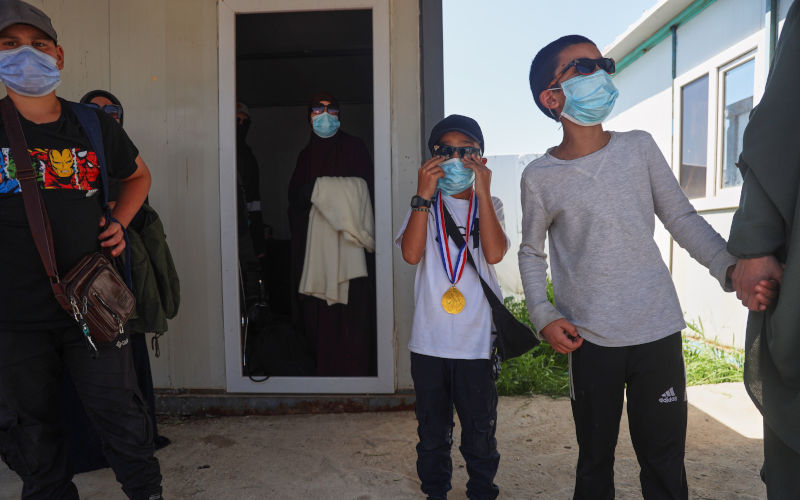
The return of four Australian women and nine children from Syria after the conflict with Islamic State is no cause for alarm and should not be politicised. Now is the time for their rehabilitation and reintegration into the community.
Australia has some of the toughest counter-terrorism laws in the democratic world. These can effectively neutralise threats and hold anyone accountable for past atrocities. So there will be no surprises: law enforcement and security agencies will be crawling all over the women returning from Syria. The authorities have had years to investigate and to prepare for their return.
For years, the United States, Syria, security professionals and human rights experts have all urged Australia to bring their nationals home. Unlike Syria, Australia is peaceful, has a strong legal system, a professional and well-resourced national security sector, and comprehensive social services. Even the ASIO director-general has stated he is not concerned by their return but will keep a watchful eye on them.
Australian law contains many terrorism offences that could apply to Islamic State crimes in Syria. In relation to terrorist organisations, these include offences of membership, associating with members, providing support, training, recruiting, funding and directing the group’s activities. In addition, it was an offence merely to enter areas such as Raqqa and Mosul, previously declared off-limits by Australia’s foreign affairs minister. International crimes also apply, including war crimes, crimes against humanity and genocide.
Australian courts take terrorism offences extremely seriously and impose some of harshest terms of imprisonment in the democratic world.
If a person did not commit a crime but poses a future terrorist risk, Australia’s ‘control orders’ allow a federal court to impose heavy restrictions on living in the community to prevent the risk. These include curfews at a particular address, bans on entering certain areas and on overseas travel, limits on contacting specific people, restrictions on communications and the internet, regular reporting to authorities, bans on certain activities and items, wearing electronic tags, and participation in counselling or education.
The government has already issued a ‘temporary exclusion order’ to prevent one Australian returning home from Syria, which can be applied to prevent a risk of terrorism. The fact that the group about to return has not been excluded may suggest they are not considered to be threats.
Then there are criminal offences for ‘advocating’ terrorism in Australia, if any of the returnees attempted to radicalise others here.
On top of all of this, the women may be subject to physical and digital surveillance by police and security agencies. ASIO also has special powers to question them.
Every Australian deserves a second chance, even those who made terrible life choices and have learnt an incredibly brutal lesson under Islamic State. The police have rightly indicated that the returnees will undergo community integration, therapeutic support and programs to counter violent extremism, to enable them to rebuild their shattered lives.
There is little evidence that previous Australians who returned from Syria under Coalition and Labor governments have subsequently engaged in terrorism. This is also the experience in many other countries that have rehabilitated and reintegrated their citizens.
The children are themselves victims of terrorism, and in some cases of parental abuse. Child protection services and schools must be closely involved in helping them to resettle.
In my United Nations work, I have encountered victims of terrorism, international crimes and grave human rights violations in many places, from Somalia to the Middle East. But I have been profoundly shocked by the callous indifference of politicians on both sides to the plight of innocent Australian child victims of child abuse. Politicians have done everything possible to exile them from their own country, and to leave them indefinitely detained in insurgent prisons under violent, cruel, inhuman and degrading conditions.
To be clear, this has also perpetuated the terrorist risk to the world. It has exposed people to risks of radicalisation among hard-core Islamic State detainees. Prison breaks over the years have seen thousands of potential risks disappear into the wind.
As an Australian whose ancestors have been in this country since its earliest convict days, I am also profoundly ashamed of our political class and its betrayal of our most basic national and human values – decency and compassion, child safety, and real, not affected, public safety.
Republished from The Sydney Morning Herald, 7 May 2026

Ben Saul is UN special rapporteur on the promotion and protection of human rights and fundamental freedoms while countering terrorism.