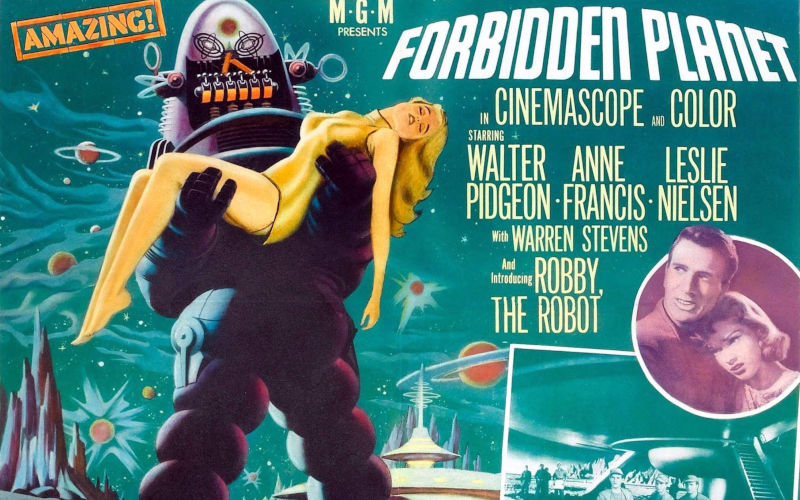
A 70-year-old science fiction film offers a stark warning for today’s AI race, showing how powerful technology can amplify humanity’s most destructive impulses.
This year marks the 70th anniversary of MGM’s release of Forbidden Planet, a film that would become a classic of the sci-fi genre. Shot in CinemaScope and Eastmancolor, it was groundbreaking with its advanced special effects, electronic music score and its setting entirely on a far-away planet. It also had a challenging theme that, in the age of AI, has new – and chilling – relevance.
In the film, the United Planets starship C-57D arrives on the planet Altair IV to investigate the fate of an expedition sent there 20 years earlier. The crew discover that all members of the expedition are dead, except for two – a father, Morbius, and his daughter, Altaira.
As Morbius explains to the ship’s crew, the planet had previously been inhabited by a highly advanced civilisation called the Krell. Beneath the surface of their planet, the Krell had built the ‘ultimate machine’. A kind of mother of all data centres, it was massive, powered by thousands of thermonuclear reactors and capable of maintaining and repairing itself over the 200,000 years since the entire Krell population mysteriously and suddenly disappeared.
The machine had made the Krell super-intelligent, with the technology providing every individual with God-like powers. Morbius, himself, experimented with the Krell technology, but it proved too much for a human being and nearly killed him. Nevertheless, he found that it had doubled his intellectual capacity. It also had another, much darker, effect of which he was unaware. At least, at first.
When Altaira becomes attracted to the ship’s captain, strange things begin to happen. A mysterious invisible force kills a member of the ship’s crew and destroys its communication equipment. Later, when the force returns to kill four more members of the crew, it is revealed as a terrifying monster – that only appears when Morbius is sleeping.
In a rather Freudian twist, it becomes clear that the monster is a creation of Morbius’ jealous and possessive subconscious mind. He has fallen victim to the same fate that met the Krell. Their highly-advanced technology had empowered not just their conscious desires, but their darker and uncontrollable subconscious ones. Given full rein, those primitive impulses led to the total extinction of the Krell. Only the machine survived.
When Altaira declares her intention to return to Earth with the captain, the monster returns, more terrifying than ever, and she, the captain and Morbius retreat to a fortified inner sanctum. It’s no match for the monster, fuelled by the boundless power of the machine. As it melts through 26 inches of steel, Morbius is finally forced to admit that he is the monster. It’s a creation of his subconscious mind. In a last desperate gesture, he confronts it head on. The monster disappears but Morbius lies dying. Before passing away, he instructs the captain to trigger a switch that will cause all the machine’s thermonuclear reactors to go critical at once, destroying the entire planet, and with it, the cursed machine.
As the starship rockets deep into interstellar space, Altaira and the ship’s crew look back to see Altair IV erupt in a blinding flash and disintegrate into the void.
This is how Forbidden Planet intersects with AI and something called ‘The Fermi Paradox’. In 1950, Enrico Fermi, one of the developers of the atomic bomb, posed the question: ‘Where is everybody?’ What he meant was, with the vast number of likely habitable planets in the galaxy, why was there absolutely no detectable evidence of alien civilisations? One hypothesis was that, long before they master interstellar travel or communication, civilisations reach such a level of technological sophistication that they have the capacity to destroy themselves – and they inevitably do. At that point, like the Krell, they become a light that goes out in the universe.
Of course, what drove Fermi and his colleagues to propose this hypothesis was that, with the invention of nuclear weapons, they realised that they had created just such a technology. All-out nuclear war could easily lead to the extinction of all large animals – including us – and most plants, leaving behind a dark, cold and toxic planet, inhabited by little more than insects and grasses.
But now there is another advanced technology that is more directly akin to the Krell’s nemesis – AI. With the headlong rush to develop artificial general intelligence, with few restraints and insufficient thought given to the dangers, the Earth is suddenly beginning to look a lot like Altair IV in the last days of the Krell.
Although AI may offer miraculous benefits to mankind, as on Altair IV, super intelligence could prove to be super dangerous. Whether by intention or by accident, it can become a vehicle for the most primitive impulses of our nature – greed, jealousy, fear and aggression (already fully evident in the rivalry between AI entrepreneurs). Such dark impulses, given agency through the power of AI, could result in the creation of novel pathogens or deadly chemical weapons, the unleashing of crippling cyberattacks or nuclear war – or threats that we haven’t yet even imagined. And without sufficient guardrails, like the Krell, we could end up being another light that goes out in the universe, leaving behind only the self-sustaining machine.
Despite having been made 70 years ago, Forbidden Planet is very much a cautionary tale for our times. And while we can’t turn back the clock, it may be prudent to start giving serious consideration to Morbius’ warning to the crew of starship C-57D: ‘Humanity is not yet ready to receive such limitless power’.

Jeff Peck
Jeff Peck is a writer, filmmaker and former lecturer in film history at La Trobe University and Programme Manager at the Australian Children’s Television Foundation. He holds a Ph.D. in Communication Arts from the University of Wisconsin, Madison.