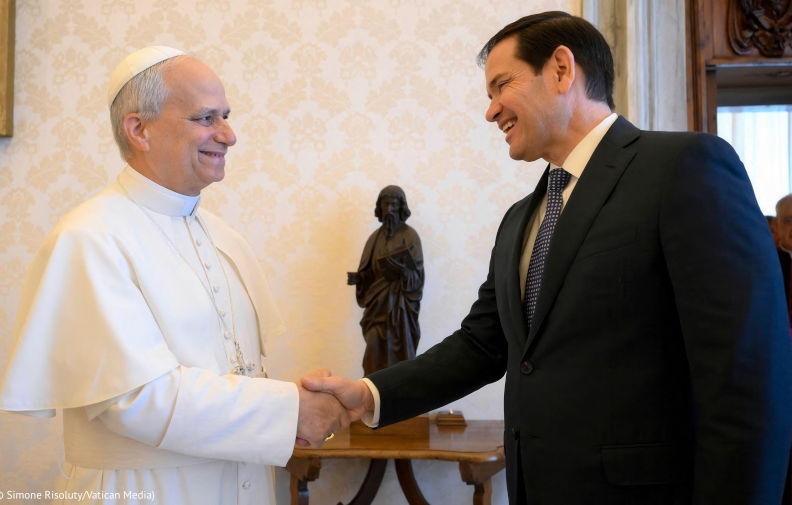
US Secretary of State Marco Rubio’s Rome visit exposes the contrast between White House fury and papal diplomacy.
US Secretary of State Marco Rubio went to Rome on 7 May. He met the Pope. He met Cardinal Pietro Parolin, the Vatican Secretary of State. And he met Archbishop Paul Gallagher, the Vatican’s foreign minister.
The Vatican communiqué described the meetings as “cordial talks.” Cordial. Not tense, not candid, not difficult. Cordial. A word chosen with diplomatic precision.
That is the heart of the matter. President Donald Trump, on the eve of Rubio’s visit, accused Leo XIV of wanting Iran to obtain nuclear weapons – a crude falsehood, given that the Holy See opposes the possession of nuclear arms. Yet the following day, his secretary of state sat across from the pontiff.
And the meeting concluded with a statement reaffirming the “need to work tirelessly for peace.” Which is precisely the language the president has been attacking.
Trump raises his voice; the Vatican lowers the temperature. And in the restraint of that communiqué, a kind of rhetorical defeat for the White House quietly takes shape. Because accepting that language means acknowledging that the grammar of peace is not a form of weakness. It is terrain on which even Washington, eventually, must agree to walk.
Leo XIV had already said as much with unusual clarity: “If someone wishes to criticise me because I proclaim the Gospel, let him do so with the truth.” Truth. Not opinion, not narrative, not spin. A word that, in the present climate, has come to sound almost exotic.
Rubio himself acknowledged that the visit had been “scheduled before” Trump’s attacks. “Obviously, things happened in the meantime,” he said. It was a perfect sentence in its helplessness: it said everything while explaining nothing. The syntax of a statesman trying to hold together a president who smashes through walls and a diplomacy tasked with rebuilding them.
The Vatican did not move an inch. As Parolin had put it, the Pope does what popes do. Always. And Leo XIV did exactly that. He received Rubio, spoke with him, and listened to him. Then, in the final communiqué, he used his own vocabulary – the vocabulary of peace – which the American side ultimately echoed. Peace, countries at war, humanitarian crises: everything Trump would prefer erased from the international lexicon, the Pope compelled his interlocutors to reaffirm.
It was a lesson in power without force. The Holy See has no armies, no sanctions, no drones. It has words. And today, those words carry weight.
Leo XIV finds his voice in a fractured world
One year after the election of Pope Leo XIV, his pontificate appears to have moved beyond its waiting period. That was never guaranteed. Prevost ascended to the Chair of Peter at a moment that allowed no apprenticeship: open wars, international diplomacy in crisis, hollowed-out multilateral institutions, and geopolitical tensions growing ever more radical.
From Ukraine to the Middle East, from mounting pressure across Asia to instability in Africa, the new pope entered a global landscape increasingly governed by the logic of force.
And yet the first defining characteristic of Leo XIV has been precisely his refusal of immediate reaction. During his first months, he spoke little. Many interpreted that silence as excessive caution or hesitation. In reality, it was something else entirely: listening. Prevost took time to find his own voice.
At the centre of his pontificate seems to lie a specific conviction: holding together what is coming apart. A polarised Church, a world that has stopped speaking to itself, an international order that replaces dialogue with permanent pressure.
Leo XIV speaks insistently about unity, though not as uniformity. Rather, as the capacity to live within differences without turning them into ideological or cultural warfare. It is a deeply Augustinian vision: unity as a living tension, not as flattening conformity.
Against this backdrop, his distinctive understanding of diplomacy also becomes clearer. Leo XIV never separates prophecy from mediation. On the one hand, he has spoken with unmistakable clarity against war, against the sacralisation of power, against the political use of religion, much as Pope Francis did before him. On the other hand, he has kept channels open with everyone, even the most hostile interlocutors. His position is clear: peace does not emerge from humiliating one’s adversary, but from remaining inside contradictions without abandoning dialogue.
It is here that his relationship with Donald Trump has become emblematic. In recent months, the American president’s attacks on the pope have been extraordinarily harsh: paradoxical accusations, aggressive rhetoric, repeated attempts to cast Leo XIV as a political adversary.
Yet the Pope has carefully refused to enter that dramaturgy. He has not answered on the terrain of personal conflict. Instead, he has continued speaking about war, human dignity, international law, and a peace that is both “disarmed and disarming.” And it is precisely this choice that seems to have strengthened his moral authority.
Observers have also been struck by the firmness that has gradually emerged in his public character. Prevost is not a man unfamiliar with fear. During the 1980s and 1990s, he lived in Peru through the bloodiest years of the Shining Path insurgency.
He was offered armed protection and refused it. He remained alongside communities most exposed to violence. Today, that same experience seems to reappear in the way he exercises the Petrine ministry: restrained, never theatrical, yet inwardly resolute.
Over the course of this first year, a broader perception has also taken hold. In a world largely devoid of genuine global moral leaders, the pope’s voice remains one of the very few that can still speak beyond political camps and ideological blocs. Not because of material or economic power, but because of symbolic and spiritual authority. Leo XIV inherited that role and has chosen to exercise it without turning it into a spectacle.
Now the pontificate enters its most delicate phase. The voice has been found. The posture as well. What begins now is the longer test: sustaining the weight of a ministry called to speak of peace in a world that increasingly seems accustomed to war.
Republished from ucasnews
Antonio Spadaro
Antonio Spadaro, SJ, is undersecretary of the Dicastery for Culture and Education of the Holy See. He is a member of the board of directors of Georgetown University and an Ordinary academic of the Pontifical Academy of Fine Arts and Letters of the Virtuosi al Pantheon. He was editor in chief of La Civiltà Cattolica for 12 years.