
The Farrer by-election revealed a deep political realignment, with One Nation consolidating support in regional Australia while multicultural and younger voters continue to move sharply against it.
On 9 May 2026, a One Nation candidate won a seat in the House of Representatives for the first time in the party’s 30-year history via a by-election. David Farley’s victory in Farrer was not a defection from another party. It was a direct election. In a rural seat that has sat with the Liberal or National parties for more than eight decades, the two Coalition partners combined for around twenty per cent of the primary vote. The seat once held by the immediate-past opposition leader, Sussan Ley, deposed by Angus Taylor three months earlier, fell to the party most Liberals had spent the previous few months, pretending could be managed, contained, or out-flanked by changing the rider on what is clearly a lame horse.
For anyone willing to read the data correctly, it tells us two things at once. One Nation now has a viable path to becoming the dominant party of regional Australia. And the structural collapse it represents will not, cannot, extend into the seats where most (not all) Labor’s vote sits today. The first half of that sentence is keeping Liberal MPs awake at night. The second half is the half some commentators are trying very hard to misunderstand.
Start with what Farrer actually demonstrates. A seat that delivered the Coalition a 56 per cent two-party-preferred margin in 2025 returned a Coalition primary of 20 in a four-way contest twelve months later.
The bleed is not ideological. It is institutional. The voters who used to send Liberal and National members to Canberra out of habit no longer regard the Coalition as their natural home. The bloc that authoritarian-trait political psychology predicts will go searching for an angrier, more culturally combative vehicle has now found one and it sits inside the federal parliament.
Map that pattern across the rest of regional Australia and the implications are stark. In New South Wales, Page, Cowper, Lyne, Parkes and Riverina sit in the firing line. In Queensland, One Nation’s home state, Hinkler, Wide Bay, Flynn, Dawson, Capricornia, Maranoa and Wright are all vulnerable. In Victoria, Mallee, Nicholls and Gippsland are not safe. In Western Australia, Durack and O’Connor sit on demographic profiles indistinguishable from Farrer’s.
And then there is Hume. Angus Taylor’s seat. The opposition leader sits on a 58 per cent two-party-preferred margin against Labor. Against Labor. That number was built in a world where the Coalition’s rural and outer-suburban base voted out of inheritance. It does not survive contact with a One Nation candidate running on cost-of-living grievance, and on cultural resentment across the Camden growth corridor.
Strip the assumption that Coalition voters stay Coalition voters and a swathe of these seats are competitive for One Nation right now. Add a further twelve months of cost-of-living pressure, energy policy fights and the visible disintegration of the Liberal-National partnership, and “competitive” turns into “locked in like a missile.”
This is where the analysis from a certain class of commentator collapses under its own weight. The argument runs: if One Nation can take regional Liberal seats on a wave of cultural and economic grievance, surely the same wave can roll into outer-suburban Labor seats? Same financial stress. Same hostility to elites. Same anti-incumbent mood. Therefore Werriwa is in play. Therefore Watson. Therefore Calwell, Lalor, Gorton, Hawke, Bruce.
This is what happens when you read a primary vote without reading a person.
The voters who anchor those Labor seats are not the voters One Nation knows how to talk to. They are not in the bloc that responds to Pauline Hanson’s pitch. They are, in many cases, the people her pitch is explicitly designed to alienate. The demographic wall is real, it is measurable, and it is composed of three overlapping groups: people born overseas, people who speak a language other than English at home, and almost anyone under forty-seven.
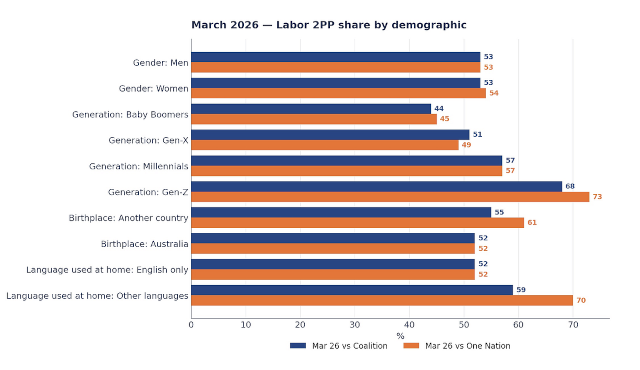
The RedBridge–Accent Research federal tracking poll (n=5000) from March quantifies exactly how steep that wall is. The relevant test is not how Labor performs in a two-party contest against the Coalition. However, it is all about the difference between Labor’s two-party share against the Coalition and Labor’s two-party share against One Nation. That gap is the wall and significant.
For voters born in Australia and voters who speak only English at home, the gap is zero. Labor sits at 52 per cent against both opponents. The wall, for that cohort, does not exist. That is the cohort One Nation has been recruiting from, and it is the cohort the Coalition has been losing.
For voters born overseas, Labor’s two-party share climbs from 55 against the Coalition to 61 against One Nation. Six points of additional resistance, even though this group does contain many from England, New Zealand and South Africa. For voters who speak a language other than English at home, the shift is from 59 to 70. Eleven points. Eleven. That is a categorical refusal.
Generationally, the picture is sharper still. Among Gen Z voters, Labor leads the Coalition 68 to 32. Against One Nation, that figure climbs to 73. Among Baby Boomers, by contrast, Labor’s vote against One Nation is essentially identical to its vote against the Coalition. The wall is generational. It is also getting taller every year the voter roll turns over.
Forget the abstract categories for a moment. The wall is made of people.
It is the 26-year-old nursing graduate in Cabramatta, in the seat of Fowler, whose parents arrived on a leaky boat from Vietnam in the early 1980s. She votes Labor because her family’s entire experience of Australia is the experience of being told, by figures who sound exactly like Pauline Hanson, that they did not belong. She does not need a focus group to teach her what One Nation is. She watched her parents live through it.
It is the Lebanese-Australian electrical apprentice in Greenacre, in the seat of Watson, whose first jobs took him through suburbs his grandfather laid bricks in. He has cost-of-living grievances. He has views on housing, on wages, on the price of running a ute. He is exactly the kind of voter the right-wing populist playbook says should be drifting away from Labor. He is not drifting anywhere near One Nation, because One Nation’s project is, in part, the cultural erasure of his family.
It is the Indian-Australian software engineer in North Parramatta, whose parents put themselves through Master’s degrees in their forties to make her a permanent resident. She is university-educated, she is open-experience-coded in every psychological dimension that matters, and her ballot is locked.
It is the Iraqi-Australian mother in Meadow Heights, in the seat of Calwell, who arrived in 2008 with a son she carried out of Baghdad. I grew up half a kilometre from where she now lives. The political psychology of that suburb is unrecognisable from the political psychology of the towns One Nation just swept through. They share a postcode in the national imagination and almost nothing else.
It is the Filipino-Australian retail worker in Werribee, in Lalor. The Punjabi-Australian truck driver in Truganina. The Hazara-Australian small business owner in Dandenong, in Bruce.
These voters live in seats that, on a map, look like the natural territory of an economic-populist insurgency. They are nothing of the kind. They are the front line of the cultural settlement One Nation exists to overturn, and they know it.
The psychological frame we at RedBridge have been using for several years now sits underneath all of this. Australian voters are sorting not on left-right economic axes but on openness-versus-authoritarian trait dimensions, and the sort is accelerating. Right-wing cultural populism, the One Nation product, mobilises the authoritarian end of that distribution. It is effective in cohorts where authoritarian traits are over-represented: older voters, voters with low formal education, voters in racially and culturally homogeneous areas, voters whose lived experience does not include being on the receiving end of the politics of race.
The same product is a contaminant in cohorts where openness traits dominate. Among migrants, among the children of migrants, among the university-educated, among Gen Z, the higher One Nation rises, the harder the bloc consolidates against it. This is not a mood. It is the central mechanism. Every gain One Nation makes in regional Anglo Australia tightens Labor’s grip on multicultural and younger Australia. The trade is structurally fixed.
This is why the RedBridge–Accent data shows 11-point swings in Labor’s favour the moment One Nation replaces the Coalition as the opponent in voters’ minds. The wall is not built by Labor strategists. It is built by One Nation itself, every time Hanson opens her mouth.
It is also why the superficial argument, that financial stress and incumbent fatigue must, mechanically, push working-class voters in any seat toward the loudest populist on offer, fails as soon as you disaggregate the cohort. Financial stress in Cabramatta does not produce the same political behaviour as financial stress in Bundaberg. The economic grievance is comparable. The cultural meaning of the parties offering to channel it is not. The bloc separates voters who share a payslip and a postcode but who live on different sides of a fault line One Nation cannot cross.
What this means for the Liberal Party
The Coalition is not in a slump. It is in a structural decomposition. After the next federal election, on current trajectories, the Liberal Party will sit in the parliament as a minor party, outpolled on the primary vote by One Nation in significant parts of the country, eclipsed in the major capital cities by a combination of Labor, Greens and Teal independents, and squeezed in regional Australia by exactly the kind of insurgency that just took Farrer.
This will not be contained to Canberra. The South Australian result has already shown what happens when the bottom falls out of the Liberal brand at the state level: Labor displacement deepens, One Nation moves into second place, and the Liberals are reduced to a residue. New South Wales, Victoria, Queensland and Western Australia are all on the same trajectory at different speeds. The party that has been the dominant centre-right vehicle in Australian politics since the 1940s is being disassembled in real time, from both flanks at once, and there is no plausible reassembly model on its current leadership’s whiteboard.
The map, honestly read
For commentators looking at Farrer and projecting wave-like uniformity across the country: read the data and its people. The wave breaks where the wall begins. Regional Anglo Australia is realigning toward One Nation. Multicultural, younger, urban Australia is consolidating against it. The two movements are not in tension with each other. They are the same movement, viewed from opposite sides of the same demographic divide.
The Liberal Party has spent the last two years trying to find a strategic answer that addresses both flanks simultaneously. There is no such answer. The bloc politics will not permit it. Which is why, on current trajectories, the answer the electorate is going to deliver is the one nobody in the party has been willing to say out loud: relegation.
Farrer was not the beginning of a uniform national wave. It was the beginning of two diverging ones and the wall between them is the most important line on the Australian political map.
Republished from RedBridge Intel

Kos Samaras
Kos Samaras is a director at RedBridge Group, a research and strategy firm specialising in public opinion, social trends, and behavioural insights. He works across industry, government, and media to help organisations understand community attitudes and navigate complex social and political environments.