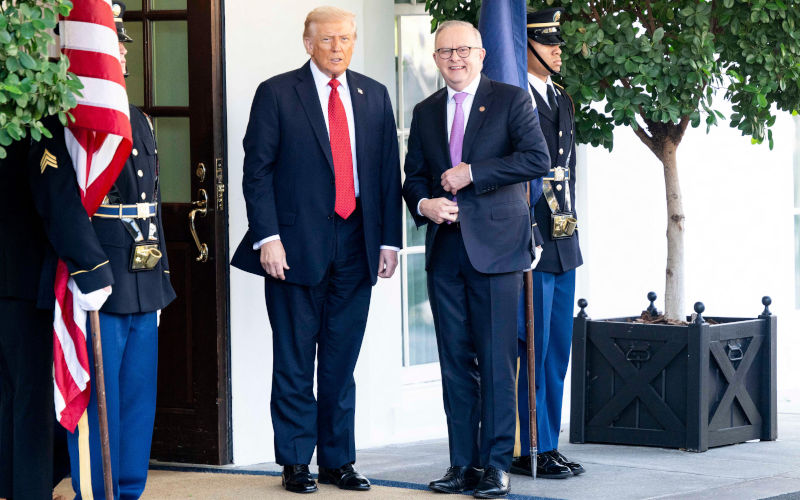
Both Labor and the Coalition are deepening Australia’s alignment with the United States, even as doubts grow about AUKUS, the rules-based order and the risks of being drawn into a US-China conflict.
Australia, at least in American and Chinese minds, is a small outpost of the US empire. The Trump administration has, in its own way, put that on record.
As Donald Trump prepares to meet Xi Jinping this coming week, significant nuances in the foreign defence policies of the government and the opposition are emerging. They are prompted by the Trump whirlwind and the continuing growth of the military and economic power Xi wields.
The most surprising and significant policy commitment is the government’s.
It might fairly be said that the Albanese government has fundamentally embraced the defence and foreign policies of Scott Morrison and his Coalition predecessors. While some of the Coalition’s most influential shadow ministers are pinpointing the changes that Trump and Xi have delivered and are trying to think seriously about the changes to US alliance practices that Trump I and II and Joe Biden have brought.
The government must surely be seen in Beijing and Washington now as a firm and unwavering US ally, after some early and important work to restore the trade relationship with China. And the US bases in Australia are a reliable part of the US network that surrounds and seeks to contain China.
The best recent outline of Labor’s defence policies came from Richard Marles, and they were historically the most orthodox. Marles still stands by the rules-based order and the US alliance.
This, and Prime Minister Albanese’s wholehearted embrace of an enhanced strategic relationship with Japan last week, surely represent a confirmation that Labor has signed up totally to the United States and its regional policy in the teeth of the Trump whirlwind. Any hope that Labor would adjust or modify its approach to the US alliance must now be considered forlorn.
Even as acceptance grows that AUKUS is cannibalising the defence budget, a point which even the most apostolic AUKUS advocates now acknowledge, the respective ministers in cabinet and their advisers believe the problem only needs to be managed, not addressed.
Freed from the constraints of decision-making and awarding defence contracts, Coalition shadow ministers are challenging some of the assumptions that Marles treats as holy writ.
Thus, opposition spokesman on industry and sovereign capability Andrew Hastie conceded in his ANZAC Day oration that the effort to make Australian real estate more valuable for Washington had resulted in “the loss of sovereign capability [and] increased dependency on the United States” which has “cost us … our strategic freedom of action in ways that we are now discovering”.
Hastie is at least recognising there is a problem with current policy settings. He wants a stronger Australian industrial base so that “ANZUS looks more balanced”.
Days after Hastie’s speech, opposition defence spokesman senator James Paterson said Labor was not “being honest with the Australian people about the threat” from China and that, in fact, people “are being lulled into a false sense of security”. But he later said that the primary security threat was “not an invasion of our homeland” but rather “coercion leveraging our supply chain vulnerabilities”.
Yet, Paterson’s speech, while denouncing the Albanese policy of “stabilising” relations with Beijing, also acknowledged that the rules-based order was on life support, and that Australia could not just “cling to the alliance as our only, or even primary, security strategy”.
He also stressed that the government is “trying to deliver future AUKUS capability on a pre-AUKUS defence budget”.
The problem, however, is possibly greater than either the government or the opposition is prepared to admit.
Namely, that Australia, at least in American and Chinese minds, is a small outpost of the US empire. At least the Trump administration has, in its own way, put that on record. Forget the old euphemisms; allies are simply being told what to do. As US Secretary of Defence Pete Hegseth said in recent testimony to the House armed services committee, allies “must step up”.
Washington hands bouquets to those who do, like South Korea; brickbats to those who don’t, like Germany.
And yet, there are now precedents for close US allies, even during a time of military conflict, to withdraw permission for US access to jointly operated military bases and airspace.
While Britain initially equivocated, then acquiesced to the US using its base on Diego Garcia, Spain point-blank denied the US use of two of its critical bases for Iran-related missions.
Saudi Arabia and Kuwait likewise appear to have placed restrictions on Washington’s use of joint facilities critical to Trump’s ‘Project Freedom’ mission in the Strait of Hormuz. Though both have subsequently lifted the restrictions, the damage is done. The decisions have revealed a lack of faith in US protection and a fear of escalation.
The point is that Australia could, if it so chose, do the same. But is Australia even considering this might be an option in the future?
Those bureaucrats who are inclined to counsel an alternative policy can see that, try as one might, this government is incapable of pulling off a more imaginative and skilful, if demanding, policy that thinks long-term about the post-Trump world that awaits.
Instead, it follows the old policy rails, a pattern that history and tradition too easily dictate.
The approach, it has to be said, is not without some advantages. It might allegedly deter a Chinese military adventure. The problem is whether it encourages an American one. But it can be safely assumed that both Beijing and Washington believe Australia is committed to the US if a conflict between the two superpowers were to eventuate. So far, Canberra is doing next to nothing to disavow either capital of that assumption.
Republished from AFR

James Curran is Professor of Modern History and senior fellow at Sydney University’s US Studies Centre. He is writing a book on Australia’s China debate for New South Press.
James Curran is the AFR’s International Editor and Professor of Modern History at the Sydney University.