Pauline Hanson is wrong. Lakemba’s residents are welcoming, hard working and kind.
Every year as Ramadan approaches, the southwest Sydney suburb of Lakemba seems to attract unfair criticism from the community at large. In 2026 (and not for the first time), Senator Pauline Hanson was the ringleader, with one of her familiar eruptions of vitriol and ill-informed attacks on Muslim Australians and, specifically, on Lakemba.
It all began on the evening of Monday 16 February, when the divisive One Nation Leader told Sky News host Sharri Markson that there are “no good Muslims” – comments made just days before the start of the Islamic holy month.
In a follow-up interview Hanson named Lakemba directly, claiming the suburb made visitors “feel unwanted”. Her remarks were so inflammatory that even usually right-wing media voices such as Markson herself, Ray Hadley and Mark Levy publicly distanced themselves.
Having worked full-time for the Lebanese Muslim Association in Lakemba for much of the past four years – regularly visiting the shopping centre and being part of community life, including attending the Ramadan night markets, manning LMA’s Dawah stand – I feel compelled to speak out.
Not necessarily to defend Muslims per se…after all, what’s to defend? But to defend Lakemba as a suburb: its residents, its shopkeepers, its restaurant and takeaway owners, its families and everything else it represents.
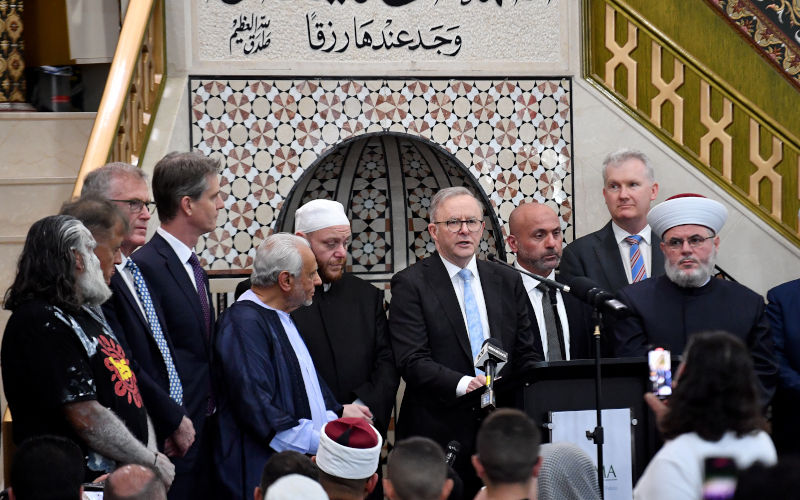
Lakemba is best known for the iconic Ali Bin Abi Talib Mosque – a majestic place of worship that, since its opening in 1977, has drawn more than 150,000 worshippers annually during Ramadan and Eid alone. The night markets, while not everyone’s cup of tea, provide a wonderful boost to the local economy each and every Ramadan.
To reduce Lakemba to tired stereotypes is both lazy and dishonest.
Two recurring myths require clarification. First, Lakemba is frequently described as a predominantly Lebanese suburb. While Lebanese Australians and the Lebanese Muslim Association played a major role in the establishment and early growth of Lakemba Mosque and local community life, the suburb’s demographics have shifted significantly over time. According to Australian Bureau of Statistics Census data, Lakemba is now one of Sydney’s most culturally diverse suburbs, with a large proportion of residents born in South Asian countries, particularly Bangladesh, Pakistan, India and Nepal, alongside Lebanese and other communities. It is inaccurate to frame Lakemba as belonging to any single ethnic group.
Second, Lakemba is sometimes labelled online as a ‘suburb of dangerous drivers’, a claim based on anecdote rather than evidence. There is no transport or road safety data identifying Lakemba as an outlier for crashes or dangerous driving compared with other suburbs. Furthermore, lower-than-average household vehicle ownership in the area – consistent with higher public transport use and a significant number of households without cars – further undermines broad claims about poor driving behaviour being a defining feature of the suburb.
Among the most egregious pieces of misinformation to follow Hanson’s comments was the viral claim that Lakemba has around 1,300 NDIS providers – roughly one for every 13 residents! One YouTube video alone posted in early March attracted more than 219,000 views within its first four days. Other social media followed with fury, with some versions of the claim inflating the number even further to 1,500!
With a suburb population of around 17,000 at the last census, those figures simply never passed the pub test. Ironically, the number was formally debunked at a Senate Estimates hearing in February 2026, the very same month as Hanson’s inflammatory interviews and the month prior to the viral YouTube video…so effectively, most of the social media hoo-hah only became public after the figure had already been proven incorrect.
NDIA deputy CEO and NDIS integrity chief John Dardo confirmed the claim was misleading. The 1,300-plus figure resulted from a fundamental misreading of the NDIS provider finder tool: a postcode search that captures every provider within a five-kilometre radius spanning Belmore, Wiley Park, Strathfield South and beyond. as well as providers used by Lakemba residents anywhere in Australia, inactive businesses and online services operating nationally.
The real number? Just 16 active, registered NDIS providers hold a physical office address in Lakemba – a figure subsequently confirmed by AAP FactCheck: a far, far cry from the 1,500 or even 1,300 mischievously claimed.
Dardo also noted that Lakemba doesn’t feature anywhere in the top 40 Australian suburbs for NDIS provider density – that distinction belongs to Port Macquarie, Hervey Bay, Sunshine Coast, Frankston and Southport.
My experience at the night markets this year, as a white Australian who is not visibly Muslim, was exactly the same as every other time I walk those streets – and the same as when I stand shoulder to shoulder with worshippers at Lakemba Mosque most days. Nothing but smiles, kindness and respect.
Religious organisations, charities, politicians and decent Australians of all faiths rightly demanded an apology to the Muslim community following Senator Hanson’s rant. That support was welcome and important.
But I ask: where is or was the specific apology to the people of Lakemba? To the families raising children there? To the small business owners opening their shops every morning? To the volunteers who serve their community quietly and consistently?
Never has a suburb been so thoroughly misrepresented.
Lakemba stands for community. For enterprise. For faith. It deserves far better.
It deserves an apology.
Republished from AMUST
