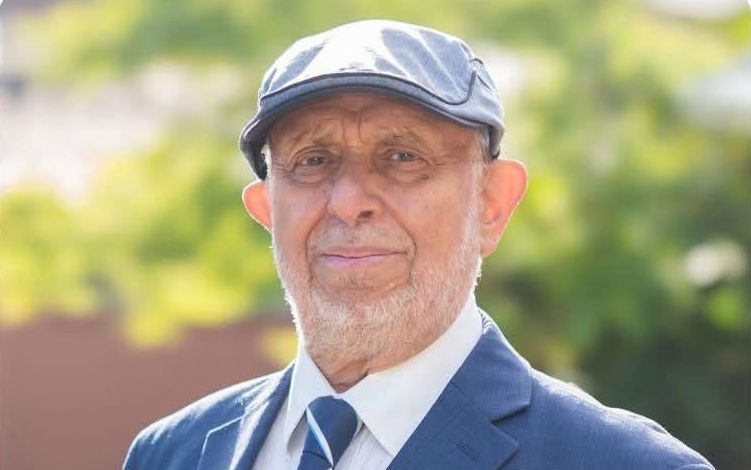
This week Zia Ahmad – a regular contributor to P&I – became the first Muslim to receive the Medal of the Order of Australia for services to journalism – and the second member of his family to receive the nation’s highest civilian honour.
Two generations. Two OAMs. One remarkable family.
In this week’s King’s Birthday honours list, Ziaul Islam Ahmad – known to everyone as Zia – was named a recipient of the Order of Australia, following in the footsteps of his late father, Dr Qazi Ashfaq Ahmad OAM, who received the same honour in 2020.
In most families, that would be extraordinary. In the Ahmads’, it feels almost inevitable – the product of relentless, unglamorous decades of community work spanning three generations.
That Zia is also the first Muslim in Australia to receive the OAM specifically for services to journalism makes this a landmark moment, not just for his family, but for the country’s multicultural media landscape.
Zia Ahmad, 73, is best known as the editor-in-chief of this newspaper, the Australasian Muslim Times – AMUST – the country’s leading independent Muslim newspaper and news portal, founded with his father in 1991.
Under Zia’s stewardship, the publication has grown from a modest print community paper into a multimedia platform covering Muslim and multicultural Australian life for readers well beyond any single faith or background.
AMUST is an activity of Seena Incorporated, a not-for-profit organisation based in Bonnyrigg in Sydney’s south-west.
“I accept this recognition with gratitude and humility,” Mr Ahmad said. “This honour belongs not only to me but to the many individuals, organisations, colleagues, volunteers, friends and family who have accompanied me on this journey – and to the communities I have had the privilege to serve over many years.”
“My most significant contribution to journalism has been founding the Australian Muslim Times with my father in 1991 and evolving it into the Australasian Muslim Times – AMUST – in 2014, today a print and digital publication supported by a multicultural online platform and an active social media presence.”
The Ahmad family story is, in many respects, a distinctly Australian one.
Dr Qazi Ashfaq Ahmad – a mechanical engineering professor who had taught at the Regional Engineering College in Kashmir before political upheaval forced him out – arrived in Australia in 1971 with his wife Jamal Ara and six children.
He went on to complete his PhD on a University of Sydney scholarship and spent the following decades as a founding force behind Islamic institutions, interfaith forums and community organisations.
He was also a cousin of former Indian Vice President Hamid Ansari.
By the time he received his OAM shortly before his death, he had become one of the most decorated Muslim figures in Australian history.
Zia, professionally a biochemist who retired in 2013 after more than 40 years working in the School of Molecular Biosciences at the University of Sydney, has quietly built a legacy to match his father’s.
When the Premier’s Multicultural Communications Awards panel handed him their Lifetime Achievement Award in 2021, they noted his career had delivered “a significant and long-term impact on the community promoting multiculturalism, global outlook and unity of mankind” – almost 50 years, the citation read, of social cohesion and harmony.
It wasn’t his first time on that stage, having taken home the same panel’s best editorial prize in 2016 and best print report in 2019.
An interfaith dialogue award followed in 2018, alongside the Excellence Award from the Multicultural Communities Council of NSW.
The AMU Alumni of Australia recognised him in 2016 and the Universal Peace Federation appointed him an Ambassador of Peace.
Along with many other hats he currently wears, Zia is a member of the Abraham Conference Organising Committee and serves on the board of Western Grammar School in Western Sydney.
“Drawing on both my Eastern heritage as an Australian of Indian Muslim background and more than five decades of lived experience here, I have come to appreciate the richness of diversity and the value of respectful engagement across cultures, faiths and viewpoints,” he said.
“Australia is home to countless individuals who make extraordinary contributions quietly and without recognition – among them many volunteers, women, people with disabilities and those from multicultural backgrounds who dedicate themselves selflessly to others.”
“I encourage Australians to nominate such deserving individuals for national honours….the Order of Australia exists to acknowledge and celebrate exactly that kind of excellence, service and community leadership.”
What makes Zia’s story particularly special is that his life’s work has been, in every sense, a family affair.
His daughter Rubinah Ahmad, born and raised in Sydney, has been AMUST’s graphic designer and technology director since 2014 – responsible for the layout of almost 150 print issues and its entire digital and social media presence.
She also serves as Office Manager of the Australian Islamic Medical Association (AIMA) and her volunteer work across dozens of not-for-profit organisations earned her the technology volunteer of the year award at the 2022 Australian Not-for-Profit Technology Awards.
“Growing up, watching dad balance full-time work, volunteering and caring for our family was truly inspiring,” Rubinah told me.
“Despite my disability, I never felt limited or held back – he and mum made me feel capable of anything.”
“Dad encouraged us to give back from a young age and was the driving force behind the diverse skills and experiences we each developed. Seeing him continue my grandfather’s work in interfaith and multicultural relations is incredibly special.”
“I’m so proud of him, and so proud to call myself Zia’s daughter.”
Another daughter, Mobinah Ahmad – a journalist, social media strategist and event producer – served as AMUST’s managing editor for many years and has been involved in interfaith and multicultural advocacy, including with the Australian Human Rights Commission. She currently works with the OnePath Network.
“My father’s leadership reflects my grandfather’s before him – wisdom, humility and a deep commitment to service,” Mobinah said.
“Both men understood the privilege they carried and used it not to centre themselves, but to open doors for the women in their lives.”
“My father constantly empowered us to lead with confidence, to step into influential spaces and to know our voices belonged there.”
“At times, he was willing to step back so we could step forward – and that quiet, principled leadership has shaped our family across generations.”
The Ahmad family, together with their large extended family, have also been a major driving force behind the Multicultural Eid Festival and Fair – MEFF – the first, the largest and the longest-running festival celebrating Eid in Australia, now in its 41st year.
Zia’s wife of 50 years, Mehar Ahmad, a regular AMUST contributor and multi-award winning Toastmaster speaker, was herself recognised at the inaugural Crescent Awards in 2022 with the outstanding contribution to school community award.
“Zia’s recognition as the first Muslim to receive the OAM for services to journalism is a fitting tribute to his decades of dedication, integrity and service in this field,” Mehar said.
“Through his commitment to ethical journalism he has informed, educated and empowered communities, given voice to the underrepresented and helped build bridges across Australia’s diverse society.”
“This honour not only celebrates his personal achievements but also highlights the vital role community media plays in strengthening social cohesion and enriching Australia’s cultural and democratic landscape. Congratulations, Zia – well deserved.”
For Zia Ahmad, the recognition lands at a moment when independent multicultural media in Australia is under pressure and arguably never more needed.
“I wish to acknowledge the support during this most successful journey, first to my immediate family members including my wife Mehar, daughters Sakinah, Saminah, Mobinah and Rubinah, my son-in-laws Wali and Wasseem as well as my extended family members who have helped towards the growth of AMUST and its promotion, production and distribution,” Zia said.
AMUST marked a decade of its current form at a celebration in Bankstown in September 2024, and the publication continues to operate outside the commercial media ecosystem – self sufficient, supported by community, run by family and accountable, its editor would argue, to no-one but its readers.
I should declare here that Zia has been both a great mentor and a dear friend to me – a man whose generosity of spirit is as much a part of him as his commitment to his faith and his community.
His work ethic is next level – and writing this piece is an absolute privilege.
The Order of Australia will be conferred at a ceremony in coming months.
It is a sure bet Zia will receive it with the same combination of humility and purpose that has defined his life.
“We are a dawah family,” he says. “I have committed my life and involved my loving family into inviting all to see how grateful I am of the opportunity Australia has provided us with.”
Today, after five decades of quiet, principled service, Australia has taken the time to acknowledge this in the best possible manner.
Republished from AMUST
