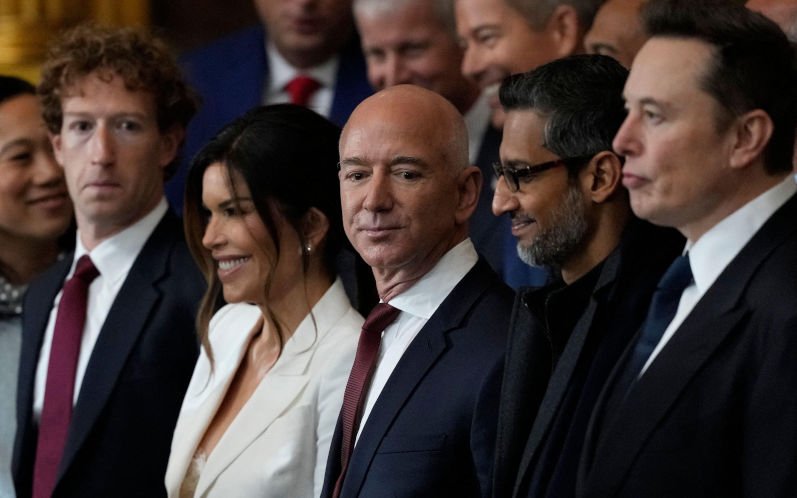
Donald Trump’s alliance with Silicon Valley’s Tech Right has united two fundamentally incompatible visions of the future. As AI infrastructure drives up energy costs, the contradiction between technocratic disruption and populist politics is becoming harder to ignore.
Few political marriages are stranger than the one binding Donald Trump’s MAGA movement to the newly ascendant ‘Tech Right’ – the cohort of Silicon Valley billionaires and venture capitalists who bankrolled Trump’s return to power and whet his appetite for deregulation. The alliance fuses a backward-looking populist movement with a Silicon Valley vanguard whose guiding principle is that AI will render a great many people economically redundant.
The two sides do not merely want different things; they inhabit different worlds. MAGA’s rhetoric is anchored in a mythical past. It seeks the restoration of a lost industrial, national, and cultural order in which work, gender roles, and community life were familiar and locally grounded. Silicon Valley’s dominant ethos treats disruption as a civilisational imperative and existing social arrangements as expendable. One side pines for an idealised past, while the other strives to make the present obsolete.
Their views of ordinary people diverge accordingly. MAGA’s self-image is that of ‘forgotten’ citizens, among them manual workers, small business owners, and voters in deindustrialised interior states who have been written off by coastal elites.
The tech billionaires, by contrast, openly anticipate a semi-permanent underclass as advanced systems displace tens of millions of jobs, concentrating wealth and power in the hands of existing capital owners and AI firms.
According to what some have called the “San Francisco consensus,” the average worker is not the protagonist of the future but a vestige of a bygone era – presumably to be mollified by minimal welfare payouts while innovation proceeds.
Rather than addressing this contradiction, the coalition hides it behind a personality cult. While tech investors exalt themselves as geniuses, Trump strikes a doubly absurd pose, boasting at once of his towering IQ and his singular devotion to the “poorly educated.”
For a while, this pose papered over the fact that the same hierarchy of cognitive worth that flatters the donors also marked many of his supporters as expendable. Trump’s coalition has accommodated two incompatible stories: a flattering populist narrative for voters, and a meritocratic-elitist one for funders.
But as Trump’s power ebbs under the weight of his Iran debacle, so too does his capacity to make two mutually inconsistent promises at once. The sleight of hand that held the coalition together no longer works, and the uneasy marriage is beginning to unravel. And of all the places where the strain is evident, the deepest fracture runs through the electrical grid.
Trump promised to cut Americans’ power bills, at one point vowing to halve them. Yet in many of the locales that anchor the MAGA coalition, residential electricity rates have climbed sharply, with capacity prices rising more than tenfold in two years.
Nearly half of these recent cost increases are attributable to the voracious demand for electricity from data centres. The typical household where data centres have been built will pay an estimated US$70 more on its monthly bill by 2028.
As electricity bills spike, the Tech/MAGA alliance’s contradictions can no longer be muffled. Heavily MAGA rural communities and exurbs across Virginia, Ohio, Georgia, and Arizona are mobilising against substations and transmission corridors that serve compute clusters whose benefits go elsewhere; state-level populists are flirting with rate-class protections that wall households off from data-centre costs.
The great irony, then, is that the loudest protests against AI infrastructure in 2026 may arise from within Trump’s coalition. Heating a rural residence through a Pennsylvania winter is a problem that a personality cult cannot solve.
The unfairness is undeniable. While one grid remains public, politically contested, rate-regulated, and slow, another is increasingly private, co-located alongside data centres, vertically integrated, and insulated from the constraints imposed on everyone else. Hyperscalers have signed gigawatt-scale nuclear and gas deals and begun to recommission shuttered reactors and build dedicated gas plants behind the meter.
They are supported by federal regulators who have rewritten rules so that data centres can plug in directly at power plants, bypassing the transmission infrastructure that the rest of the grid depends on. Compute clusters get steady, dedicated megawatts, while households get rate volatility on the same wire. One grid is what the citizen pays for; the other is what the citizen funds but cannot enter.
The tech right’s superfluous human is a strategy, not an aspiration. AI clusters are being sized to absorb the paid work of a vanishing labour force, while the unpaid work that households still do quietly drops out of the model. The pattern is partly familiar. Publicly financed infrastructure has always served some groups better than others – based on where lines are routed, how access is priced, and how reliably service is delivered.
Though non-discriminatory in principle, infrastructure investment tends to track the contours of class, geography, and political voice.
That said, what we are witnessing in the United States now goes further. It is not the ordinary gradient of advantage built into public provision, but a parallel system, an electricity apartheid established through private contract. The hyperscalers are creating a bifurcated regime in which consistent, dedicated capacity is engineered for one class of user while the public grid absorbs the volatility and the cost.
The demographic majority on the losing side of the wire is not a racial other, as it was in the apartheid South Africa of Elon Musk’s memory. It is the working- and middle-class voters of the deindustrialised interior – the very constituencies MAGA claims to champion. They overwhelmingly supported Trump, and now they are the very people being made to pay for a system designed to render them obsolete.
Technopopulism, it now seems clear, contains the seeds of its own dissolution. A growing war over energy is making divorce inevitable. The meter does not ask who was promised the future. It records who actually receives it.
Copyright Project Syndicate 2026


Stephen Holmes
Stephen Holmes, Professor of Law at the New York University School of Law and the Richard Holbrooke Fellow at the American Academy in Berlin, is the co-author (with Ivan Krastev) of The Light that Failed: A Reckoning (Penguin Books, 2019).