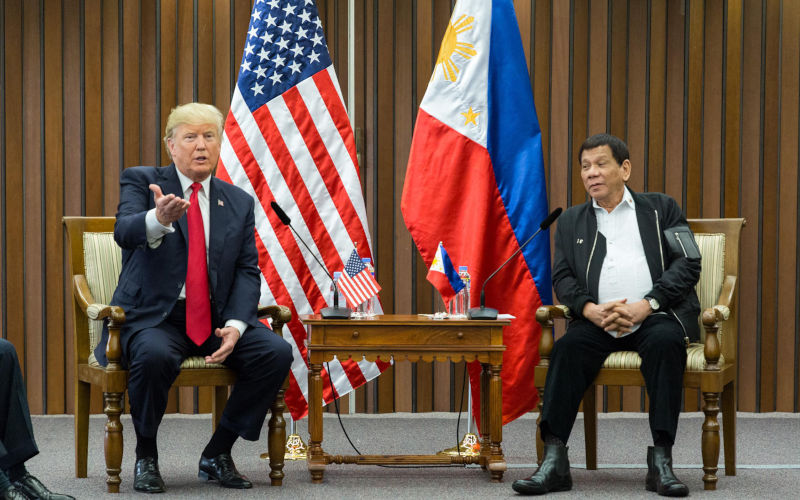
The court cases facing Nicolás Maduro and Rodrigo Duterte highlight the legal exposure of leaders who use violence, abduction and war as instruments of power – and raise hard questions about Donald Trump’s own vulnerability to international law.
This month, two former presidents will be in court where a third, the President of the United States, must be hoping never to join them.
In January this year, Nicolás Máduro Moros and his wife Cilia Flores were abducted from Venezuela by the US armed forces. From Brooklyn Federal jail Máduro has pleaded not guilty to charges of conspiring with guerilla groups in Colombia to traffic cocaine to the US. But Trump’s ecstatic reaction to Máduro’s kidnapping was more about oil politics than drugs.
It must have come as no surprise to Máduro, nor to the American justice system, which had prepared an indictment in 2011, and unsealed it in 2020. To that an Argentinian judge added a ‘fabricated plot’ (without explaining which plot was not), and a case was filed in Buenos Aires in 2023. An arrest warrant for Máduro was issued by the US in 2024 and executed in 2026. The course the law now takes will be interesting, not least to the Trump-installed ‘interim president’ of Venezuela, Delcy Rodríguez.
Donald Trump is preparing this month for his 80th birthday bash – literally, with a cage fight staged at the White House, to which he has invited ‘hundreds of fit men’ – but a planned concert is likely to be cancelled as performers drop out, stating their opposition to Trump. That will be tested at the mid-term elections in November, about which Trump says he doesn’t care.
Meanwhile in the Hague, Rodrigo Roa Duterte also anticipates a birthday, his 81st. The former president of the Philippines has been imprisoned since 2025 on three counts of crimes against humanity in 2011-2019, for which he was arrested by the Philippines authorities on a warrant from the International Criminal Court. His defence lawyers want an indefinite adjournment of the case, claiming he is unfit to stand trial, but this was rejected after an independent medical assessment. Duterte hasn’t attended earlier hearings and may not do so in June and July.
The Duterte administration was notorious for patronage, feudal politics, and kleptocracy, says Manila journalist Maria Ressa. Duterte was little different from his oligarchical predecessors, particularly Ferdinand E Marcos who was elected in 1965 and, after declaring martial law nationwide in 1972, held office for another 14 years, enriching himself and his family by $10 billion before ‘people power’ threw him out. (His son Bongbong is now president). Marcos’ later successors Glora Macapagal Arroyo and Duterte each declared martial law in a single province.
Ressa is co-founder in Manila of the digital website Rappler, and a co-winner of the 2001 Nobel Peace Prize in 2021. In her 2022 book, How to stand up to a dictator, Ressa recalls Duterte as mayor of Davao admitting to her that he led by violence and fear, anticipating that as president he would kill to fix government and stop criminality and corruption. Even Marcos had never said “If I have to kill you, I’ll kill you. Personally”, as President Duterte told Ressa in 2016. She and her Rappler investigative journalist sisterhood were reduced to near bankruptcy by 14 investigations because they researched and broke true stories about Duterte, including revealing the fake news his people put out about Rappler.
In 2016 Duterte and Trump were both elected. The Philippines in effect got a Trumpian president just six months before the US did. Trump and Duterte saw the potential of social media and used it to great effect to change people’s thinking and behaviour in the US and the Philippines – the world’s two greatest users of Facebook respectively. In 2015, most of Trump’s Facebook likes came from outside the US and one in every 27 followers in the world was from the Philippines. In 2017, 97 per cent of Filipinos were on Facebook and You Tube.
Both presidents disdained domestic and international law and favoured fascism. As both aged, their behaviour became increasingly unhinged. In 2016 Duterte declared a ‘state of lawlessness’, and from 2017 to 2019 put all of Mindanao under martial law, flattening Marawi city which ISIS-aligned militants had seized, but arresting no rebels. Under Duterte, some 27,000 people were killed in the Philippines between 2016 and 2018 according to the Philippines Commission on Human Rights. By 2020 with his term ending, he was desperate for support.
Meanwhile in 2020 Trump demanded his lost election results be overturned. In 2021 he called on his supporters to attack the Capitol, and pardoned them in his second term. Under Trump, ICE agents have killed ‘only’ 40 Americans, but his ongoing foreign wars are responsible for untold thousands of deaths.
Kleptocratic presidents are not unusual in the Philippines, but Trump has outdone most of his US predecessors in manipulating policy for personal gain through his family from investments, share trading, and crypto-currency. “I don’t think about Americans’ financial situation” he recently declared. Trump’s Midas-like taste for gold on everything, including a triumphal arch in Washington, in the oval office, and in his proposed $1 billion ballroom at the White House may distract MAGA supporters from the bankruptcies of six of his corporations, and some 4000 lawsuits against him ranging from casinos, real estate, tax disputes, and personal defamation to rape. After Trump had his name added to the John F. Kennedy Center it has been removed. But he was told Congress must approve his face appearing on a proposed new $250 note – which they might.
When Duterte goes to court in the Hague, Trump should reflect on potential charges against him for crimes against humanity and international law. Not only has he imposed sanctions on judges of the ICC and on Francesca Albanese, the UN Special Rapporteur on the Occupied Palestinian Territories, he is waging wars of aggression without Congressional approval, and without a UN Security Council resolution, while the US hosts Israeli indicted war criminals. Forget a Nobel Prize.
Australian leaders might remember that those who lie down with dogs end up with fleas. Prime Minister Albanese is reportedly considering going to the US for an American-Australian soccer match on 20 June. What’s the best 80th birthday present he could give Trump (the man who already has everything)? Tell him to keep the second-hand Virginias, scrap the unbuilt SSN-AUKUS submarines, and cancel AUKUS.

Dr Alison Broinowski AM is a former Australian diplomat and a member of Australians fr War Powers Reform