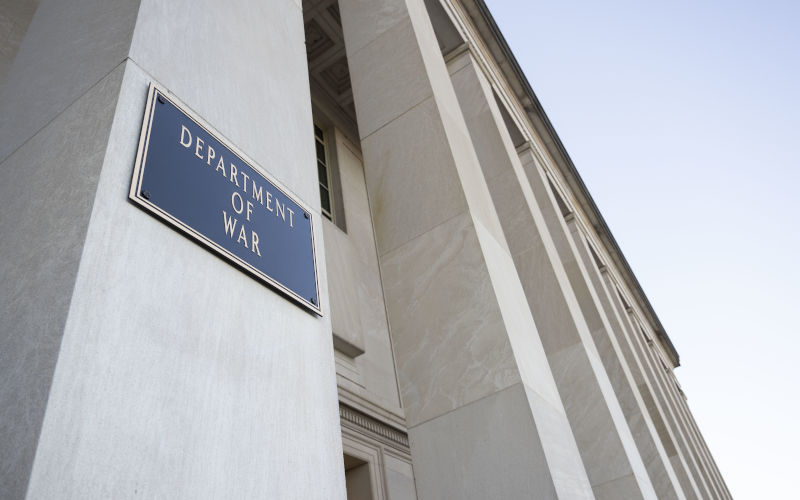
In the fourth of an eight-part series, John Keane shows how the fading American empire is resorting to military solutions for its mounting global ills, without winning.
Democracy promotion has dropped to the bottom of the fading American empire’s list of global priorities. Treating the rules-based order it created after 1945 as a sham is the new priority. Bully politics backed by a might-makes-right mentality is the gold standard. ‘We’re a superpower. And under President Trump, we are going to conduct ourselves as a superpower’, says deputy chief of staff Stephen Miller. ‘We live in a world in which you can talk all you want about international niceties and everything else. But we live in a world, in the real world…that is governed by strength, that is governed by force, that is governed by power…These are the iron laws of the world.’
It’s as if the fans of American supremacy believe that power, like the mythical rabbit’s foot, automatically generates its own charm. The reality is harsher. As each day, month and year passes, the magnetic symbolic allure of the United States is fading, which is a key reason why America, foolishly, as previous fading empires did, resorts to military force as a prime solution to its mounting global ills.
The depth and breadth of the militarisation of the American empire are scary. Currently backed by a network of 800 military bases in at least 75 countries, US military spending (according to the Stockholm International Peace Research Institute) reached $916 billion in 2023, a figure more than three times larger than China’s (US$296 billion) and higher than 20 other governments combined (Russia, India, Saudi Arabia, United Kingdom, Germany, Ukraine, France, Japan, South Korea, Italy, Australia, Poland, Israel, Canada, Spain, Brazil, Algeria, Netherlands, Türkiye plus the province of Taiwan). Military spending is ballooning: in 2026, the US Congress approved a budget of over $1 trillion, a substantial increase from the previous year, which may reach $1.5 trillion for 2027 if President Trump’s latest budget proposal is accepted. The United States is by far the biggest global arms dealer: between 2016 and 2020, it exported 37 per cent of global arms. (During the same period China accounted for 5.2 per cent of the total.)
The disturbing point is that the failing empire is now permanently at war. Since its founding as a republic, the United States has invaded other territories nearly 400 times; more than a quarter of these invasions have happened since the collapse of the Soviet Union. There have been untold numbers of engineered coups d’états, CIA-led assassinations and covert operations, although, as might be expected of an empire losing its grip on the world, the rate of military interventions has recently been accelerating. As the 2026 Israel/US war on Iran unfolds, the wise warning of old Montesquieu in his Considérations sur les causes de la grandeur des Romains et de leur décadence (1734) that militarism corrupts republics and ruins empires goes unheeded.
America’s rulers have long insisted that interventions are good and necessary because they promote peace, human rights, international law, alliances, counterterrorism and democratisation. These bullshit alibis are contradicted by ugly realities. Since the Second World War, featuring the Vietnam fiasco, the Iraq debacle, the Ukraine quagmire and the multiple failures of the war on Iran, the United States has lost just about every war. Its inability to win small or medium wars in asymmetric conflicts has been matched by shocking losses of life and ecological destruction. The American military is the world’s largest global polluter. The invasion and two-decades ‘Operation Enduring Freedom’ military occupation of Afghanistan resulted in the deaths of at least 250,000 civilians and a sudden withdrawal that left behind contaminated land and rivers, toxic burn pits and unexploded weapons containing known carcinogens, teratogens and genotoxins.
The military imperium, with its reliance on outdated technologies of aerial bombardment with no boots on the ground, is faltering, as the catastrophes unleashed in Iraq, Afghanistan and the Gulf region confirm. It is also now the regular victim of perversely unintended consequences, which can’t easily be remedied by military methods. A case in point: the sanctioning and blockade of Iran not only triggered widespread nervousness about the fragility of global supply chains and the damaging consequences of higher inflation. The long-standing military encirclement and attempted economic strangulation of Iran encouraged that country to shift its payment systems to cryptocurrency convertible into renminbi, the reliance on hawala networks and barter arrangements, the combined net effect of which has been to promote the de-dollarisation of the global economy. Analysts describe this as a global ‘axis of evasion’ capable of outflanking of America’s geo-military might.
Then there is a fact of sobering importance: the People’s Liberation Army (PLA) and its strategy of what I have elsewhere called the yīn-yáng doctrine of ‘militarised peace’. The PLA is now the chief rival of the United States. It is the globe’s largest standing army, with two million troops backed by an expanding nuclear arsenal, more submarines than any other power and sophisticated military hardware. The PLA is heavily involved in UN peacekeeping operations. In Libya, Yemen and the Sudan, it has practised the difficult arts of military evacuation of its citizens from conflict zones. Its hand has been strengthened by China’s internal colonisation of Tibet and Xinjiang and its settlement of disputes with neighbouring states, including India.
The PLA’s militarised peace strategy is backed by a military-industrial-aerospace complex featuring mega-companies such as the China North Industries Group Corporation (NORINCO) and the Aviation Industry Corporation of China (AVIC). It is reinforced by space power aspirations, a heavy reliance on smart diplomacy, and a commitment to a new and formidable model of warfare that presupposes, as the Chinese saying puts it, that melons forced from the vine don’t taste sweet. Success in war, runs this way of thinking, demands self-control, forbearance and the ability and willingness to wait (wuwei: non-action). Only fools rush into war. Wars are won, or avoided, not in the American way of Operation Inherent Resolve (the unfinished, more than a decade-long intervention in Syria and Iraq) but by outfoxing opponents, slowly wearing down or frightening enemies without firing a single shot.
This article was drawn from notes prepared for public lectures in Nanjing and Oxford, May-June 2026
Read more articles from this series.

John Keane is Professor of Politics at the University of Sydney. Renowned globally for his creative thinking about politics, history, media and democracy, he is the author of the best-selling Tom Paine: A Political Life (1995), The Life and Death of Democracy (2009), Power and Humility (2018), The New Despotism (2020) and The Shortest History of Democracy (2022), which has been published in more than a dozen languages. He was nominated for the 2021 Balzan Prize (Italy) and the Holberg Prize (Norway) for outstanding global contributions to the human sciences.His latest books are China’s Galaxy Empire (2025) and Demagogues and Despots: Democracies on the Brink (2026).