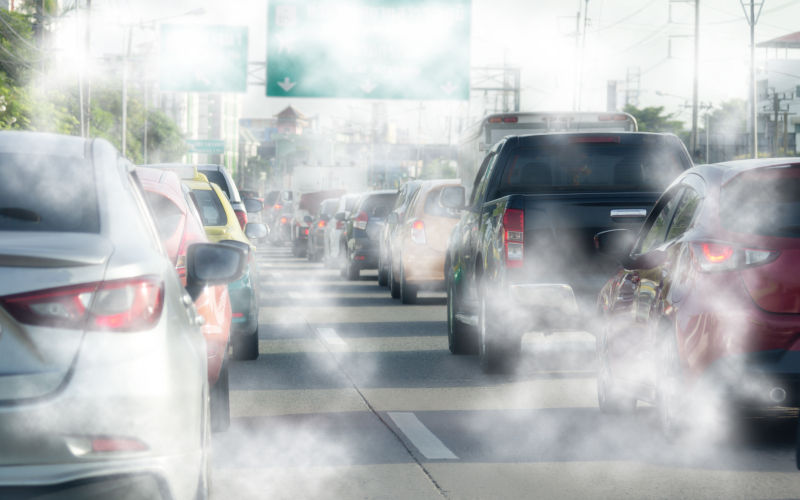
Australians are too complacent about allowing diesel-run vehicles in urban areas. Diesel exhaust is carcinogenic and can cause other illnesses.
Most Australians understand that air pollution is harmful to human health. But they usually associate it with smog-bound cities in developing countries, where the main culprit is traffic-related air pollution (TRAP). The bushfires of Black Summer in 2019–20 did dramatically raise awareness of air pollution as a health issue along the eastern seaboard, with heartbreaking stories of newborns being delivered in smoky hospitals. The cause, though, was seen as a transient, natural phenomenon. Australia is a land of bushfires, after all.
The general consensus is that background air quality in Australia is good and we live in a clean environment. This is why it’s called ‘air quality’ and not ‘air pollution’. This belief is reflected in individual behaviour, urban planning and policy decisions at all levels of government.
It’s considered acceptable to drive fuel-inefficient SUVs and diesel utes in the centre of our cities, which are largely planned around cars. Nobody is calling for ultra-low emission zones as they exist in some European cities, where combustion-engine vehicles are either banned or heavily taxed. While the National Environment Protection Council sets nationally consistent air pollution standards to be enforced by state regulators, there is no single agency tasked with correlating TRAP with health outcomes in adults and children. The noxious emissions standards (Euro 6d) that now apply to new Australian vehicles do nothing to address the large stock of old cars, buses and trucks. Even the recent New Vehicle Emissions Standard (NVES) is designed to reduce carbon dioxide emissions, while only indirectly addressing air pollution.
We agree with an increasing number of researchers that there is a false narrative around air pollution in Australia: there is ample evidence of harm from current levels of air pollution. In fact, air pollution as an environmental risk to Australians is second only to sun exposure. The World Health Organization (WHO) states there is no safe level for air pollution but, in Australia, we have upper acceptable limits for air pollutants. Areas in our cities regularly exceed those upper acceptable limits.
The pollutants commonly measured are nitrogen dioxide (NO2) and fine particulate matter smaller than 2.5 microns (PM 2.5). Motor vehicles produce over 50 per cent of the air pollution in our cities; nearly all traffic-related PM 2.5 comes from diesel exhaust. NO2 is a potent respiratory irritant with no safe lower limit of exposure. PM 2.5 passes into the bloodstream to all organs and is harmful at levels well below current WHO guidelines.
Australian researchers have estimated that the number of premature deaths attributable to TRAP may be up to 11,000 per year compared with the road toll of 1,300 people per year. This is almost certainly an underestimate, as they applied minimum levels of pollutants, whereas New Zealand researchers assumed no safe minimum level and came up with 8,000 premature deaths in a country of five million.
TRAP is responsible for 33 per cent of childhood asthma in the European Union. The figures are less certain in Australia. Despite this evidence, we continue to allow childcare centres and schools to be sited near main roads.
More recently, Australian research has directly linked levels of NO2 and PM 2.5 with peaks in national hospitalisations for respiratory and cardiovascular disease. Although pollution levels in Australia are relatively low, they still accounted for up to 7.5 per cent of respiratory admissions and 3.9 per cent of cardiovascular admissions at an estimated annual cost of
$6.2 billion.
Evidence is accruing that chronic exposure to PM 2.5 is associated with many common diseases, including high blood pressure, diabetes, and even dementia. Your long-term health (and your child’s respiratory health) may be partly determined by how far away you live from a major road.
There is no good news with TRAP. The International Agency for Research on Cancer classifies diesel exhaust a class 1 carcinogen. Class 1 carcinogens are those proven to cause cancer. Fine combusted soot and polyaromatic hydrocarbons inhaled from diesel exhaust are deposited deep in the lungs. Long-term exposure to diesel exhaust causes a small but significant risk of lung cancer. Trucks that mostly run on diesel are four per cent of the Australian road vehicle fleet but produce 20 per cent of the TRAP. Petrol exhaust isn’t considered to be carcinogenic but Australian petrol of all grades contains up to one per cent benzene. Benzene is another class 1 carcinogen associated with acute leukaemia in children and adults. There is no safe upper limit for benzene exposure.
These significant issues have remained largely underestimated and unaddressed because of a combination of general lack of awareness, complacency and the lack of a single national agency responsible for air pollution and population health. Such a body could measure, cost, and link air pollution to health. The opposition to NVES indicates that powerful interests in the fuel and vehicle industries are happy to keep it this way.
The solutions are multifaceted. We need public awareness, urban planning, funding for active travel and public transport, traffic control, vehicle emissions regulation and the electrification of transport. The NVES will be too slow and does not yet address polluting heavy vehicles already on the road. Some measures will be unpopular.
The most pressing matter is to lower PM 2.5 levels by rapidly reducing the use of diesel in urban areas, concentrating on heavy vehicles and public transport, before ultimately considering restrictions on diesel light vehicles in urban environments.
Ben Elliston
Ben Elliston is an energy systems researcher at UNSW.

Christopher M. Johnson
Chris is a retired specialist paediatric anaesthetist from Perth WA with a longstanding interest in renewable energy and electrification. He is an active member of the Australian Electric Vehicle Association (AEVA). He and his partner regularly drive an electric vehicle across Australia to visit family.