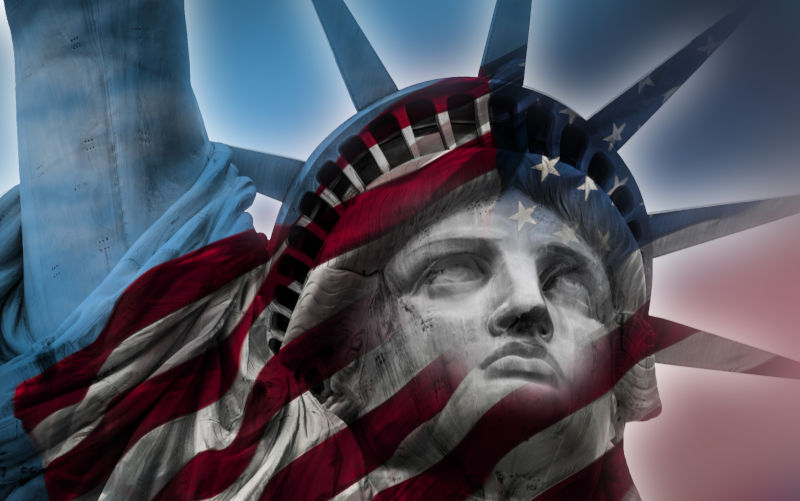
In the fifth of an eight-part series, John Keane says the declining US empire will manage without democracy as it turns on its own citizens.
In the history of democracy, militarism has been democracy’s chief nemesis. A new form of militarism is now infecting the empire’s heartlands with damaging effects on the spirit and substance of democracy everywhere. The boomerang effects of empire are palpably hurting its own democracy.
Trump has a definite fancy for military symbolism. His imperial presidency has robbed taxpaying and arms-bearing citizens of their say in matters of war. The Congress has voted – by a majority, probably unconstitutionally – not to restrict the war-making powers of the presidency.
The arbitrary design and execution of military goals and strategies are now high-level imperial secrets and prerogatives. Troops are meanwhile despatched to home borders to protect America from the scourge of unwanted immigrants. Undocumented civilians are rounded up in frightened communities, flung into military camps or deported to Guantánamo Bay.
The US military sells off or transfers its used or surplus weaponry to domestic police agencies. Militarised policing is consequently the new fashion. Officers kitted out in combat gear and armed with stun guns, tear gas cannon, pepper spray, sniper assault rifles, armoured trucks, drones and tanks are becoming the new normal. The data shows that in the United States around fifty thousand SWAT (special weapons and tactics) raids are carried out annually on household dwellings by teams dressed in military gear and wielding military weapons, including grenades thrown prior to the raids. Military-style police teams are also active during street demonstrations and in urban communities, where disproportionately they are deployed against African American, Muslim and other minority communities. And ICE (Immigration and Customs Enforcement) now specialises in aggressive arrests in schools, hospitals and airports and high-volume deportations of suspects by masked officers in plain clothes and unmarked vehicles.
Democracy in America?
Pressured by these various trends, which double as symptoms of America’s declining global empire, what can we say about democracy and its future? What’s the probable fate of the ideals and practices of power-sharing democracy for which the United States proudly once claimed to stand?
Again, we can’t be sure, but what’s already evident is that the accelerating decline of the United States is destroying more than a few illusions about democracy. An example: the old dictum that ‘a democracy is incapable of governing and managing an empire’ (as the Athenian historian Thucydides famously wrote in his late 5th century BCE History of the Peloponnesian War) has been turned on its head.
For the foreseeable future, the empire will manage without democracy. That’s the rule in the history of empires. To repeat: when on the rise, durable empires, often pressured by the resistance of their distant subjects, extend them a measure of self-government. But when empires are in decline, they are bad losers. Shrinking empires grow self-absorbed, skittish, mean-spirited and bellicose. Outbursts of megalomania (‘Make America Great Again’) come mixed with paranoid violence repeatedly directed at enemies abroad.
At home, unless ‘Hands Off’ and ‘No Kings’ citizen fightbacks grow stronger, the drift in the United States towards a new kind of despotic rule will accelerate. Fuelled by Trump-style talk of the ‘tremendous fraud, tremendous waste’ in government, the Epstein class of politically powerful and rich corporate ‘poligarchs’ will continue to flourish. Within ruling circles, high-handed power moves will generate high praise and centre-stage media coverage.
Friends will receive rich rewards. Enemies will be threatened with reprisals, abused, sacked and generally handed rough justice. The quintessence of politics will be that the few tell the rest what to do.
Even though it used to be taught in America that democracy requires a vibrant civil society, rough justice will flourish in the field of social life. As each day, month and year, the damage being done will become harder to undo. In the heartlands of the shrinking empire, there will be more guns, street shootings, immigrant arrests, misogyny, religious bigotry and media untruths. Middle-class anxiety and the angry underclass’s conviction that democracy is a mere façade for plutocracy will grow. Millions of citizens will feel the paralysing pinch of decades of past and future neglect. They already know that the wealthiest three Americans, each of them indulgers of the MAGA fantasy, currently own more wealth than 50 per cent of the whole society. They are aware there is no universal medical care and that their healthcare system totters on the edge of collapse. They know a quarter of American citizens currently can’t afford the drugs prescribed by their doctors; that there’s a major housing shortage; and that officially at least 800,000 people, including one child in every five households, are homeless. By 2023, only 10 per cent of workers belonged to a trade union, half the number of four decades earlier.
As the empire shrinks, unless a radically different government committed to the redistribution of wealth comes to power, social conditions will worsen. The number of Americans who have little faith in the future will multiply. A sizable majority of citizens (around six-in-ten) already say that life is worse today than it was 50 years ago. And they expect things to grow worse. They say that in 2050 their economy will be weaker, the United States will be less important in the world, political divisions will be wider and that there’ll be an even bigger gap between the poor and the rich.
Ominously, everything will be made worse by the coming fires, floods, droughts and crop failures of the drill-baby-drill age. Disasters can bring out the best in citizens but, as Americans are already finding out, extreme environmental shocks desecrate democracy. People suffer injury and death. They fear for their lives. Survivors are quarantined, told to keep their distance from others, dragged and pushed from their dwellings and habitats, supervised by police and army and government service agencies. Environmental disasters show just how quickly the tapestry and tissues and threads of trust and cooperation of civil society can be torn asunder by fear, greed and corruption. Ecological disasters also normalise arbitrary power. They get citizens used to emergency rule: it’s what must for a time be endured, and what out of ‘necessity’ is in future to be expected.
Slowly but surely, in the name of their ‘safety’ and ‘security’, people are encouraged to accept the permanent administration of their lives.
This article was drawn from notes prepared for public lectures in Nanjing and Oxford, May-June 2026
Read earlier articles in the Decolonising democracy series

John Keane is Professor of Politics at the University of Sydney. Renowned globally for his creative thinking about politics, history, media and democracy, he is the author of the best-selling Tom Paine: A Political Life (1995), The Life and Death of Democracy (2009), Power and Humility (2018), The New Despotism (2020) and The Shortest History of Democracy (2022), which has been published in more than a dozen languages. He was nominated for the 2021 Balzan Prize (Italy) and the Holberg Prize (Norway) for outstanding global contributions to the human sciences.His latest books are China’s Galaxy Empire (2025) and Demagogues and Despots: Democracies on the Brink (2026).