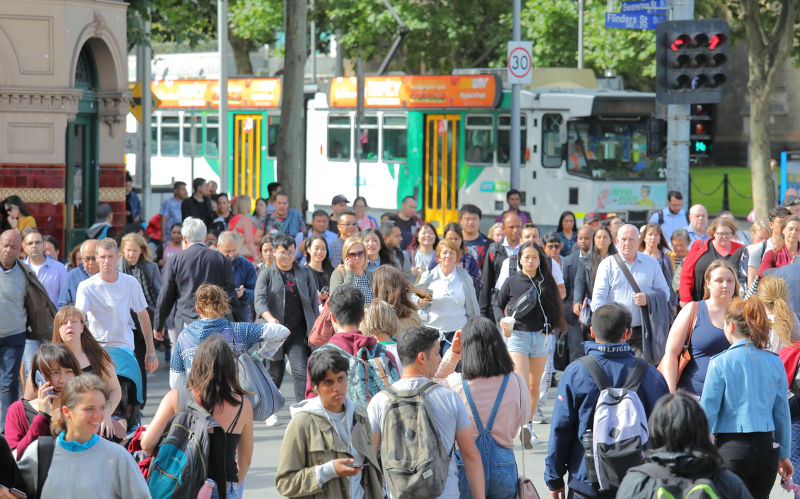
A diverse nation is held together not by embracing monoculture but by building familiarity and then trust.
There is a growing argument in parts of Australian public debate that multiculturalism has failed and that Australia should aspire to become a monocultural society.
This view gained renewed attention following Pauline Hanson’s recent National Press Club address, where she argued that multiculturalism had weakened national unity and that Australia should place greater emphasis on a single national culture.
Whether one agrees with that view or not, the question it raises is serious. What actually holds a diverse nation together?
After more than three decades living in Australia, nearly thirty years in the Australian Public Service, and a lifetime across several countries and cultures, I have come to a simple conclusion. It is trust.
My understanding of multiculturalism did not begin in Australia. I was born and raised in Bangladesh. Later, I received a Malaysian Government scholarship to study economics at the International Islamic University Malaysia, where I was part of the pioneer intake. For the first time, I lived and studied alongside Malays, Chinese, Indians and students from many parts of the world. Later, I pursued postgraduate studies in economics in Canada, before migrating to Australia in 1992.
Those experiences shaped a lasting insight. People do not leave their identities behind when they migrate. They expand their sense of belonging.
I remain proud of my Bangladeshi heritage. I am also deeply Australian. These identities do not compete. They strengthen one another. That is why I have never been persuaded by the monoculture argument.
Australia was never monocultural. Long before European settlement, this continent was home to hundreds of First Nations nations, languages and cultural systems. Diversity is not new to this land.
Post-war migration added further layers. Millions arrived from Europe, followed by migration from Asia, the Middle East, Africa and Latin America.
According to the 2021 Census, almost 30 per cent of Australians were born overseas, more than half have at least one parent born overseas, and more than 300 ancestries and languages are represented across the country. This is not a future possibility. It is the present reality. The question is not whether Australia is diverse. It is whether diversity can coexist with cohesion.
During the three decades in the Australian Public Service, I worked with Australians from every background imaginable. Nobody asked me to abandon my identity to belong. What mattered was professionalism, respect and contribution to the public good.
That experience reinforced lessons I had already learned during my time in Malaysia and Canada, as well as my travels across Asia and the United States. Again and again, across very different societies, I saw the same pattern. Successful societies are not built on sameness. They are built on shared civic values and mutual respect.
My most important lesson in social cohesion, however, did not come from policy or theory. It came from helping to build the Gungahlin Mosque. When I became President of the Canberra Muslim Community in 2015, there was no mosque in Gungahlin despite its rapidly growing and diverse population.
The challenge was not simply to build a mosque. It was to build trust.
My intention was always clear. It was not only to build a mosque, but to build an inclusive mosque and a cohesive community. We formed a committee that reflected the diversity of our community. We engaged openly with neighbours, residents, elected representatives, journalists and other faith groups.
Some residents initially raised concerns about traffic, parking and the character of the area. We did not dismiss those concerns. We listened. We responded. We kept dialogue open. Over time, something shifted. Uncertainty became familiarity. Familiarity became connection.
When we opened the Gunghalin Mosque in October 2017, residents, politicians and community leaders from many backgrounds joined the celebration. But the real work came after. We held community Iftars and open days, inviting neighbours, church groups, politicians and people of all faiths and none.
I still remember the reactions of non-Muslim visitors when they came to the mosque for the first time. Some arrived uncertain. Many later said their expectations were very different from reality. They found families, conversation, children playing, volunteers sharing food and a community that was not foreign at all, but familiar.
Those moments mattered. They showed that social cohesion is not abstract. It is lived. And it is built through contact, not assumption. Over time, suspicion gave way to familiarity, and familiarity to trust.
This reflects what social research has long confirmed. Contact between groups reduces prejudice and strengthens cohesion. The Scanlon Foundation’s Mapping Social Cohesion research consistently finds that around 84 per cent of Australians believe multiculturalism has been good for Australia. This is a strong result in a period of global polarisation and rising anxiety about identity and change.
At the same time, the research highlights concerns about economic insecurity, discrimination and trust in institutions. The message is clear. Multiculturalism is widely supported, but cohesion must be actively maintained.
This brings us to the argument advanced by Pauline Hanson and others who question whether increasing diversity weakens unity. These concerns should not be dismissed. Every society needs shared foundations.
Democracy matters.
The rule of law matters.
Freedom of speech matters.
Freedom of religion matters.
Equality before the law matters.
No cultural or religious practice should override these principles. But shared values do not require cultural uniformity.
My experience suggests the two are often confused. In the 2020 ACT election, I stood as a candidate in Yerrabi. During my door knocking, I heard repeatedly that people were not concerned with identity. They were concerned with everyday issues like housing, schools, jobs, traffic, transport and opportunity.
The concerns of a Bangladeshi-born Muslim candidate and those of other Australians were remarkably similar. People want the same things: safety, opportunity and a sense of belonging.
In 2024, I was honoured to receive the Medal of the Order of Australia for service to the multicultural community of Canberra. I did not see it only as personal recognition. I saw it as evidence of what Australia can be at its best. A country that allows someone born in rural Bangladesh to contribute, belong and be recognised as part of the national story.
In many ways, my own journey reflects a broader Australian reality. Millions of Australians carry histories, cultures and faiths from elsewhere. Most are not seeking separation. They are seeking participation. That shared aspiration is the foundation of cohesion.
The strongest communities I have known, in Bangladesh, Malaysia, Canada and Australia, were not defined by sameness. They were built on trust across difference.
Australia is already one of the world’s most successful multicultural societies. Its success has not come from cultural uniformity, but from the ability of people to contribute, belong and share a common future.
The challenge is not whether diversity exists. It already does.
The challenge is whether we continue building trust across it. Trust does not come from slogans or political debate. It grows slowly in workplaces, neighbourhoods, schools, sporting clubs and places of worship. It grows when people recognise that, despite differences, they share the same future.
Mainul Haque
Mainul Haque OAM is an economist, board member and non-executive director with more than 30 years’ experience in Australian public policy and community leadership. He is a former senior Australian public servant and former ACT Multicultural Ambassador. He currently serves on boards across the health, community and not-for-profit sectors and writes on public policy, migration, social cohesion, multiculturalism and Australia’s future. He was awarded the Medal of the Order of Australia (OAM) for his service to the ACT community.