Australia is anchored in Asia, yet elements of our defence posture continue to assume a different centre of gravity. This makes it difficult to reconcile long-term strategic planning with the region Australia relies on for its economic security and wellbeing.
Australia is deeply integrated into Asia in every practical sense that matters. We trade there, we depend on it for growth, and increasingly our prosperity is shaped by it. Yet much of our strategic thinking continues to behave as if this reality is secondary. This is the central contradiction in Australian policy today.
The gap between economic reality and strategic imagination is no longer abstract. It is visible in trade dependence, supply chain exposure, energy vulnerability and the lived experience of recent global shocks, including the COVID-19 pandemic.
Paul Keating’s push to embed Australia within Asia was not symbolic. It reflected a strategic reading of geography, economics and long-term national interest. Through initiatives such as Asia-Pacific Economic Cooperation, he sought to align Australia with the region that would define its future. That future is now our present.
Australia is a middle power whose prosperity is structurally tied to Asia. Our major trading partners including China, Japan, South Korea, India and the economies of Association of Southeast Asian Nations are central to our export economy and national income. Minerals, energy, agriculture and education are deeply embedded in Asian demand and supply chains.
In economic terms, Australia is already part of Asia. This economic reality is reinforced socially. Modern Australia is one of the most successful multicultural societies in the world, with a significant and growing proportion of Australians having roots in Asia. These communities bring language, cultural understanding and direct regional connections that strengthen trade, diplomacy and economic opportunity. This is not just a social achievement. It is a strategic asset.
Yet this deep integration sits alongside a strategic posture that is often shaped elsewhere. Since the era of John Howard, Australia has increasingly anchored its security architecture in traditional Western alliances. This trajectory has culminated in commitments such as the $368 billion dollars AUKUS agreement, including plans for significant long-term investment in nuclear-powered submarine capability sourced from the United States and the United Kingdom.
These capabilities will take decades to fully materialise. By then, the strategic and technological environment may have shifted significantly. This raises an important policy question: whether the scale and structure of long-term defence investment aligns with Australia’s most immediate and practical national priorities.
Australia is simultaneously facing significant domestic pressures. Our health system is under strain, housing affordability has reached crisis levels, and cost of living pressures continue to rise. Homelessness is increasing in major cities, and higher education debt continues to weigh on younger Australians trying to build financial security.
Our aged care system is also under pressure, with more than 3,000 older Australians occupying hospital beds due to a lack of appropriate aged care placements. This contributes to hospital congestion and reflects broader structural strain across health and social care systems (we need an alternative age care model that I have written about earlier).
Energy security further highlights Australia’s vulnerability. Despite being a major exporter of raw energy resources, we lack sufficient domestic refining capacity and remain heavily dependent on imported refined fuel. We export raw materials and import processed energy at higher cost, leaving the economy exposed to global price volatility.
Rising diesel and fuel costs are already flowing through to transport operators and tourism businesses, with surcharges and service adjustments affecting the real economy. This is not an abstract risk. It is already shaping prices, services and household costs.
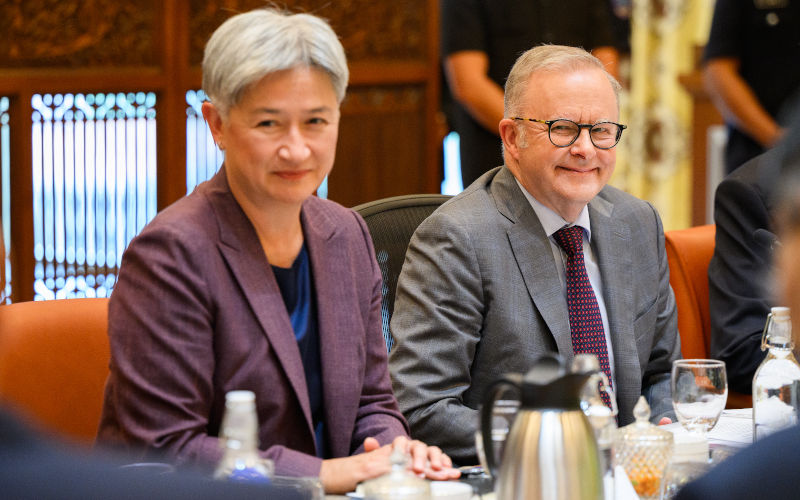
Recent energy challenges have demonstrated that Australia’s economic resilience and energy security are increasingly shaped by Asia, where key supply chains and regional partnerships play a central role. In response, Australia’s Foreign Minister has prioritised strengthening relationships with key regional economies including Japan and South Korea, alongside broader engagement in Southeast Asia, as part of Australia’s energy security and trade stability.
In parallel, Prime Minister Anthony Albanese has engaged directly with regional partners, including Malaysia, Singapore and Brunei, to reinforce supply chains for fuel, fertiliser and broader economic stability. These engagements reflect a practical reality: Australia’s resilience is increasingly dependent on its region.
This was made even clearer during the pandemic, when global systems were disrupted and Australia’s economy was immediately affected. International education collapsed, tourism stopped and supply chains fractured. Recovery, however, was driven largely through re-engagement with Asia as trade, education and mobility gradually resumed. The lesson was clear: Australia’s resilience is inseparable from Asia.
This brings us to a fundamental question of national priorities. Why is Australia committing very substantial long-term resources to strategic defence capabilities designed for uncertain future scenarios, while simultaneously facing growing pressure in essential domestic systems such as health, housing, aged care and energy security?
This is not an argument against defence capability. It is an argument for balance and coherence in national strategy. It also raises a deeper strategic tension highlighted in public debate by Paul Keating in 1993. Australia’s prosperity is fundamentally dependent on its trade relationships in Asia. In that context, it is difficult to reconcile long-term strategic planning that implicitly assumes potential confrontation with the same region that remains central to Australia’s economic security and wellbeing.
As a middle power deeply integrated into Asia, Australia’s strength lies not only in defence capability, but in economic resilience, regional trust and domestic stability. Investment in health, housing, energy security and aged care is not separate from national security. It is central to it.
A more coherent approach would begin by recognising Australia’s actual position in the world. It would deepen engagement with Asia not only through trade, but through long-term institutional partnerships, supply chain resilience and people-to-people connections. It would also recognise multicultural Australia as a strategic asset, not just a social reality.
The question is no longer whether Australia is in Asia. Geography and economics have already settled that. We trade with Asia. We depend on Asia. We are shaped by Asia through our economy, population and experience of global shocks.
Yet strategic priorities do not always reflect this reality, with Australia’s policy settings seeming to be more aligned with the world as it once was not the world as it is today. A country so deeply embedded in Asia cannot afford to let its strategic imagination drift away from that reality.

Mainul Haque
Mainul Haque OAM is an economist and former senior Australian public servant with nearly 30 years’ experience shaping and analysing policy across government, academia, and the not-for-profit sector. He is a community leader, board member and non-executive director, and former ACT Multicultural Ambassador. He writes on social cohesion, migration, and public policy, grounding his analysis in practical experience.Mainul has held numerous board and advisory roles across Canberra’s community, education and multicultural sectors, and was awarded the Order of Australia Medal for his significant contribution to the ACT community.