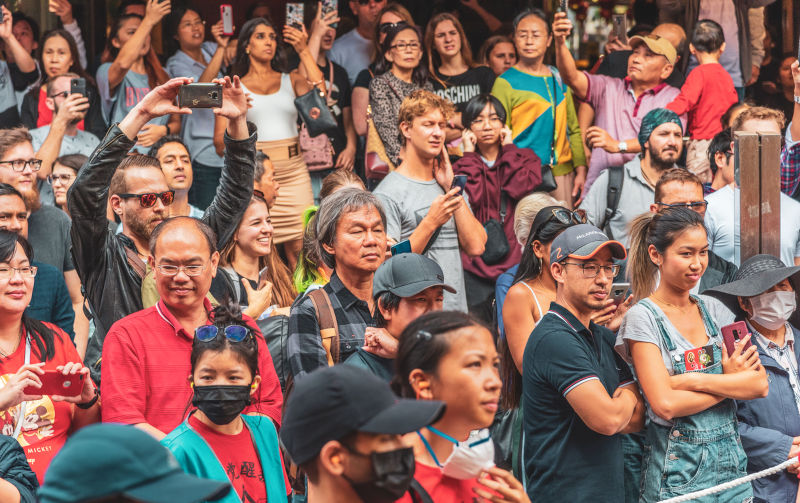
The idea of a monoculture is repressive. What Australia needs is the opposite – a revived cosmopolitan version of multiculturism.
Pauline Hanson is insisting that Australia must be a monoculture and that any attempts to transform it into a multicultural society should be resisted. Angus Taylor seems to be tiptoeing around a similar proposal, insisting that ‘Australian values’ need to be ingrained in the minds of all Australians.
Senator Hanson has suggested that Japan is an example of a successful monoculture, demonstrating how little she knows of the cultural differences that have historically characterised Japanese society and still do today. Maybe she was thinking of North Korea where Kim Jong-Un’s totalitarian government determines what its citizens can know and how they must conform with the Dear Leader’s dictates? Putin’s Russia and Xi’s China are not far behind North Korea in the ways they control their citizens. Are there aspects within these authoritarian monocultures that inspire Pauline Hanson’s idea of an Australian monoculture? Does she – or Angus Taylor for that matter – understand that the repressive nature of a monocultural society is a fundamentally political construct? As Marcia Langton has appropriately recognised, it is a prelude to a proto-fascist state.
Throughout the first half of the 20th century and well into the 1960s immigrants were expected to assimilate or integrate into Australia’s mainstream Anglo-Celtic culture. Prime Minister Menzies declared that he was – and by implication all Australian citizens were – ‘British to the bootstraps’.
Presumably Pauline Hanson is nostalgic about this era, which was often repressive, where books, plays and films could be censored, where citizens could be clandestinely investigated without their knowledge by some stunningly incompetent ASIO agents and where loyalty to the British Crown was expected to be dutifully displayed without question. The ‘Lucky Country’ under Menzies and his successors was a provincial, narrow-minded, racist, populist and xenophobic mini-monoculture. To try to turn the clock back to that monocultural past would be catastrophic for the country in today’s world. We should all understand that Australia’s ethnic diversity is advantageous for the country’s economy, its sociability, for its very civilising influences.
A monoculture is one in which a conformist collective consciousness dominates. It is repressive not liberative, authoritarian not democratic, collectivist not individualist, closed not open. Non-conformity with the collective consciousness leads to sanctions, including racial or gender stereotyping, verbal or physical abuse, bullying, marginalisation, ostracism, torture, even death. It is a jingoistic, mean-spirited, selfish and backward-looking idea whose time passed decades ago, especially as far as contemporary Australia is concerned.
In fact, ‘monoculture’ is a malevolent political metaphor designed to shore up the survival of the leaders of the state, giving them precedence over the rights and freedoms of their subjects. If outsiders are admitted into the monoculture they must conspicuously assimilate to its prevailing habits and values. Newcomers who speak different languages, who dress differently, who worship differently or who eat different foods, are often accused by the monoculture’s cheerleaders of taking advantage of the benefits of their new society without shouldering its obligations or respecting its values.
Australia effectively began its great experiment with multiculturalism in the 1970s, even though it had introduced large-scale immigration programs under the Chifley government in the post-War reconstruction years. The Whitlam government initiated it formally, if somewhat clumsily, as a policy. It was the Fraser government that gave it real meaning with a raft of policies, including establishing the research-oriented Institute of Multicultural Affairs (delinquently dismantled by the Hawke government) and SBS, which began with the provision of vital social and legal services in a range of community languages. This made those services accessible to people previously shut out from them but it was also a firm commitment to recognising their human rights.
Arguably, most significantly of all, the Fraser government facilitated the arrival of refugee ‘boat people’ fleeing from the aftermath of the Vietnam War. This opened Australia to the immense advantages of a post-white Australia era.
The multiculturalism that Gough Whitlam and Malcolm Fraser forged was about the politics of recognition – recognising the integrity of the cultural histories of all the various peoples who had come to Australia over many decades. It aimed to show these people that they were valued and it encouraged them to share their rich cultural heritages with all their fellow citizens. But this great multicultural project has stalled.
The great multicultural project that Australia embarked on in the early 1970s is unfinished business. Our ethnic communities too often feel obliged to retreat into defensiveness, rather than feeling assured that they are valued and that they are being given the resources to share their cultural distinctiveness with everyone. It’s time for the Australian Institute of Multicultural Affairs to be resurrected and resourced to clarify how our ethnically diverse individuals and communities are thriving (or not) and how well (or not) the wider Australian society understands the important contributions they are bringing to the country.
Australia’s multicultural thinking has begun to stagnate. It is mired in too much political double-speak and silly back-slapping about Australia being ‘the greatest multicultural society in the world’. It urgently needs to be updated with cosmopolitan in-put into its thinking and policymaking. As an important philosophical idea, cosmopolitanism is simultaneously a celebration of cultural diversity and about sharing a common humanity.
The said Senator needs to learn a lesson. When she complains about too many ‘races’ in Australia, geneticists can show her that the species Homo sapiens – we humans, all of us, worldwide – are uniformly structured genetically. Physical and cultural differences have nothing to do with some spurious biological notion of race. There is only one race, the human race. To preach otherwise is racist; it is socially and politically divisive and morally disgusting. And so is the furphy of a monoculture. It’s time to expunge it from the country’s political vocabulary. It’s time to celebrate our rich multicultural traditions with uniquely Australian cosmopolitan characteristics.

Dr Allan Patience is an honorary fellow in political science in the University of Melbourne.