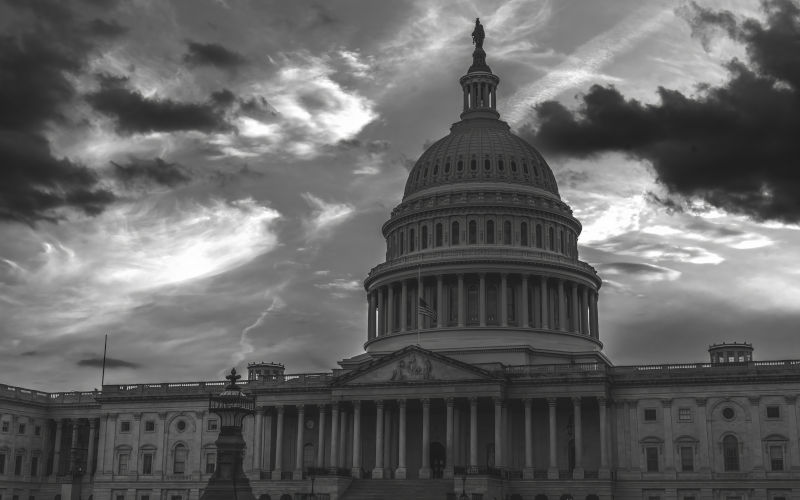
To counter the rise of tyranny, the West must overcome its belief that democracy cannot lead to wrongdoing and instability.
The book Regime Change, Inside the Imperial Presidency of Donald Trump by Maggie Haberman and Jonathan Swan fleshes out the bones of the way President Trump has captured and corrupted the process of US democracy. Its American focus does not consider how this destruction is enabled by the comforting belief across the Western world in the inevitable virtues of democracy and the protection this provides against adverse outcomes.
The West stands stunned and apparently powerless against this US descent into moral anarchy. The American public seems to accept it, albeit with levels of increasing protest. Valued friends and allies turn a blind eye or offer the mildest of criticism when countries are illegally attacked or leaders kidnapped in their pyjamas.
This is all eerily reminiscent of the toleration initially shown towards the Nazis and Hitler before the period of appeasement. Charles Lindbergh, sympathetically famous for the kidnapping of his child, is infamous for his leadership of American Nazi supporters. Now we see this resemblance more closely in the tolerance of the atrocities inflicted on Gaza and Lebanon. With barely a whimper of protest, Western political leaders watch on in morbid disbelief.
What stays their hand? What quells the outrage that ought to overwhelm these travesties of civilised behaviour? Can the root cause be found in the delusions that have become embedded the Western concept of democracy?
The West holds their versions of democracy as the universal elixir and panacea that cures all ills and are happy to force it on unwilling patients.
America makes no claim to be a democracy, although it abuses the term with monotonous regularity in its relations with the rest of the world. The founding fathers established a republic, not a democracy. They deliberately structured their political system to avoid the tyranny of the masses. The Electoral College exists to frustrate what many Western democracies would call a fully democratic outcome. Despite these differences, there lies deep in the core of the belief in democracy the idea that a democracy cannot elect a tyrant or a leader disfigured by moral turpitude.
The West takes comfort and refuge in Churchill’s assertion that democracy was the “worst form of government, except for all the others”. It believes their system of democracy will weed out the corrupt, the incompetent and the vile. There are outliers elected in the process. Enoch Powell, Joe Mcarthy and Pauline Hanson spring to mind but they do not make it into leadership positions.
This ascendance of corrupted excess is not something the West likes to associate with democracy so the rise of the Nazis is built around the collapse of the Weimar republic rather than the triumph of democracy. Democracy advocates conveniently forget that the arch villain of the 20th century, Adolf Hitler, was elected in the thriving, if somewhat fragile, democracy of Weimar Germany. Then he used his electoral success to subvert the very system that propelled him to success.
The same momentum is propelling President Trump, who has surrounded himself with ICE rather than the SS. Just as Hitler did, Trump and his handpicked henchman are purging the generals and destroying those in the bureaucracy and judiciary who would dare apply brakes to his whims and policy objectives. From banking heads to the lowliest reporter, none are immune from the frenzy of vitriolic insults.
The systematic sabotaging of the foundations of democracy with voter suppression, destroying or ignoraing legal legitimacy, and with a morality based on “what I decide it is” almost exactly replicates the processes adopted by Hitler that put Germany under the yoke of tyranny. The corrupt venality of Trump and his administration is unmatched even by the excesses of Herman Goring and his kleptomaniac plundering of the treasures of Europe.
Democracies can, it is thought, do no sustained wrong. The West cites Israel as the only democracy in the Middle East so therefore its dreadful Gaza genocide and annexation of southern Lebanon are somehow less reprehensible than if they had been undertaken by a non-democratic assailant.
If the West is to resile from this moral corruption and overcome the paralysis that has enabled Gaza, Lebanon and the unlawful attacks on Iran then it must first acknowledge that democracy, for all its virtues, can turn up a fruit so rotten that if left unplucked, it will destroy its progenitor.
Defending the ideals of democracy requires courage. It also requires the West to acknowledge and accept that the democratic process does not always produce the best of the bunch. The process can be, and is being, subverted in a way that is almost unimaginable but horrifyingly revealed and documented detailed in Regime Change.
The solution is quite literally a matter of opposing this regime change. It may come about via some form of civil unrest in the United States, although such is the nature of entrenching tyranny that this may not be possible. Therefore, the solution also falls on the shoulders of the international community and must be enforced by concerted action not to accept or normalise the increasingly deranged behaviour of America’s leadership. It means using all the available mechanisms in trade, in treaties, in alliances to shout “enough is enough”. Ireland, Spain, Italy, France have all raised their voices. They have refused permission for military overflights and started repatriating gold reserves from the US. Several have stopped buying US debt. Even the UK, stung by Trumps’ insults about its naval capacity, is speaking just above a whimper.
Most of all, the solution requires the West to revise its idea that democracy cannot lead to dangerous instability.
Australia is not immune. The abuse of parliamentary majority to force through radical taxation changes that were never taken to the electorate, the destruction of transparency and accountability and the rampant corruption in Victoria and elsewhere are assaults enabled by a belief that democracy does not deliver adverse outcomes. Preserving the moral framework of democracy is a daunting but necessary task and it starts by acknowledging it is possible that democracy can be subverted by its own mechanisms.

Daryl Guppy
Daryl Guppy is an international financial technical analysis expert. He has provided weekly Shanghai Index analysis for mainland Chinese media for more than a decade. Guppy appears regularly on CNBC Asia and is known as “The Chart Man”. He is a former national board member of the Australia China Business Council. The views expressed here are his own.