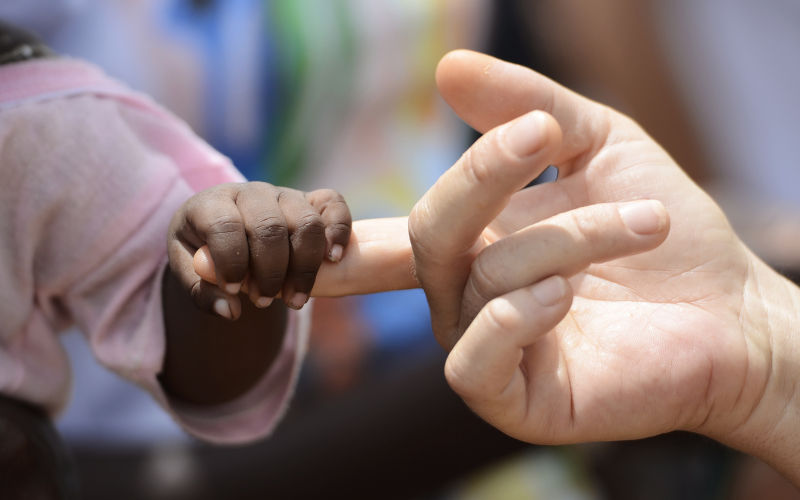
Helping others begins with respect, recognising what they have already achieved and how to assist them to realise their capabilities.
Education rescued me from poverty, but not from responsibility.
For years our father repaired the family house as best he could, patching cracked walls and replacing broken roofing sheets whenever money allowed. The house survived, but survival and dignity are not always the same thing.
After completing my doctorate in Glasgow, I returned home and renovated it, strengthening the walls, repairing the roof and adding a shaded veranda. When the work was finished, my mother stood quietly beneath it before saying, “Now, if I die, people will not stand in the sun to say goodbye”.
No degree had prepared me for the weight of that sentence.
Until then, education had always meant escape: from school fees my parents could barely afford, through scholarships, from the narrow opportunities of village life. It carried me from rural Ghana to Glasgow and eventually to an academic career in Australia. Like many children born into poverty, I assumed success would make life easier. For a brief moment, I believed I had arrived.
Instead, I entered another form of poverty: the poverty of never having enough to help everyone.
The requests began quietly, school fees, hospital bills, funeral contributions, then multiplied into support for migration, small businesses, unemployed relatives, community development donations and countless other genuine needs. I discovered something few successful migrants discuss openly. Escaping poverty does not end obligation; it expands it. Every opportunity that enlarged my own life enlarged the circle of people who hoped I might enlarge theirs. Even an Australian professor’s salary could not stretch to the horizon.
Eventually I realised I needed more than generosity. I needed a way of deciding.
The answer came from an old Ewe proverb: “The one who lifts the load to the knee is the one helped to raise it onto the head.”
Only later did I understand its wisdom. Help those already walking. Meet effort with opportunity. Strengthen initiative rather than replace it.
That became the principle guiding my giving, not because I became less generous, but because generosity also requires judgement.
Sometimes it worked beautifully. Supporting one of my younger brothers through vocational training eventually enabled him to supervise the construction of major hospitals. A roadside trader who sold bananas and roasted groundnuts used a small donation and simple bookkeeping to expand her business. Years later she arrived carrying a live chicken and proudly told me that one child had become a nurse and another a teacher.
Not every story ended that way. Some young people never found work. Illness consumed money intended for investment. The dead still needed burying and the sick still needed treating. No principle removes the pain of saying no. But helping those already helping themselves proved the fairest way I could navigate a world where need would always exceed my capacity to respond.
Years later, Australia tested that philosophy in an unexpected way.
After moving from teaching Aboriginal health workers into health and medical research, I expected congratulations. Instead, an Aboriginal colleague asked: “What are you doing with those research mobs? We’ve been researched to death. The researchers get their PhDs and become professors. What do we get?”
Their words stopped me. They reminded me of another question I had heard years earlier in my own village. When I first left home, my father had asked, “If we send you to school and what you learn cannot improve our lives, what is the point?”
Separated by continents and history, my father and my Aboriginal colleagues were asking exactly the same question: What is knowledge for if it does not improve people’s lives?
That question changed my career. Instead of asking what interested researchers, I began asking what communities themselves wanted to achieve and how research could strengthen those efforts. Working alongside Aboriginal leaders through participatory action research, with continuous quality improvement approaches, I learned that lasting change begins by strengthening people’s own aspirations rather than importing solutions.
The lesson reaches far beyond my own life.
In 2024, Africans living abroad sent home about US$95 billion, more than the continent received in foreign aid and roughly as much as foreign direct investment. But still universities teach courses on aid effectiveness, while paying remarkably little attention to remittance effectiveness.
Perhaps we have been asking the wrong question.
Development assistance often begins by asking, “What should we do?” The diaspora usually begins somewhere else: “What are people already trying to do?”
Across Africa, governments, businesses, farmers, churches, women’s groups and families are already solving problems with whatever resources they possess. Their efforts are imperfect, but they exist. The diaspora’s greatest contribution may not be to create new initiatives but to strengthen those already demonstrating commitment. Helping those already helping themselves is not simply a family philosophy; it is also a development philosophy. It directs scarce resources towards effort rather than dependency, builds on trust rather than replacing it, and is less vulnerable to the waste and corruption that undermine many well-intentioned interventions.
I have never solved the problem of deciding whom to help; nobody can. Need has no natural boundary. Our resources do.
Over four decades, as a son, brother, teacher, researcher and member of the African diaspora, I have come to believe that the most enduring help multiplies the efforts of others rather than replacing them. Perhaps that is why the old Ewe saying has stayed with me. “The one who lifts the load to the knee is the one helped to raise it onto the head.”
Africa does not lack people trying to lift the load. So, perhaps the diaspora’s greatest contribution is not to carry Africa but to recognise those already walking and help them walk a little further.
Sometimes I think back to my mother standing beneath the veranda of our family home. Only years later did I understand that she was not thanking me for a house. She was teaching me something about dignity. Development, whether in a family, a village or a nation, begins there, not with rescue, but with respect.
Komla Tsey
Komla Tsey is a Ghanaian–Australian writer, retired Professor of Education for Social Sustainability, and part-time Professorial Research Fellow at the Jawun Research Institute, Central Queensland University. His writing explores education, democratic culture, identity, Indigenous empowerment, colonial legacies and the moral certainties that shape public life. His forthcoming memoir, Botoku Child, traces a journey from a small village in Ghana to universities and communities across the world, examining how inherited beliefs, curiosity and lived experience shape both personal lives and democratic societies.