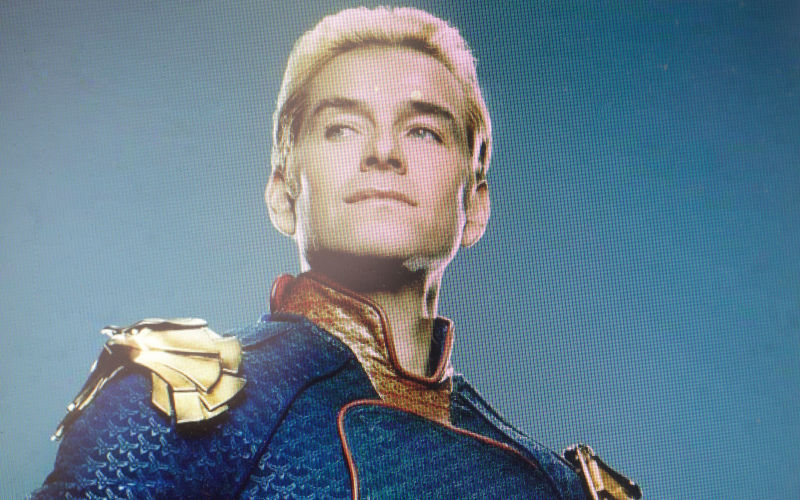
The Boys spent years exaggerating the Trump era. By its final season, political reality had become so grotesque that satire was struggling to stay ahead.
I don’t get much time to watch TV – and when I do I normally fidget my way through an episode before distractedly picking up my phone – but I do set aside time for The Boys, whose final season has recently aired.
Before we get into that, some disclaimers. This show is extraordinarily, graphically violent. It features superheroes and an unconscionable amount of spandex. It stars Kiwi actor Karl Urban giving us probably the worst attempt at a London accent since Dick Van Dyke brutalised the ears in Mary Poppins.
Honestly, if you haven’t seen it, enter at your own risk.
The show is about what happens when superheroes are products controlled by a corrupt and villainous corporation, when people are the valueless collateral of capitalism and when religion is used to reinforce a deeply broken status quo.
It tells the story of superpowered Homelander – think an all-American Superman but narcissistically evil – and a small group of flawed people who try to stop him as he goes from being a case study in ‘absolute power corrupts absolutely’, through increasingly fascist tendencies and literally sleeping with a Nazi, to believing – and demanding others believe – that he is god.
It’s also biting political satire. Since its first season in 2019, it has held a mirror up to the absurdity of the Trump era. And like the best political satire, it has stayed ahead but uncomfortably close to the politics it is poking.
By its final season, though, something had changed.
Over the course of the show’s five seasons, staying that one step ahead became harder and harder. With Trump back in power and increasingly unhinged in his vanity, greed and cruelty, the gap narrowed even further.
The grim reality of US politics caught up with its satire.
In season five, Homelander completely collapses the distinction between a leader, a celebrity brand and a commercial enterprise. Ring any bells? He casually shows public cruelty to assert his dominance. Sound familiar? And he presents himself through religious and messianic imagery. Remind you of anyone?
This is the struggle of the final season of The Boys. What happens to a show when the reality it’s satirising starts to overtake its ability to keep up? When the absurdity of the real world feels indistinct from the absurdity of the show?
Satire works best when it is reality, plausibly stretched. How could The Boys possibly hope to keep up with Trump’s second presidency?
In its fifth season the show wrestled to find the answer to that. At times its targets felt a bit obvious and uncomfortably close to the news cycle. Australians might call it “a bit on the nose”, without needing to lean into a Mockney accent.
But over the course of its seven-year run, The Boys graphically, bloodily, illustrated the machinery around power – celebrity culture, corporations with too much influence, a compliant media, distorted religious devotion, public cruelty and people rationalising the indefensible because it’s their side that’s doing it.
That machinery will be very familiar to readers of P&I. In just the last couple of weeks we’ve had John Menadue writing about institutional decay and collapsing trust, Ronald Keith on what Trump’s transformation of America means for Australia, and Marta Khomyn on the merging of presidential power and personal enrichment through crypto.
The Boys cranks this up to comic-book volume 11. The uncomfortable point is that the underlying machinery is real, and familiar.
Satire helps us to see political reality differently. Dr Strangelove did it. So, too, did Yes, Minister. It turns out that a grotesque TV show full of exploding body parts can do it as well.
Would I recommend that you watch The Boys? Yes, with all the caveats I’ve detailed here. Did its satire always work? No, but it had a lot more hits than misses. Did Karl Urban’s accent get better? It did not.
But did it succeed in being a clever, mocking accompaniment to the Trump era?
Very much yes.
The Boys arrived during Trump’s first presidency and increasingly mirrored and exaggerated it. By the end of its fifth season, the disturbing thing was how little space there was left for that exaggeration.
At its best, it gave viewers the chance to see something ugly, laugh at its absurdity but then realise the joke was getting uncomfortably close to the truth.
—
If you like our work, you can help. We take no corporate or government funding, run no ads and subscriptions are free. So please consider making a donation.

Martyn Pearce is the sub-editor at Pearls and Irritations