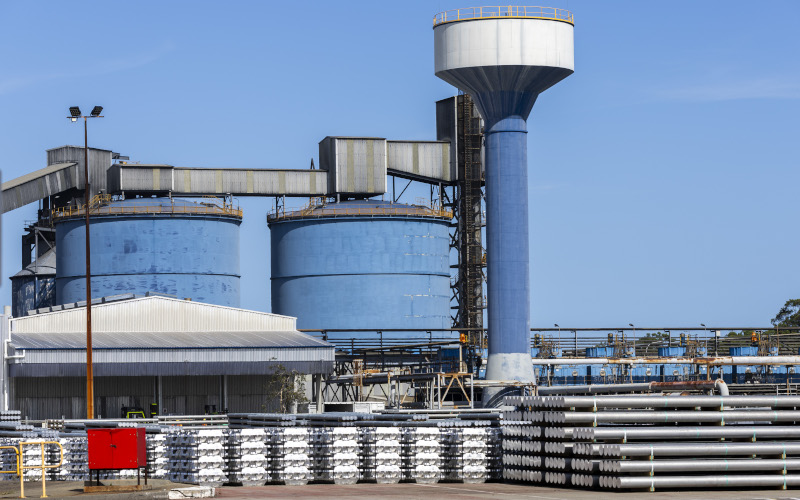
Keeping Tomago open is not just about one smelter. It is a test of whether Australia is prepared to invest strategically in manufacturing, energy and industrial capability.
Economists have a curious habit in Australia of calling for increased productivity and economic diversification, only to then cry foul over any government intervention to promote innovative ideas and technologies, let alone ‘prop up’ existing industrial assets.
We want to be a nation that makes things, yet mainstream policy advisers balk at investing in the very industrial ecosystems that ensure manufacturers can survive and expand on our shores. When it comes to the future of Tomago – Australia’s largest aluminium smelter – this contradictory argument is well and truly alive.
We have heard plenty in recent months about the fiscal ‘cost’ of saving Tomago. But there has been far less focus on the cost of inaction, or the benefits of creating a blueprint for how we can invest in the future of our manufacturing base wisely, efficiently and strategically to ensure the taxpayer receives genuine upside.
First, consider the cost of doing nothing. Australia remains overwhelmingly reliant on exporting unprocessed raw materials to drive growth. We are effectively sustaining a first-world lifestyle with a third-world trade and industrial structure.
Australia currently ranks 74th on the Harvard Atlas of Economic Complexity because of our abject failure to move up the global value chain. Our manufacturing capacity has plummeted from nearly 30 per cent of GDP in the 1960s and 1970s to less than 6 per cent today, the lowest level of self-sufficiency in the OECD. This has been accompanied by a decline of business investment in R&D to less than half the OECD average and the lowest productivity growth for 60 years.
For the average household, these might seem like abstract macroeconomic data points. But we have now suffered two massive sovereign shocks in the space of six years – first the pandemic, and now, as we speak, war in the Middle East closing vital global shipping lanes like the Strait of Hormuz.
Imagine these events playing out again in five years’ time, but without Tomago or our other remaining heavy industrial facilities. If our supply chains become even more reliant on volatile trading patterns and commodity price cycles, what does the cost of past inaction look like then?
Imagine, too, the cost of abandonment for the people of the Hunter region of NSW. Over many years – most recently as reviewer of the Federal government’s Energy Industry Jobs Plan – I have had the opportunity to discuss the region’s future with workers, business owners, community leaders, and policymakers.
For them, the cost of letting the smelter close is immeasurable. The negative network effects would ripple across the region, from the loss of skilled, intergenerational livelihoods to the hollowing out of the local engineering and service supply chains that rely on Tomago’s scale.
Now look at the benefits of acting. Tomago is a vital asset within nine industrial subsectors that form the backbone of Australia’s productive economy and is a major value adding contributor to an otherwise resource-heavy export mix. These assets support over one million jobs – around eight per cent of total national employment.
Without such assets, we lose a springboard for investment in high-value, knowledge intensive manufacturing.
These facilities – particularly alumina and aluminium operations – are incredibly energy-intensive. Whether they produce cement, green steel or aluminium, they require access to low-cost, abundant and reliable electricity. As our aging coal-fired power stations retire, costs for industrial users are spiking because fossil fuels are increasingly expensive, and we are not deploying renewable replacement energy at the speed and scale required.
With Tomago, it is pleasing to see that the Federal and NSW governments are committed to solving multiple structural problems at once with an innovative approach to maintaining and renewing the facility.
This approach provides an opportunity to leverage the state’s lower cost of capital to underwrite lower-cost energy for the smelter. Crucially, for every 1 per cent reduction in the cost of capital, we can reduce end-user energy costs by roughly 10 per cent.
With the government becoming a strategic off-taker via its Special Investment Vehicles (SIVs), we can give the myriad renewable energy and storage projects currently stalled in the NSW planning pipeline the commercial certainty they need to build and deliver power.
Repowering the smelter efficiently actually reduces the broader burden on our grid. Let’s not forget that Tomago consumes 10 to 12 per cent of the state’s electricity; integrating it smartly into a modernised grid helps stabilise the system for all consumers.
Most importantly, by investing in Tomago we secure a highly strategic sovereign asset perfectly positioned to produce the exact material the global economy is demanding: low-carbon aluminium for everything from electric vehicles to modern infrastructure.
But this funding shouldn’t be a one-way street. Done right, we can build equity or upside-sharing mechanisms into this state support. If the asset thrives and profits rise, the Australian taxpayer should directly share in that financial upside.
Once we have done it once, we can do it again – moving Australia up the value chain and securing our manufacturing base. This will build confidence to invest in the jobs and technologies of the future, which will in turn underpin a diversified trade and industrial structure.
Investing in Tomago can change the conversation in regions like the Hunter from one of anxiety and closure to one of proud, sustainable, well-paid industrial communities that enable families to work and give back to their community. We can turn the rhetoric of repowering our industry into reality – and that’s a benefit that is priceless.

Emeritus Professor Roy Green AM is Special Innovation Advisor at the University of Technology Sydney, where he was Dean of the UTS Business School. He has pursued a career in universities, government and industry, and has published widely on innovation and industrial policy, including with the OECD. He has chaired the CSIRO Manufacturing Sector Advisory Council, the Enterprise Connect Innovative Regions Centre, the Queensland Competition Authority and the NSW Manufacturing Council. Currently, Roy chairs the Advanced Robotics for Manufacturing (ARM) Hub and the Port of Newcastle, and he is a board director at CSIRO and SmartSat CRC. Roy Green is Special Innovation Adviser at the University of Technology Sydney and Chair of the Advanced Robotics for Manufacturing (ARM) Hub