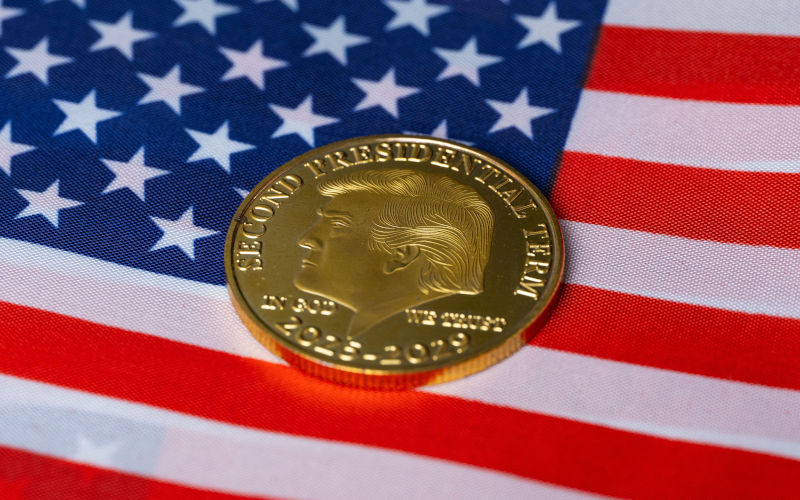
Trump’s cryptocurrency ventures show how political loyalty can be converted into money, access and market value while US institutions struggle to restrain conflicts of interest.
Like many people outside the United States, I admire much of what it represents: open debate, strong institutions, energetic politics and the belief that public power should be restrained by rules. That is why watching the US today is so extraordinary.
Consider US President Donald Trump’s meme coin. Nearly a million accounts that bought the $TRUMP coin have lost money, according to a report in The New York Times based on analysis of blockchain transactions. Their collective losses have been estimated at US$3.8 billion. Trump, meanwhile, has reportedly received more than US$1.4 billion from cryptocurrency ventures associated with him and his family.
In a social media post, economist Paul Krugman called the buyers of coins “suckers” of a pump-and-dump scheme in which naive investors piled into a worthless asset while insiders prospered.
This might not fully explain what happened. Trump demands unquestioning loyalty and has an intensely loyal political following. Is it really surprising that some of the people who voted for him would buy something carrying his name?
Think of the meme coin less as a conventional investment and more as a strange combination of political donation, memento and lottery ticket. People buy hats and T-shirts bearing the name of a politician they support. They donate to campaigns despite knowing they are unlikely to receive a financial return. Fans pay extraordinary prices for objects associated with their idols.
The Trump coin combines all of these impulses. You buy a digital piece of Trump and feel you are part of his world. Many small buyers do not see themselves as victims. It might even be exciting to purchase something so new.
This does not remove the obvious conflict of interest. Quite the opposite. The significance of the Trump coin is that it shows, in a particularly vivid form, something Trump appears to understand exceptionally well: political loyalty can be converted. Loyalty can become votes, campaign funding, television audiences, social media attention and demand for merchandise. Now it can become the market value of a financial asset.
What happens to a political system when a leader commands an intensely loyal community and becomes highly effective at converting that loyalty into money, power, access and market value? For those of us watching from afar, this question is front and centre.
Trump’s critics search for criminality. While that might not always be clear, the conflicts of interest are in plain sight. That distinction matters. Conflict of interest rules, political conventions and norms of public service exist precisely because there is a large space between conduct that is criminal and conduct that is healthy for government.
Trump repeatedly occupies this space. His administration makes policy affecting cryptocurrency, while Trump and his family have major financial interests in cryptocurrency ventures. His political supporters can buy a coin bearing his name. Large holders have been offered access to him. The commercial and political worlds overlap in full public view.
Perhaps lawyers can explain why particular transactions are permissible, but that is not the point. The rest of the world watches with astonishment.
The same instinct to reduce everything to its political value is visible in Trump’s discussion of elections. Following a recent US Supreme Court decision affecting voting rights and redistricting, Democratic lawmakers proposed legislation to strengthen voting protections and reform political institutions. Trump attacked the proposal, declaring that if Democrats succeed, “the Republican Party is DEAD!”
American politics has always involved fierce battles over electoral rules, redistricting and the courts. What is striking about Trump is he dispenses with institutional language while other politicians argue about federalism, constitutional interpretation or judicial restraint. Trump baldly tells you his political calculation: this will hurt my party.
Again, he converts the question. An electoral rule is understood through political power. A political following becomes a commercial market. Access becomes an asset. Attention has a price.
None of the forces behind this began with Trump. Money was already embedded in elections. Gerrymandering long predates him. Celebrity had already merged with politics. Trump is the culmination of these forces rather than their sole creator, but he has brought them together in one person and stripped away the embarrassment that once accompanied them.
For an outsider who has long admired the US, this is the most unsettling part. America has spent decades telling the world about the importance of institutions, transparency, conflicts of interest and the rule of law. Its influence rested not only on its economic and military power but also on the idea public institutions mattered.
We see an American president openly monetising his political following while exercising public power. We see electoral rules increasingly debated, not simply as principles of democratic participation but as instruments that determine which side wins.
To say all this is not to take the side of Trump’s opponents. It is to ask a more fundamental question about the US. Trump has shown how political loyalty can be transformed into votes, money and market value. He has built a political community whose attachment to him appears remarkably resilient.
America’s political system can see obvious conflicts of interest and debate them loudly, yet it appears to have limited capacity to constrain them. So, the question is whether America’s institutions can deal with a political leader who is skilled at converting loyalty into every other form of power.
Republished from the South China Morning Post

Christine Loh is the chief development strategist at The Hong Kong University of Science and Technology’s Institute for the Environment. She was a former undersecretary for the environment in the HKSAR Government (2012-17), a former legislator in Hong Kong, and former CEO of the non-profit think tank Civic Exchange.