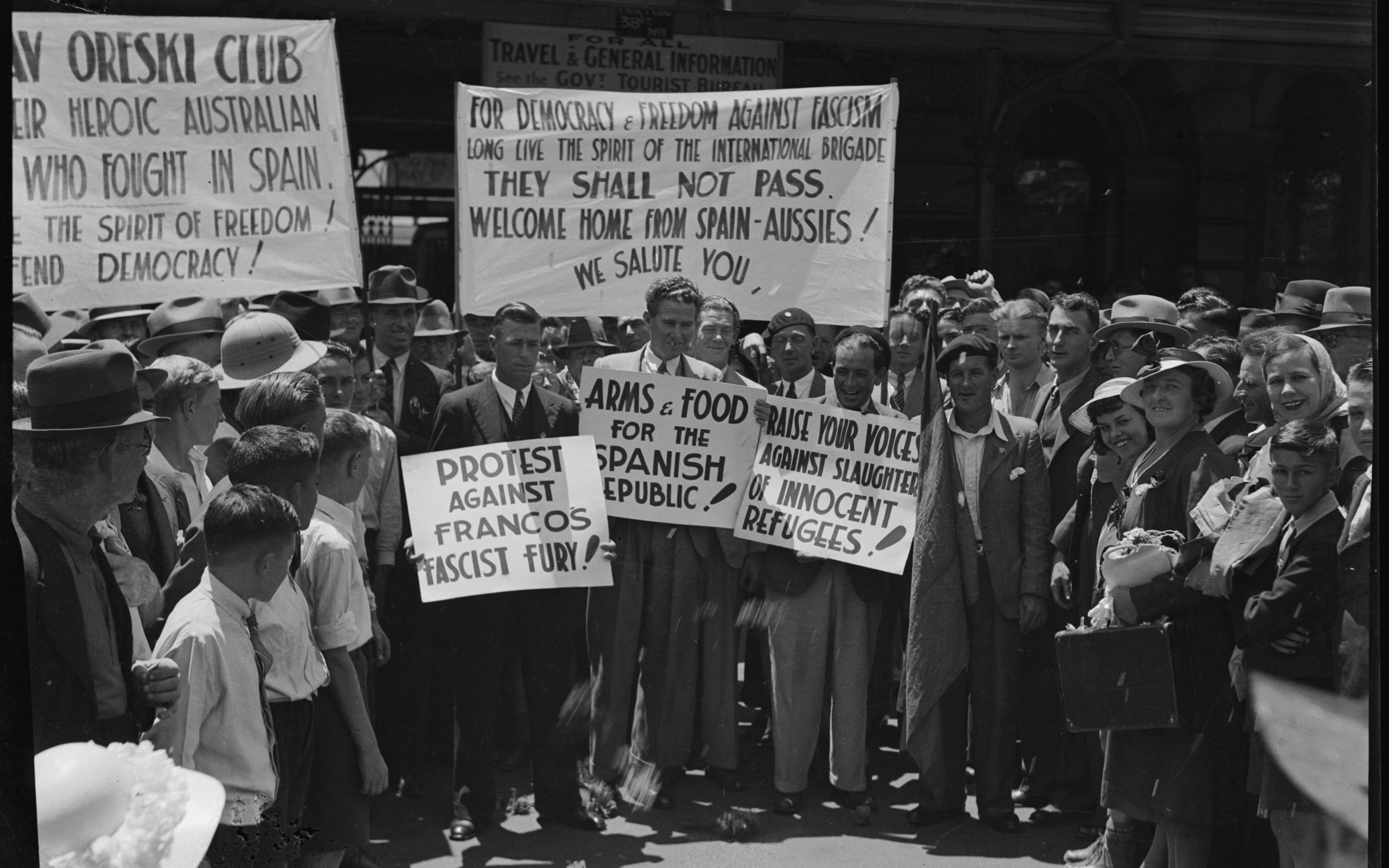
Ninety years after the Spanish Civil War began, the Australians who fought for the Spanish Republic remain largely excluded from official remembrance.
During the Second World War, more than one million Australians fought in the global struggle against fascism. These men and women have rightly been honoured with official memorials, honours, pensions and support.
But the first Australians to fight fascism, those who fought for the Spanish Republic against the forces of Hitler, Mussolini and Franco in the Spanish Civil War, have never been so honoured. In fact, they have been officially ignored.
The Spanish Civil War began on 17 July 1936, 90 years ago this week, with a military coup against the democratically elected government of the Spanish Republic. Hitler and Mussolini sent troops to assist the rebels; a faltering coup turned into the Spanish Civil War. Stalin sent some aid to the Republic but the Western democracies stood aside and, as they would with Czechoslovakia, allowed a European democracy to be destroyed by fascists.
Supporting the Spanish Republic became a global cause. About 70 Australians went to fight with the International Brigades. Many were working-class men, toughened by the hardship and degradation they had endured during the Depression. Some had fought the New Guard on the streets of Sydney, while others were veterans of bitter strikes. One was Jim McNeill.
Spain was a long way from Australia, with a different language, history and culture, but the volunteers had a political commitment, an international outlook, and were prescient in understanding fascism’s threat. They were convinced that fighting it was the right thing to do.
These Australian men and women were defeated on the battlefields of Spain – 16 never returned – but it did not take long for their actions to be vindicated. Within a few months of the fascists winning the war in Spain, the Second World War began.
The Australian Government did not welcome the returning International Brigaders and provided them with no official recognition. Fighting fascism in Spain did not make them eligible to receive the health benefits, pensions or the support provided to other veterans and their families.
The reasons for this different treatment are not hard to discern. These Australians ignored their government’s directives and travelled across the world to fight fascism, while at the very same time, their government was supporting Britain’s policy of appeasing the fascist regimes of Hitler and Mussolini. After the Second World War, the Australian veterans of the Spanish Civil War were an awkward reminder that during the 1930s, not everyone had been an appeaser or, worse, an open admirer of the dictators.
Throughout the Cold War, the fact that the volunteers in Spain were members of the broad left, with most being trade unionists, and many being card-carrying members of the Communist Party of Australia, made it even harder for the Australian Government to acknowledge the correctness of their cause.
The International Brigades have been culturally remembered, including in Hemingway’s classic novel For Whom the Bell Tolls, and in music, such as Britten’s Ballad of Heroes. The National Gallery of Australia’s collection includes James Cant’s powerful Returning Volunteer, an unsettling picture of a maimed International Brigader. One of cinema’s all-time greats, Casablanca, tells the story of an embittered ex-International Brigader, Humphrey Bogart’s Rick Blaine, returning to the anti-fascist fight.
Despite being recognised in the culture, these pioneering anti-fascists are not honoured in the Australian War Memorial, which has never had an exhibition about the Australian International Brigaders. Ignoring Australian involvement in a conflict that was the prelude to the Second World War corrupts historical understanding and stands in stubborn contrast to the Memorial’s sibling institution in London, the Imperial War Museum, which has staged major exhibitions on Spain.
It was not until 1993 that a memorial to the Australian volunteers, funded not by the Australian Government but by public subscription, was finally erected in Canberra. Another memorial was placed in the Victorian Trades Hall in 2024. There are still no memorials in Sydney or the other capitals.
On this, the 90th anniversary of the beginning of the Spanish Civil War, the courage, selflessness and solidarity of the Australians who fought should be remembered. They were Australia’s pioneers against fascism.

Michael Samaras
A Sydney-based researcher and writer, Michael Samaras is the author of Anti-Fascists: Jim McNeill and his Mates in the Spanish Civil War.