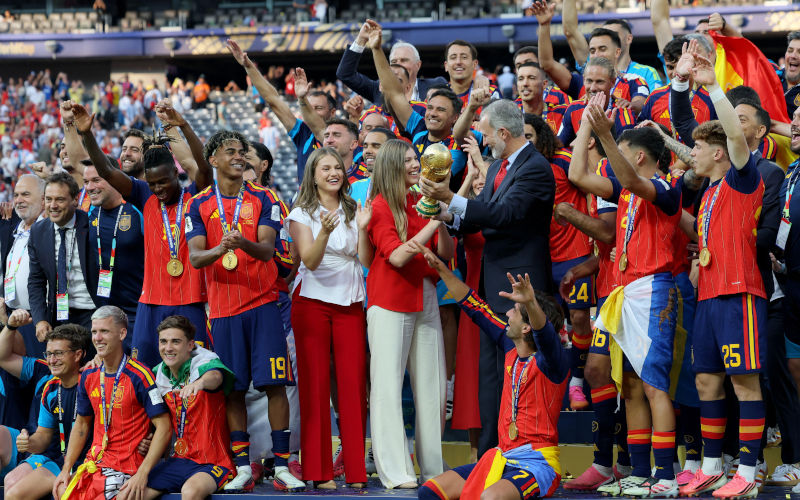
Gaza has rearranged the world’s moral geography. Once-distant countries feel close because they have spoken when others are silent. At the World Cup final, that moral geography was evident in the football stands.
For many of us, Gaza was on our mind when we watched and celebrated Spain’s triumph at the World Cup.
This week, Spain defeated Argentina to win the World Cup. Ordinarily, for those of us with no national connection to either country, the choice of whom to support would have been gloriously trivial. We might have chosen the team that played more beautiful football, the player we most admired or simply the side whose colours we preferred.
Gaza and Palestine have changed the way many of us see the world. It has become a moral prism, refracting our judgements not only about governments and political leaders, but about institutions, universities, media, corporations and public figures. We have watched people and institutions we once respected avert their eyes from the destruction of a people. We have watched others discover elaborate vocabularies of qualification and equivocation when confronted with horrors that, in another place and against another people, they would have condemned without hesitation.
And we have remembered those who refused to look away.
That is why, as I watched, I was Spanish.
Of course, a football team is not a government. Spanish footballers are not responsible for the policies of Spanish Prime Minister Pedro Sánchez, any more than Lionel Messi and his teammates are responsible for the politics of Argentinian President Javier Milei.
But sport has never existed in the hermetically sealed apolitical world we sometimes pretend it inhabits. We bring ourselves to sport. We bring our histories, our identities, our sympathies and, inevitably, our moral judgements. We decide whom we want to win for reasons that often have very little to do with formations and statistics.
And so, for many people of conscience, Spain has come to represent something larger.
At a moment when much of the Western political establishment has twisted itself into moral and linguistic contortions over Gaza, Spain has stood apart. Sánchez and his government have been willing to speak with a clarity conspicuously absent from many of Spain’s Western allies. Spain recognised the State of Palestine. Sánchez has openly used the word genocide to describe what is being done in Gaza. His government has moved to entrench an arms embargo against Israel.
One need not agree with every policy of the Spanish government to recognise the significance of that position. Moral courage is measured precisely when taking a position carries a cost.
There was also something deeply moving about seeing Lamine Yamal, one of the brightest young stars in world football, waving the Palestinian flag during Barcelona’s celebrations after winning La Liga.
It was a small gesture in the vast landscape of Palestinian suffering. But symbols matter, particularly when so many powerful institutions have worked so hard to make Palestine invisible.
There was Yamal, at the summit of sporting success, surrounded by celebration, holding up the flag of a people whose suffering the world has been asked repeatedly to forget. And he wore the colours of Spain in a World Cup final and emerged a world champion.
On the other side stood Argentina, a magnificent footballing nation led by perhaps the greatest footballer of his generation. And here, too, Gaza intruded upon the emotions with which some of us watched. An image of Lionel Messi at the Western Wall in occupied East Jerusalem has circulated widely. It dates back to Barcelona’s 2013 visit to Israel and the Occupied Palestinian Territory, years before the present catastrophe. But images have lives beyond the circumstances in which they were created, and Gaza has transformed the way many of us see them.
The contrast with Lamine Yamal is striking. There is the image of Messi at the Western Wall. And there is the image of Yamal, at one of the happiest moments of his young career, waving the Palestinian flag. Different moments, different circumstances, different intentions.
Symbols matter. For those whose view of the world has been transformed by Gaza, it is impossible not to feel the emotional force of the contrast.
And beyond Messi stands the politics of Javier Milei. Argentina’s president has made his allegiances clear. He has embraced US President Donald Trump and declared himself “the most Zionist president in the world” at precisely the historical moment when Palestinians in Gaza have endured unimaginable destruction.
Argentina’s footballers are not responsible for Milei, and its people cannot be reduced to their president. But neither can those politics be entirely erased from the emotions with which the rest of us watch.
Then there was another recent vote, far removed from Gaza but revealing in its own way. In March, the United Nations General Assembly adopted a landmark resolution confronting the historical wrongs of the transatlantic trafficking and enslavement of Africans and calling for reparatory justice. One hundred and twenty-three countries voted in favour. Fifty-two abstained. Only three countries in the entire world voted against it: the United States, Israel and Argentina.
There is something extraordinary about that alignment. On an issue concerning one of humanity’s greatest historical crimes and the continuing demand for reparatory justice, Trump’s America, Benjamin Netanyahu’s Israel and Milei’s Argentina found themselves standing together, virtually alone.
It is difficult for those of us who increasingly view the world through the prism of Gaza not to notice the pattern. The issues are different, the histories are different and the legal questions are different. But the moral instinct seems eerily familiar: when the victims of historical injustice demand recognition, accountability and redress, the same governments so often seem to find reasons to stand on the other side.
So, yes, I watched a football match.
I admired Messi because greatness remains greatness. I marvelled at the extraordinary history of Argentine football.
But I wanted Spain to win.
And Spain won.
Perhaps that says something about what Gaza has done to us. It has rearranged our moral geography. Countries that once felt distant can suddenly feel close because they spoke when others were silent. Governments we barely thought about can earn our respect because, at a moment of profound moral testing, they refused to avert their gaze.
And sometimes that moral geography spills into the most unexpected places.
This week it spilled onto a football pitch.
Millions celebrated Spain’s victory because they love Spanish football, because they admire Lamine Yamal or simply because their team had won the greatest prize in the sport.
But many also celebrated out of solidarity with the Palestinian people.
A World Cup cannot deliver justice to Palestine. Spain’s victory will not feed a hungry child in Gaza, rebuild a destroyed home or bring back the dead. We should never confuse symbolism with justice.
But human beings live partly through symbols. And for some of us, the red shirt of Spain carried a meaning it was never designed to bear.
When Lamine Yamal and his teammates lifted the World Cup, I celebrated with them.
Not because football can change what has happened in Gaza.
But because Gaza has changed the way I watch even a game of football.
Republished from Al Jazeera

Ziyad Motala
Ziyad Motala is a Professor of law at Howard University School of Law and the former Director of the Comparative and International Law Program conducted at the University of Western Cape since 1995. He served as an Honorary Professor of Law at the University of Western Cape School Of Law in South Africa. Prior to his teaching at Howard, he also taught at Northwestern Law School as an Adjunct Law Professor and a visiting Professor at Chicago-Kent College of Law. Motala is a native of Durban, South Africa, and was active in the struggle for liberation in South Africa.