One Nation’s rise is being driven by economically stranded Gen X voters in outer suburbs and regions, not the racial and culture-war constituency Pauline Hanson keeps trying to address.
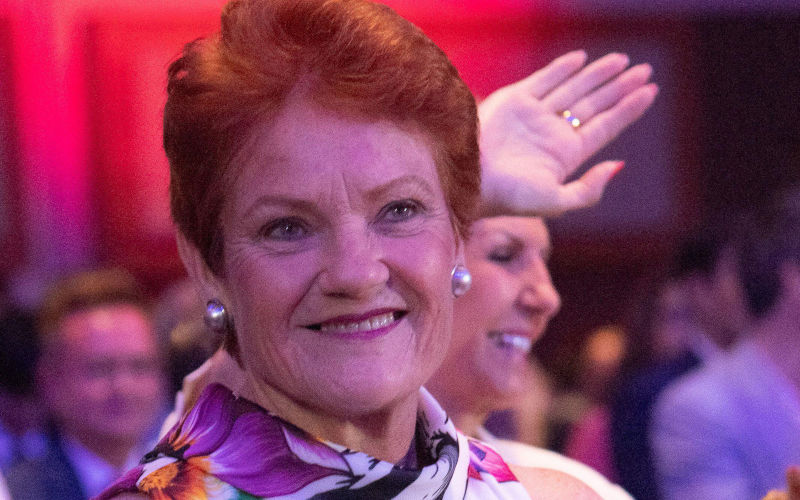
Last weekend Pauline Hanson delivered a speech to CPAC London titled The Australian Fight Back. Around 120 people turned up. Fewer than a quarter of the seats were filled. She used the platform to defend her remarks blaming the end of the White Australia policy for the country’s migration problems, and to attack the concept of white privilege.
That half empty hall is the perfect image for the moment we are in. Hanson was speaking to an audience that largely does not exist. The ideological faithful she imagines behind her party’s surge, the room full of true believers in a racial and cultural project, did not show up. Because they were never the story. The voters who have propelled One Nation to the position of Official Opposition are not in London ballrooms nor are they the Australians that have supported her for the last 20 years. Her new supporters come from Cranbourne, Ipswich, Elizabeth, the Latrobe Valley and the Hunter. And they are not voting for the things Hanson talked about on that stage.
To understand who they are, we have to look deeper. And that means looking at a generation Australian politics has ignored for 30 years.
The stable generation that stopped being stable
For most of their voting lives, Generation X were the ballast of Australian politics. Polling barely bothered to distinguish them. They split their votes between the major parties in roughly the proportions their parents did, swung modestly with the national mood and attracted none of the attention lavished on Boomers, who decided elections, or Millennials, who were supposed to decide the next ones.
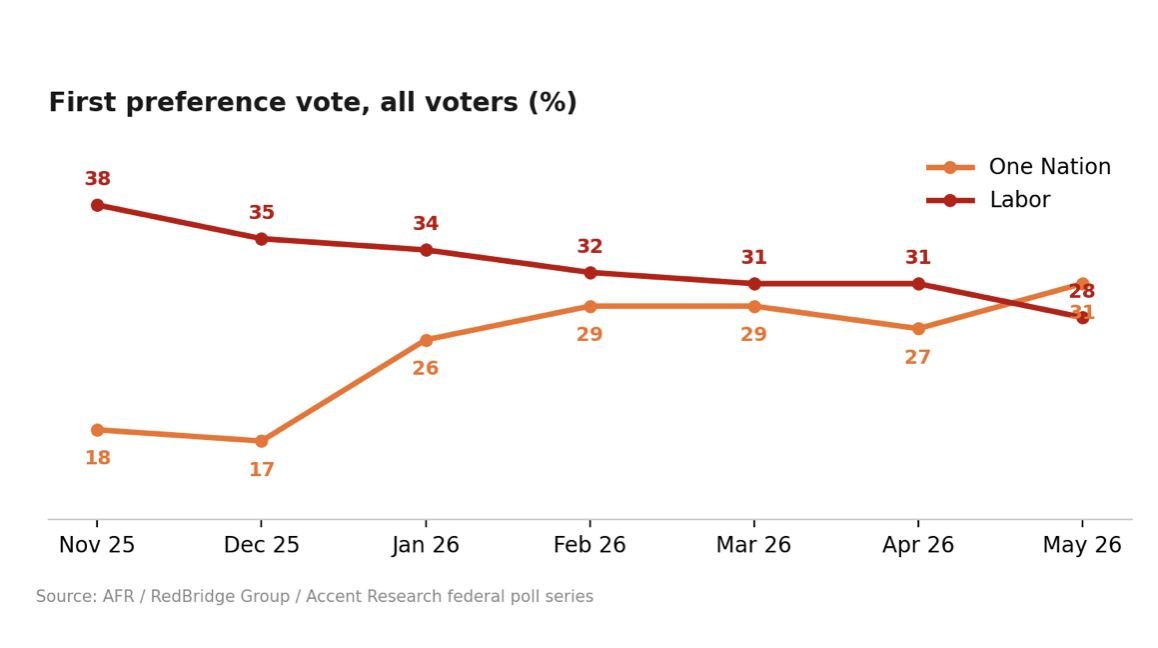
That stability has now collapsed. Our recent polls published in AFR place One Nation around 30 per cent of the national first preference vote, neck and neck with Labor. Twelve months earlier that figure was in the teens. As recently as December it was 17. The surge that followed over summer, nine points in a single month, was not evenly distributed across the electorate. It was driven by one generation above all others.
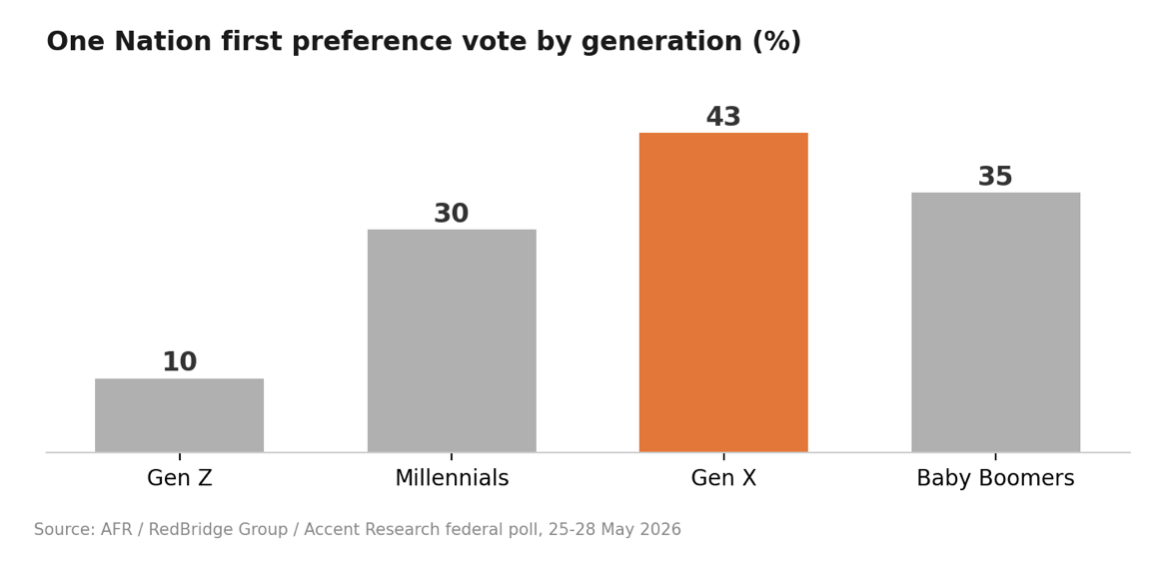
Among Gen X voters, One Nation’s first preference vote now sits at 43 per cent. That is the highest of any generation, ahead of Baby Boomers on 35, older than the party’s stereotype and vastly ahead of Gen Z on just 10. The generation supposedly defined by young male grievance is barely participating. The generation nobody was watching is driving the bulk of the realignment.
A generation that was politically boring has become the trigger for the most significant realignment since the Second World War. The question is why. And the answer is not ideology. It is biography.
A cohort formed by shocks
Not all of Gen X has moved. The movement is concentrated in a specific subgroup: outer urban and regional Australians, mostly without degrees, who entered the workforce in the early 1990s.
Consider what that timing meant. They left school into the recession we supposedly had to have, when youth unemployment in parts of regional Australia ran above 25 per cent. Many never got the secure entry into work that their parents took for granted. Those who did found their footing just in time for the Internet to arrive and begin dissolving the clerical, administrative and skilled manual work that had anchored their communities.
Then came the long decline of traditional industry. Manufacturing employment has roughly halved as a share of the workforce since this cohort entered it. In regional Australia the losses were not statistics. They were the mill, the plant, the yard. Whole towns organised around a single employer watched that employer leave, and watched the promised transition arrive for somebody else, somewhere else.
Our income divergence work tells the story in one set of numbers. Indexed to 2015, real disposable incomes in the inner metropolitan areas are up 6 points. In the outer suburbs they are down 8. In the regions they are down 11. Three Australias, moving in different directions. The Gen X subgroup that has moved to One Nation lives almost entirely in the two Australias going backwards.
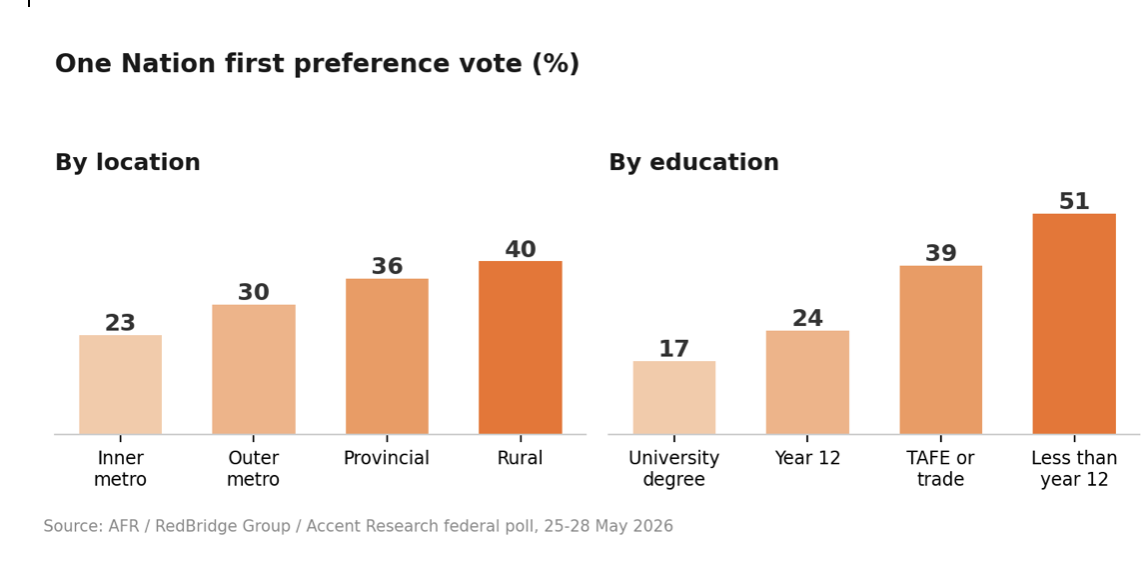
The polling trend maps that divergence with precision. One Nation’s vote climbs in a straight line as you move away from the city centre: 23 per cent in the inner metropolitan areas, 30 in the outer suburbs, 36 in provincial centres, 40 in rural Australia. The education gradient is even steeper.
Among university graduates the party polls 17 per cent. Among voters with a TAFE or trade qualification it is 39. Among those who did not finish year 12 it is 51, an outright majority. This is not a scattering of protest votes. It is a class and geography coalition, and its centre of gravity is exactly where this Gen X cohort lives and works.
The sandwich, and the trough
Now add where this cohort sits in the life course. They are the sandwich generation in its purest form: teenagers or adult children still at home because housing is unattainable; ageing parents on the other side requiring care the health system provides but with extra cost and turmoil. Many are still carrying mortgages their parents had discharged by the same age. Their superannuation, accumulated across a working life of interruptions, casualisation and the GFC, will not fund the retirement they were promised.
And they are carrying all of this at the exact point in life when human beings are least equipped to carry anything. The research on wellbeing across the life course is remarkably consistent. Life satisfaction follows a U shape, and it bottoms out in the late forties and early fifties, in country after country, independent of income. Economists who study it place the trough at around 47 to 48 and well into someone’s 50s. It is a well documented psychological low point, and Australian Gen X is sitting in it right now.
The polling captures the mood with brutal clarity. Asked about the direction the country is heading in, 68 per cent of Gen X voters say Australia is on the wrong track, against just 21 per cent who say it is heading in the right direction. That makes them the most pessimistic generation in the electorate, gloomier than the Boomers ahead of them and the Millennials behind them. And they are the generation most receptive to the political vehicle that validates that pessimism. Hanson’s net favourability sits at plus 14 among Gen X, her best result anywhere, against minus 12 among Millennials and minus 30 among Gen Z.
Previous generations passed through that trough with compensations. The house was nearly paid off. The job was stable. The kids were leaving home and starting their lives. This cohort is passing through it with none of that. The midlife dip is universal. What is new is a generation hitting it economically stranded. When a well documented mental health trough collides with genuine material hardship, the result is grievance and lots of it. The anger needs a story, and the story that says the system betrayed you will always defeat the story that says this is simply what midlife feels like.
The Millennials behind them
Here is what should worry both major parties. This is not a generational quirk that will age out. Millennials now give One Nation 30 per cent of their first preference vote, second only to Gen X and more than they give any other party except Labor. Older Millennials, now entering their forties, are driving that figure and beginning to display the same pattern. They carry larger mortgages relative to income than Gen X ever did, entered the housing market later or not at all, and are approaching the same life course trough with even thinner buffers. In our qualitative work, the language of outer suburban Millennial renters and mortgage holders is increasingly indistinguishable from the Gen X voters a decade ahead of them. The conveyor belt is running, and it is delivering new cohorts to the same destination.
What the empty seats were saying
Which brings us back to that London ballroom. Hanson has spent 30 years convinced that her movement is about race, culture and national identity. Her speech, complete with a defence of the White Australia policy, was a diagnosis of her own success. It was the wrong diagnosis, delivered to empty chairs.
The voters filling One Nation’s column in the polls are not there for a racial project. Our research has been consistent on this point. They are there because they feel economically abandoned, geographically invisible and psychologically exhausted, and because One Nation is the only vehicle on offer that treats their anger as legitimate. Hanson did not build this constituency. It arrived, and it will not stay if all it is offered is a culture war it never asked for. The half empty hall is what happens when the leader speaks to the movement she imagines rather than the one she has.
The same warning applies, with more force, to Labor and to what remains of the Coalition. If the political class reads this realignment as an outbreak of right-wing populism, it will respond with the tools for fighting right-wing populism: condemnation, fact checking, moral instruction. All of it will miss. What is actually required is much harder. Regional economic policy that is more than an announcement. A care system that does not conscript the sandwich generation as unpaid labour for their parents. A serious national response to midlife mental health, which remains the most neglected corner of the entire mental health debate.
A generation that asked for nothing for 30 years is now asking loudly. The parties that mistake the noise for ideology will keep talking to half empty halls of their own.

Kos Samaras
Kos Samaras is a director at RedBridge Group, a research and strategy firm specialising in public opinion, social trends, and behavioural insights. He works across industry, government, and media to help organisations understand community attitudes and navigate complex social and political environments.