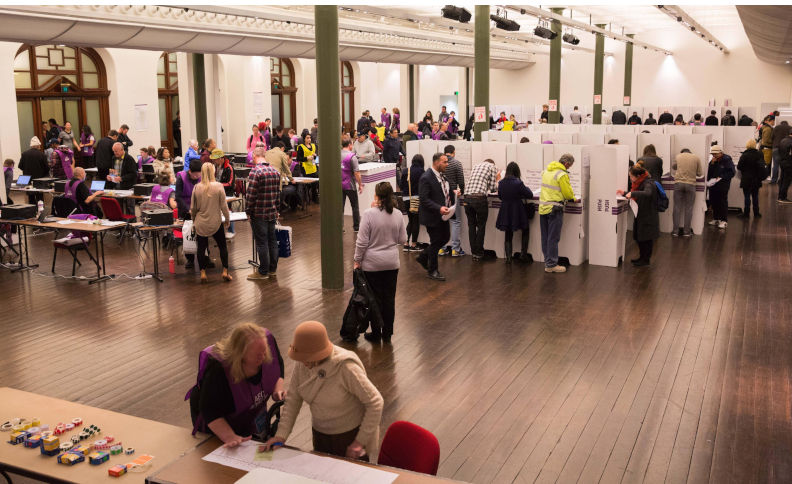
Australia’s three-year federal election cycle encourages short-term politics and uncertainty. Fixed four-year terms could improve policymaking, investment and democratic fairness – if voters can be persuaded to back reform.
In January this year, Prime Minister Christopher Luxon announced the New Zealand election would be held on 7 November.
He is not required to give voters and political opponents nearly this much notice, but it is a Kiwi convention for the prime minister to set the election date at the start of the year. The convention started in 2011 to prevent election speculation interfering with the nation’s arguably more important duty of hosting the Rugby World Cup.
Australia’s prime ministers are not quite so magnanimous, calling elections with minimal notice to maximise their political advantage. The public endures months of election-date speculation, while the public service and businesses pause big decisions as a result.
Australia’s short election cycle is holding us back
The impact of early elections is particularly acute in Australia and New Zealand, being two of only three liberal democracies globally with an election cycle of three years or less. Any uncertainty reduces the already short window our governments have to actually govern.
Australia has the added complexity that all our state, territory and local governments have four-year terms. All except Tasmania have a fixed election date. With our federal government as an outlier, election timetables clash and intergovernmental programmes are frequently delayed.
Unlike New Zealand, Australia also has a Senate. Challenges with Senate negotiations mean important reforms are often rushed or cancelled altogether as the never-too-distant election looms. In the three months before an election, bills before our Senate receive 45 per cent less debate time.
It’s a challenge made more difficult by modern politics. Australia’s parliament passes 10 times more legislation than it did at Federation. As voting preferences diversify, a broader range of parties can make forming governments and passing laws more time-consuming. A 24-hour news cycle and social media demand politicians devote ever more time to campaigning.
While politicians rarely get much sympathy, the reality is our federal representatives have tougher deadlines than most. Australia’s parliament sits less than half as many days per term as Westminster parliaments including Canada, the UK and Ireland. Our MPs get less than three years to perform before reapplying for their job, compared to a global average term of 4.4 years. It is a system that incentivises short-term politics over long-term reform.
Fixed, four-year terms would deliver a more productive economy and fairer elections
Moving Australia to a four-year term is estimated by Mandala Partners to generate $81 to $93 billion in benefits over 20 years through better policy making, increased business investment and lower election costs.
It would mean a stronger and fairer democracy. Prime ministers could no longer game the election date for political advantage. Civic engagement increases as volunteers and candidates find it easier to take part. Pointless speculation about election timing can be replaced with debate on the issues that matter.
There is support across the political spectrum for a longer and more stable election cycle
Fixing Australia’s short election cycle is not a new idea. A 1927 royal commission supported it, and the idea has attracted support across the political spectrum ever since, including from John Howard and Kim Beazley, Bob Hawke and John Hewson, Anthony Albanese and Peter Dutton, and Malcolm Turnbull and Bill Shorten.
Despite scepticism about anything that makes politicians’ lives easier, the Australian public also wants change. Only one in 10 Australians favour our current system of an unfixed, three-year term. Sixty-one per cent support moving to a fixed election date, compared to only 22 per cent supporting the prime minister choosing. Australians also consistently prefer four-year terms (around 42 per cent) to three-year terms (30 per cent or less), although many are still undecided.
The bar for change is high but not insurmountable
While a fixed election date can initially be introduced via legislation or a New Zealand-style handshake agreement, governments have been hesitant to give away the advantage once in power. A four-year term requires a successful referendum. Despite strong evidence and unusually broad support for change, the constitutional hurdle has contributed to a century of inaction.
Encouragingly, a parliamentary inquiry is examining term lengths and fixed election dates, reporting back by the end of the year. These are important steps, addressing key design questions – from managing Senate terms to triggers for necessary early elections. Labor’s 2026 National Platform also backed a fixed, four-year term for both the House of Representatives and the Senate.
The best path is to legislate a fixed election date first. It could later be enshrined in the Constitution via a referendum, which would then be a vote on the status quo rather than on change, increasing its chances of success.
The path to a four-year term is even more challenging. For the referendum to have a chance of passing, the proposal should ask a single, straightforward question, secure broad cross-party backing well in advance, and include a fixed election date. All three were missing from Bob Hawke’s failed 1988 referendum, but featured to varying degrees in the successful New South Wales and Queensland state referendums on the topic.
Making election day a long weekend unsurprisingly further boosts the odds. A clear majority of 59 per cent of Australians would support a four-year term if it were paired with an election-weekend public holiday. While business groups may baulk at an additional public holiday, the benefits of better performing governments and more political stability well outweigh the cost.
Australia’s short election cycle is a historical quirk, designed for colonial terms that no longer exist. We have done well in spite of it, but it is not equipped for the challenges of a modern democracy. Let’s fix it for good.
