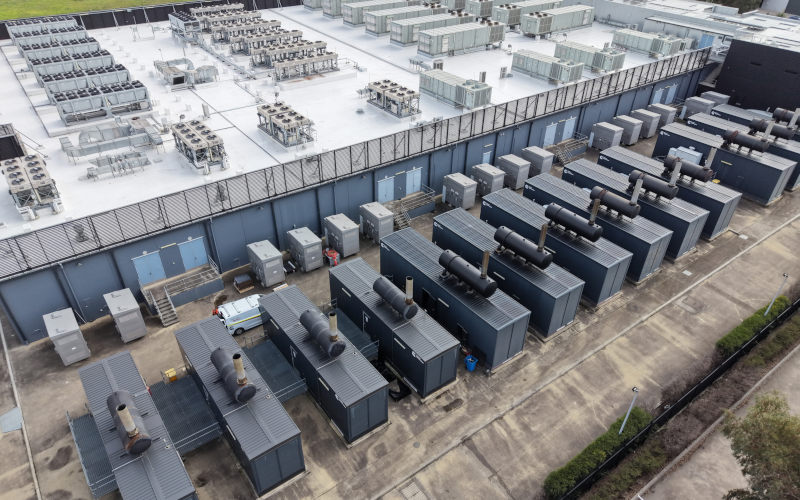
Massive AI infrastructure projects may bring jobs and investment, but regional development should be judged by what communities control, retain and can build long after construction ends.
“I’ve read this book before,” Western Downs resident Denver Kanowski said when plans emerged for a $31 billion artificial-intelligence data-centre complex near Dalby. The developer promises thousands of construction jobs, about 1,400 long-term positions and a place for rural Queensland in a new technological age. For a region accustomed to industries arriving with promises, that prospect deserves serious consideration.
So does the unease. Residents remember coal-seam gas: investment and employment, but also pressure on housing, roads, water and community life. They worry that this project will draw on land and energy while decisions and profits travel elsewhere.
I, too, have read a version of this book. My research into railway building in colonial Ghana examined infrastructure presented as a pathway to modernisation. The iron horse created movement, trade and opportunity. Officials counted miles of track, freight carried and exports increased.
But that accounting said little about who chose the routes, controlled the investment or decided what the railway should carry. Lines built to move gold, timber and cocoa to coastal ports connected rural districts to global markets on terms largely set elsewhere. Local people provided labour, land and produce without necessarily gaining the skills, institutions or authority to direct their development.
New technology can carry an old development model. Tracks can enter a district without placing it in command of its future.
An AI data centre is not a colonial railway, and Australia is not the colonial Gold Coast. Yet the analytical danger is similar. If governments treat billions invested, buildings completed and jobs announced as proof of regional development, they may overlook whether the infrastructure leaves communities with greater control over their future.
Dalby should not have to choose between embracing investment and protecting its future. It needs the power to negotiate both.
To judge what development delivers, we need to distinguish three kinds of benefit.
The first is activity: construction spending, temporary accommodation, business trade, and short-term jobs. These benefits are real and can be substantial.
The second is distribution: who receives the contracts, wages, tax revenue and advantages flowing from energy and digital infrastructure. A project can generate wealth while directing little towards the place carrying its pressures.
The third is capability: what the community can still do when construction ends, incentives expire or technology changes. Have workers gained transferable skills? Can regional businesses enter new markets? Are schools, health services and community organisations better equipped? Does the region have greater influence over its economic direction?
Announcements usually emphasise activity. Some address distribution through employment targets or community grants. Few guarantee capability. Yet capability is the most durable measure of development. My empowerment research has taught me that lasting change occurs when people gain greater control over the forces shaping their lives.
Before approving projects of this scale, governments should negotiate a regional AI bargain built around five tests.
The first is power. Will the development add generation, storage and network capacity, or will households and businesses bear higher prices and reduced reliability? A project promising productivity should strengthen the community supplying its electricity.
The second is water and land. Resource use and impacts should be independently monitored and publicly reported in language residents can understand. Assessment must consider cumulative pressure from agriculture, towns and other industries.
The third is work. How many jobs will remain after construction, and who will be prepared to fill them? Local procurement, apprenticeships and advanced technical training should be enforceable commitments.
The fourth is compute. If a region helps make AI possible, its universities, schools, health services, Indigenous organisations and small enterprises should receive affordable access to digital infrastructure and computing capacity. Otherwise, the community may power the new economy while remaining at its margins.
The fifth is legacy. A locally governed fund should convert part of the project’s value into enduring housing, education, enterprise and community infrastructure. Priorities should be determined locally and decisions accountable.
Traditional Owners must help shape all five tests and the resulting arrangements for Country, water, cultural heritage, employment and long-term benefits. Indigenous data sovereignty must govern any use of community knowledge or data.
These tests define what responsible investment should achieve. Environmental safeguards establish what a data centre must protect. A regional AI bargain establishes what it must help create: stronger institutions, broader capability and a community able to shape its future.
Building Australian AI capacity has a strong national case. The Prime Minister argues it can strengthen productivity, security, science and resilience, while committing the Commonwealth to Australian standards for its development and use.
Its physical infrastructure requires standards too. Victoria has proposed requiring new data centres to secure renewable generation and storage, fund grid upgrades, and meet rules governing water use and location.
These protections are necessary. Communities should not subsidise investment through higher power bills, depleted water supplies or overloaded infrastructure. But standards designed in capital cities cannot by themselves produce local ownership or capability. A technically compliant project may still leave its host region dependent on decisions made elsewhere. Compliance can prevent harm. Turning infrastructure into development requires more.
Australia should welcome infrastructure that enlarges regional possibilities. But history counsels against mistaking advanced machinery for development. Ghana’s iron horse moved goods and generated wealth without placing communities in command of their future. Australia’s AI infrastructure should do better. The test of the AI boom will be whether communities supplying land, energy and legitimacy possess more power when the servers are switched on.

Komla Tsey
Komla Tsey is a Ghanaian–Australian writer, retired Professor of Education for Social Sustainability, and part-time Professorial Research Fellow at the Jawun Research Institute, Central Queensland University. His writing explores education, democratic culture, identity, Indigenous empowerment, colonial legacies and the moral certainties that shape public life. His forthcoming memoir, Botoku Child, traces a journey from a small village in Ghana to universities and communities across the world, examining how inherited beliefs, curiosity and lived experience shape both personal lives and democratic societies.