New resilience data reveals the depth of disadvantage in Melbourne’s north, where factories have disappeared, health services have fallen behind and Labor’s once-unshakeable support is crumbling. Victoria’s latest hospital funding pledge has only deepened the divide.
I grew up in Meadow Heights. It sits in the federal seat of Calwell, with Broadmeadows to its south and Craigieburn to its north, in the part of Melbourne that used to build the cars the rest of the country drove. Calwell was named for the man who belonged to a political generation that opened its doors to the world, which is fitting, because the migration program that followed filled this electorate. At first, European migrants moved for work, then followed Turkish and Lebanese families, Iraqi, Assyrian and Chaldean families after them, and Indian and Pakistani families in the new estates of Craigieburn. People came to Broadmeadows for one reason. There was work, across the countless workplaces dotted across the region.
This is a story about what happened when the work left, how the people who stayed have voted, and how the government of Victoria has treated them since. It uses the first resilience index ever built for Australia at suburb level, because the argument about neglect has always been made with anecdotes, and it can now be made with numbers.
How Calwell has voted
For most of its life Calwell was as safe as a Labor seat gets. Andrew Theophanous won it at its creation in 1984 with 68.8 per cent of the primary vote and 72.2 per cent after preferences, and Maria Vamvakinou held it from 2001 to 2025 with a two-party vote that sat in the high sixties for a generation: 69.3 per cent in 2007, 69.7 in 2010, 68.8 in 2019.
It was the sort of seat that was highly sought after within the Labor Party’s ranks, where its activists spent more time stacking its local membership branches than volunteering at campaigns. But whilst they were fixated internally, they turned a blind eye to a political erosion sweeping through its suburbs.
The erosion started on the primary vote, within clusters of families, a network of streets, bound by one experience, taken for granted. Labor polled 60 per cent of first preferences in 2007 and 54 in 2019. In 2022 it fell to 44.9. In 2025, with Vamvakinou retiring and Basem Abdo as the new candidate, it fell to 30.5 per cent, a swing of 14 points against a government that was winning a landslide everywhere else.
The erosion in support has little to do with its incumbents, as their party treated similar seats like it, as political fortresses that never needed renovations. The seat went to a full distribution of preferences for the first time. Three independents polled 29 per cent between them, and the final count was Abdo against Carly Moore, a former Hume mayor, 55 to 45. One voter in 10 cast an informal ballot. Labor still finished 65 to 35 against the Liberals on the notional two-party count, which is why the result was reported as a hold. On the ground it was a seat looking for somewhere else to go.
Our May 2026 federal MRP has Labor on 34 per cent in Calwell, One Nation on 21, the Liberals on 16 and the Greens on 8. Labor holds it, because One Nation cannot build a majority in a seat where one resident in 10 speaks limited English and the Iraqi, Lebanese and Turkish communities will not vote for Pauline Hanson.
But the seat is no longer safe in the way that word used to mean. It is held by the absence of an alternative. Furthermore, on the one measure in the index that best predicts the One Nation vote nationally, the share of people who feel like strangers in their own country, Calwell sits at 52 per cent, among the highest Labor seats in the country. The feeling is there. It has simply not found a party yet.
What globalisation took
Ford built cars at Broadmeadows from the late 1950s. The plant was the reason the suburb existed in the form it took, and the component makers, the panel shops and the clothing factories of Campbellfield, Somerton and Coolaroo grew up around it. For a generation a family could arrive with no English and be on a line within a week. The wages were not high. They were regular, and they came with a house, a life of dignity, rewarding hard work.
Then the tariff doctrine arrived. From the 1980s, the duty on an imported car started to fall, down to 5 per cent by 2010, and the industry that had been built behind it came down with it. Mitsubishi closed at Adelaide in 2008. In May 2013 Ford announced it would stop making cars in Australia, and 1,200 jobs with it. A countless number of young men, who I grew up with, were by then nearing middle age, were greeted with this new world. On 7 October 2016 the last Ford built in this country, a blue XR6 Falcon, came off the Broadmeadows line, and 600 people at Broadmeadows and Geelong lost their jobs that day. Holden and Toyota followed within a year. Nobody in Canberra lost a seat over it and so they carried on, as if nothing had changed. They wrongly assumed that there was to be no political price for so many lives being upended. It was a grave mistake.
The work left but the people didn’t. That is the part of the globalisation story that the economists who argued for it never had to live in. The families who came for the factories stayed, their children stayed, and new arrivals kept coming because the houses were cheap and the relatives were there.
Our resilience index records what that looks like 20 years on. In Meadow Heights 22 per cent of residents receive an unemployment or study payment. In Roxburgh Park North it is 23 per cent, in Campbellfield and Coolaroo 22, in Broadmeadows 20. Across Melbourne the figure is 12. In Kooyong it is 9. Across the whole of Calwell, 17 per cent of residents are on those payments, the ninth highest of the 150 federal seats. Fewer than one resident in three in Meadow Heights, Broadmeadows or Campbellfield earns above the national median income. In Melbourne as a whole it is more than one in two.
The seat did not stop growing while this happened. North of the old suburbs, Craigieburn, Mickleham and Yuroke filled with new estates, and the young families who bought into them are the same families one generation on: the children of Broadmeadows and Meadow Heights, along with migrants of Australia’s largest migration wave, with a mortgage instead of a home funded by the public purse. The index scores those estates better on income and worse on almost everything that needs a building nearby. Calwell is two places now. An old industrial district without the industry, and a new one built faster than anything that serves it.
What the index says
The Mandala | Zurich | RedBridge Accent Australian Resilience Index scores every one of the country’s 2,389 suburbs and towns on health, on finances and on social connection, from the census, from Medicare and Centrelink data and from the distance to the nearest services, and combines them into one number from 0 to 100. It was built to tell industry and governments where a community will hold up when something goes wrong and where it will not. Matched to the 150 federal seats, it puts Calwell at 31.3. That is the third lowest score in Australia. The only two seats below it are Spence, which holds Elizabeth and the old Holden plant in Adelaide’s north, and Fowler in Sydney’s south-west, which booted Labor out of the seat in 2022. All three are places where the post-war migration program met the post-war factory. Calwell is the lowest of any seat in Victoria. The next lowest Victorian seats, Scullin, Lalor and Hawke, all sit above 35. Melbourne as a whole scores 44.5.
On money Calwell scores 27.4, seventh lowest in the country. On health it scores 56.6, against 68.9 for Melbourne. Inside the seat, the old suburbs score lower still. Meadow Heights is at 21 overall. Campbellfield and Coolaroo are at 22, Broadmeadows at 25. All three sit in the index’s ‘Low’ band on health. Campbellfield and Broadmeadows have the two highest smoking rates of any community in Melbourne, at 35 and 34 per cent of adults, and Meadow Heights at 32 per cent is in the top six. One resident in six in Meadow Heights speaks limited English. The new estates score better on money and worse on reach. Craigieburn’s four communities average 32. Mickleham and Yuroke are at 37, Greenvale and Bulla at 44, the only part of the seat that touches the Melbourne average.
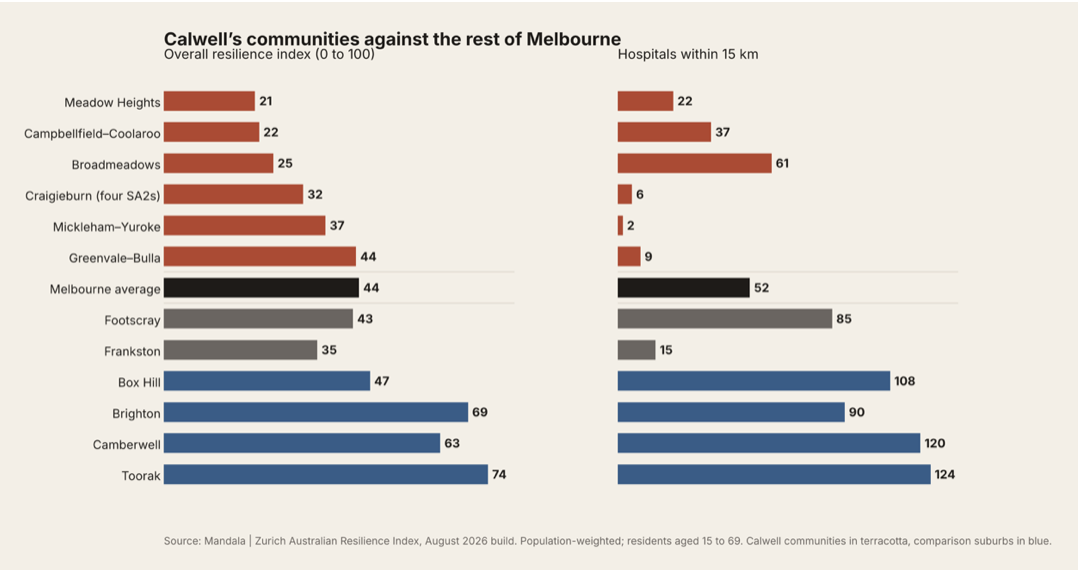
The right-hand side of the chart is the one that matters for what follows. The index counts the hospitals, clinics, health hubs of any kind within 15 kilometres of each community. Toorak has 124. Camberwell has 120, Box Hill 108, Brighton 90, Footscray 85. The Melbourne average is 52. Broadmeadows, close enough to the inner north to be counted with it, has 61. Meadow Heights, five minutes up the road, has 22. Craigieburn has six. Mickleham and Yuroke, where the new houses are, have two. For a resident of Craigieburn the nearest mental health facility is 16 to 20 kilometres away. For a resident of Mickleham it is 23. For a resident of Toorak it is under two.
These are not the numbers of a seat that is doing badly in one respect. They are the numbers of a seat that is doing badly in every respect the index measures and that has fewer of the buildings that would help than almost anywhere else in the city. The old part of Calwell has the worst health in Melbourne. The new part has the least access to care. The question is what the state that collects, has had full access to this data for decades, has done with it.
Treated with contempt
Start with what Broadmeadows has. It has a hospital, in name. Broadmeadows Hospital has no emergency department. In 2016 the state spent $17.3 million on it for two operating theatres. In March 2024 it announced $2.6 million more, and the media release listed what the money was for: sections of the ageing roof replaced, repairs to ceilings and walls, new flooring and carpets, and the lights upgraded. That is the capital program for the hospital that serves the community with the worst health in Melbourne. A roof.
Craigieburn did better, on paper. A community hospital opened there in August 2025, one of the 10 promised before the 2018 election. The Victorian Health Building Authority’s own description of it is precise. It has no emergency department. It will not accommodate overnight stays. It does not operate around the clock. It offers dialysis, dental, outpatient clinics and, at some point still not dated as of April this year, an urgent care centre for what the authority calls minor bumps, cuts and bruises. For a population the size of Craigieburn’s, with two to seven hospitals of any kind within 15 kilometres, that is the building. Limited services that are a product of lack of staffing and a Victorian Labor government that had priorities elsewhere.
Now look at where the money went. The new Footscray Hospital cost $1.5 billion, has more than 500 beds and an emergency department built for an extra 20,000 patients a year, and opened in February. Frankston got a $562 million expansion. In the 2024 budget the Hospital Infrastructure Delivery Fund put $535 million into Monash Medical Centre at Clayton and $275 million into a new emergency department at the Austin in Heidelberg. On 16 October this year the Royal Children’s in Parkville was given $66 million for 20 beds.
Each of those is a real hospital in a real community, and nobody in the north begrudges Footscray a hospital it waited decades for. The point is where those communities sit on the index. Footscray scores 71 on health with 85 hospitals/clinics within 15 kilometres. Heidelberg scores 77 with 94. Clayton scores between 71 and 80 with 64 to 80. Parkville scores 83 with 102. Every one of them is above the Melbourne average on health and above it on access, and every one of them was already better served than any community in Calwell.
The north’s share of that fund was the Northern Hospital at Epping, at $813 million. It is the one large commitment the region has had, and it should be named as such. It is also the one that has moved slowest. The first stage, an outpatient building, opened on 3 August this year. The part that matters, the larger emergency department and the inpatient tower, is described by the government as on track for 2029. Epping itself, for the record, scores 59 on health with 23 hospitals and clinics within 15 kilometres. The hospital that serves the lowest-scoring communities in the city is the one whose emergency department is last in the queue.
There is a pattern here that the index makes impossible to miss. Victoria’s health capital follows the hospitals that already exist, and the hospitals that already exist are where the healthy and wealthier people live. Toorak, with a health score of 92, has 124 hospitals and clinics within 15 kilometres and a mental health facility within two. Meadow Heights, with a health score of 47, has 22 hospitals and clinics within 15 kilometres and a mental health facility 11 kilometres away. One of those suburbs has a premier’s media release about a new roof. It is not Toorak.
The Carroll announcement
Ben Carroll’s electorate of Niddrie is a few suburbs from Broadmeadows. When he became premier there was a reasonable expectation in the north that the region would be seen. On 25 October, at Labor’s campaign launch five weeks out from the state election, he made the health announcement of the campaign: $1.5 billion to expand a dozen emergency departments by 25 per cent, 1,500 extra health workers including 750 nurses, 250 extra beds, and a target of cutting emergency waiting times by up to 20 per cent. He said the thing a premier says. “We’ve waited in an ED with our daughter many times. Nothing’s more stressful.”
The 12 emergency departments were named. Seven are regional: Ballarat, Bendigo, Latrobe, Shepparton, Swan Hill, Wonthaggi and Geelong. Five are in Melbourne: the Alfred, the Austin, Footscray, the Royal Children’s and Werribee Mercy. Read that list against the index. The Alfred sits in Prahran, health score 84, 118 hospitals and clinics within 15 kilometres. The Austin at Heidelberg, 77 and 94, already holds $275 million for its emergency department from the 2024 budget. Footscray, 71 and 85, opened its new emergency department in February. The Royal Children’s at Parkville, 83 and 102, was funded nine days earlier. Werribee is the one Melbourne hospital on the list that looks like the north: health 51 to 56, five or six hospitals nearby. Its $95 million emergency department upgrade opens this year, and now it is in the package as well. Of the five, four serve communities with better health and more hospitals than anywhere in Calwell, and one serves a place that resembles Craigieburn.
The Northern Hospital is not on the list. Nor is Broadmeadows, Craigieburn, Epping or any suburb north of the Ring Road. By its own account the Northern operates the busiest emergency department in Victoria, with an average of 110,000 presentations a year, serving Whittlesea, Hume, Darebin, Banyule, Nillumbik, Merri-bek and Mitchell, a population it expects to grow by more than half by 2036. Its new emergency department is not due until 2029. The $1.5 billion package, which the government says will deliver most of its beds next year, does not bring that date forward by a day, does not add a treatment space to Epping in the meantime, and does not put a single one of the 1,500 new health workers in the north by name.
The announcement was received exactly as it was designed to be. The Australian Medical Association welcomed a significant commitment to emergency capacity. The opposition countered with exit lounges and 25,000 surgeries a year through private hospitals. Nobody in the exchange mentioned the hospital with the longest queue.
What it means
For 40 years the argument about Melbourne’s north was made the only way it could be made, with stories. A long wait at the Northern Hospital. A factory gate with the sign taken down. Stories can be waved off as anecdote, and they were. The index ends that. Need is now a number, published for every suburb in the country by an insurer and an economics firm with no stake in Calwell, and the number says what the stories said. The lowest resilience of any seat in Victoria. The two worst smoking rates in the city. Two hospitals within reach of the newest estates. And a government that, two months after the index was published, promised $1.5 billion to 12 emergency departments and not a dollar of it to the busiest in the state.
The state did not need the index to know this. It has the Centrelink data, the Medicare data, the presentations at the Northern Hospital and the growth projections for Hume. It had the numbers and spent elsewhere, and the reason is not complicated. Hospital money follows hospitals. The Alfred, the Austin, the Royal Children’s and Monash have boards, colleges, foundations and alumni, and they are in the suburbs where ministers, editors and senior public servants live. Broadmeadows has a sub-acute hospital with a new roof.
Contempt is a strong word for a funding pattern, and it is the right one, because contempt is what it looks like from the receiving end when the data is public, the need is measured and the money goes up the hill anyway.
The politics of this are already visible. Labor’s primary vote in Calwell has halved in 18 years. The seat went to preferences for the first time in 2025 and a former Hume mayor made the final two by telling voters to put the government last. One voter in 10 spoilt the ballot. Our federal polling has One Nation at 21 per cent in a seat where it has never been a factor, and our Victorian polling in September has it winning the state seat of Sunbury on the other side of Hume and finishing in the final two in 32 districts. Fifty-two per cent of Calwell’s residents say they feel like strangers in their own country. That is a measure the index built for insurers, and of everything the index records it is the strongest single predictor of the One Nation vote. The people of Meadow Heights and Broadmeadows will not vote for Pauline Hanson. Their children in Craigieburn and Mickleham, who speak English, pay a mortgage and drive past the community hospital that closes at night on the way to Epping, are a different question.
The seat that built the cars the rest of the country drove does not expect gratitude. It expects government support, which is what the west, the east and the southeast got. The index now shows, to one decimal place, how far it is from getting that support. Whoever is premier on 29 November has that number. What they do with it will tell the north what it has suspected for a long time about how it is seen.

Kos Samaras
Kos Samaras is a director at RedBridge Group, a research and strategy firm specialising in public opinion, social trends, and behavioural insights. He works across industry, government, and media to help organisations understand community attitudes and navigate complex social and political environments.