One Nation’s rise is often treated as cultural anger. New data point to something more concrete: poor health, financial insecurity and communities left without the services that make life work.
For the past year, Australian politics has been having an argument about immigration. It has filled talkback, dominated social media and spilled onto the streets. The new Australian Resilience Index, released this week by Zurich with Mandala, RedBridge and Accent Research, suggests that argument has been aimed at the wrong target.
The index draws on two million data points to measure how well Australians can withstand and recover from a shock, across more than 2,000 local communities. It looks at health, finances, social connection and the physical environment people live in. The single strongest driver of overall resilience is financial wellbeing. Right behind it sits health. Whether you can absorb a rate rise, a lost shift or a diagnosis in the family matters more to how secure you are across all these key measurements.
More than one in five Australians now live in communities of significant vulnerability. These are households with no buffer. When something goes wrong, there is nothing between them and real hardship, and it should come as no surprise that where we find vulnerability, we find political volatility.
At RedBridge, we have matched the index against our May federal MRP, seat by seat across all 150 electorates. The result is one of the clearest relationships I have seen in this work. An electorate’s health resilience explains 63 per cent of the variation in the One Nation vote on its own. Fifty of the 53 seats One Nation is projected to win sit in the bottom three-fifths of the country on health. Not one sits in the top fifth. The average One Nation seat has five hospitals within 15 kilometres. The average Labor or Coalition seat has 38.
That is the national picture. But the real value of this data is what it shows at the level of individual communities, and what that tells political parties about the mistakes they keep making.
The pattern of the last 30 years is depressingly consistent. Policy is designed around averages, marginal seats, playing the game of elections. Communities are treated as blocs that will vote the way they always have and, when those communities finally turn, the parties that took them for granted read the anger as a cultural phenomenon rather than a material one. They blame the messenger, the social media algorithm or the populist of the moment, and miss what was happening on the ground for years beforehand.
I am going to focus on two places that detail all of this.
Meadow Heights
I grew up in Meadow Heights, in Melbourne’s north-west. It is a suburb built on the hopes of migrant families who arrived with very little and wanted a house, a job and a better life for their children. For a while, mainly during the 1980s and 1990s, it delivered.
Today it is the 22nd least resilient community in Australia out of more than 2,200. It sits in the bottom 1 per cent of the country for financial resilience. Twenty-eight per cent of residents have no access to emergency funds, almost double the national rate. Just 8 per cent hold private health insurance, against 37 per cent nationally.
Critically, its health is poor. Thirty-two per cent of residents smoke, compared with 20 per cent nationally. Seventy-eight per cent are overweight or obese. Eighty per cent do less exercise than recommended. These numbers are not mysterious, but the story behind them is a story about policy failure, across multiple governments, over many years and not about the personal choice of the working poor.
Take smoking. For more than a decade, governments have used tobacco excise as their main instrument to drive smoking rates down. It worked in the suburbs where people were already quitting. In places like Meadow Heights, where smoking rates were higher and incomes lower, it worked differently. A packet of cigarettes now costs more than many families spend on dinner. Few stopped smoking and, frankly, current attempts to measure their smoking rates have been challenged by a reluctance to out oneself in relying on the black market. Hence, a large number simply moved to the illegal market, where tobacco is cheap, unregulated and sold out of the back of shops that have become targets in a violent turf war across Melbourne.
So, a policy designed to improve health has, in these communities, become a tax on the poor, a gift to organised crime, a lucrative incentive to young children looking for easier ways to escape poverty, and a health measure that no longer reaches the people it was meant to help. Nobody in Canberra set out to produce that outcome. But nobody designing the policy was looking at Meadow Heights either. Frankly, those who continue to defend the current policy settings on tobacco should open their minds and hearts to communities like this one.
Then there is the way people live. Infrastructure in Melbourne’s north has not kept pace with the people who live there. Ninety-six per cent of Meadow Heights residents do not work in their suburb’s main local industry. The jobs are spread across the city, and too many residents spend too much of their day in a car, driving to work, driving to shifts, driving to the shops because walking is not a realistic option.
Meadow Heights has it easier than the suburbs further north. It at least has 22 hospitals within 15 kilometres. In Craigieburn there are five to seven. In Mickleham there are two. In Wallan there is one. The national average is 29. Residents of Wallan are more than 40 kilometres from the nearest mental health facility. In Craigieburn Central and Mickleham, green space makes up less than 3 per cent of the land, against 18 per cent nationally. Tens of thousands of families have been poured into estates built faster than anything to support them, along roads like Donnybrook Road that were never designed for the traffic now crawling along them. Parents leave before dawn and get home after dark. Sporting grounds, clinics and parks arrive years after the families who need them. The fast-food outlet is always the first thing built and the last thing to close.
For now, these young suburbs rate only moderately on health. More than three-quarters of adults are already overweight or obese, and in Wallan it is 84 per cent. The damage is coming. The only question is whether anyone acts before it arrives.
The Victorian Labor government has known all of this for years. It has simply chosen not to act because of a cruel form of politics that may indeed come back to bite them on 28 November. These suburbs have been treated as safe territory, places that will always vote Labor no matter what they are given, while the investment went elsewhere. That neglect will not stay hidden. Every road that isn’t duplicated, every clinic that isn’t built and every hour a parent spends stuck in traffic instead of exercising, cooking or sleeping will turn up years from now in the health budget.
Chronic disease in the north is being manufactured today by decisions made in Spring Street, and the bill will land on a future government and a future generation of taxpayers. That’s what this comprehensive Resilience Index illustrates. It does not only reveal the failure; it also now warns governments and decision-makers of what will come down the pipeline if the failures are not addressed.
Upgrading clogged roads is not just about getting traffic to move faster. It’s about the time spent on them appearing on the health balance sheet well into the future. That time on the road comes from somewhere. It comes out of the time people once spent with neighbours, at the local club, at the church or mosque, at their kids’ sport. In Meadow Heights, just 6 per cent of residents volunteer, less than half the national rate. Craigieburn sits in the bottom 8 per cent of the country for social resilience. Poor health and weakening social bonds are not separate problems here. They are the same problem, produced by the same conditions of government neglect.
Ipswich
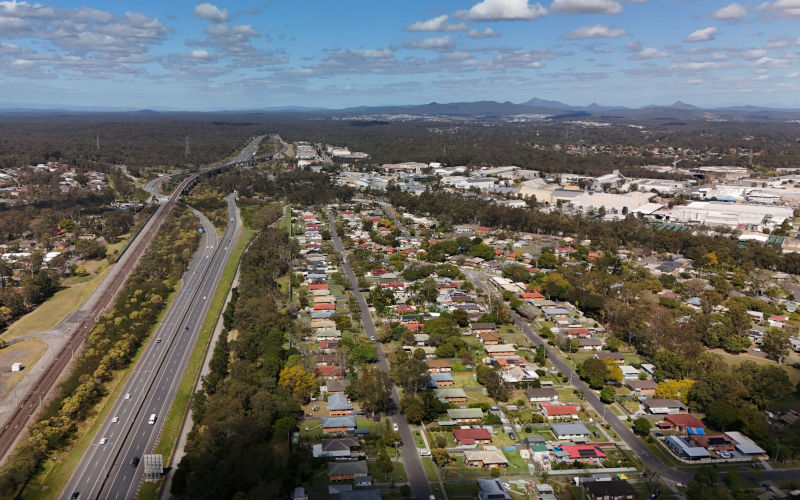
Ipswich should be a warning that every party has already been given. It was here, in 1996, that Pauline Hanson won the seat of Oxley as a disendorsed candidate and changed Australian politics. The major parties spent years afterwards treating that result as an aberration. Thirty years on, the conditions that produced 1996 have not gone away.
Goodna, on the city’s eastern edge, still sits in a seat called Oxley. It is the 68th least resilient community in Australia, and among the 50 weakest in the country on finances. Thirty per cent of residents have no access to emergency funds, double the national rate. Half rent. Only 12 per cent hold private health insurance.
Goodna has flooded repeatedly, most destructively in 2011 and again in 2022. Each time, homes were gutted, belongings were lost and families started again. The 2011 floods exposed how many people believed they were insured when they were not, and the definition of flood cover was standardised afterwards. That was the right reform. But it came with a consequence nobody fully reckoned with. In flood-exposed suburbs, premiums rose to levels many households could not pay. So they dropped their cover, or cut it back, and now carry the risk themselves.
The index finds that insurance coverage is one of the strongest dividing lines in the country. Communities where at least half of residents are insured are five times more likely to have high financial resilience and four times more likely to have high health resilience. Goodna sits well on the wrong side of that line.
Next door, in Redbank Plains, the picture is starker still. It is the 76th least resilient community in the country. Eighty-seven per cent of adults are overweight or obese and 30 per cent smoke. Redbank Plains sits in Blair, the ninth least resilient federal electorate in Australia, alongside Calwell near the very bottom of the table. But where Calwell holds, our May MRP projects Blair to fall to One Nation. Same vulnerability, opposite result. That is the realignment in a single comparison.
Queensland has the lowest financial resilience of any state in the index. Only 12 per cent of Queenslanders live in high-resilience communities, the weakest result of any state. When voters in these places say the system does not work for them, they are not speaking in metaphors.
What parties should learn
Meadow Heights and Ipswich have different problems. One is a story about health policy that missed its mark and infrastructure that arrived too late. The other is a story about financial exposure, climate risk and a safety net with a hole in it. But they share something important. In both places, the warning signs were visible for years in the data, long before they appeared in the vote.
That is the opportunity this index gives political parties, if they choose to use it.
It means designing health policy that asks where it will land, not just what it will do on average. A tobacco tax strategy that pushes people onto the black market is not a health strategy in Meadow Heights. Proper investment in preventative health, in local GPs and in programs that meet people where they are would do more than another excise increase.
It means sequencing infrastructure so that roads, transport, hospitals and parks arrive with the people, not a decade after them. Every hour a parent spends in traffic is an hour taken away from their family, their health and their community, and a cost that will eventually be paid in hospital beds. Not funding a road upgrade because of budget challenges is simply passing the buck to the next generation to find even more money as the hospital groans under the weight of multiple decades of short-sighted decisions.
It means treating insurance affordability in exposed communities as a question of national resilience, not a private matter between a household and its insurer. When whole suburbs cannot afford cover, the cost of the next disaster does not disappear. It lands on those families, and eventually on governments.
Above all else, it means abandoning the idea that communities belong to anyone. The suburbs that gave Labor its safest seats and the Coalition its regional base are not loyal. They are exhausted. They will stay with a party that helps them build a buffer against the next shock.

Kos Samaras
Kos Samaras is a director at RedBridge Group, a research and strategy firm specialising in public opinion, social trends, and behavioural insights. He works across industry, government, and media to help organisations understand community attitudes and navigate complex social and political environments.