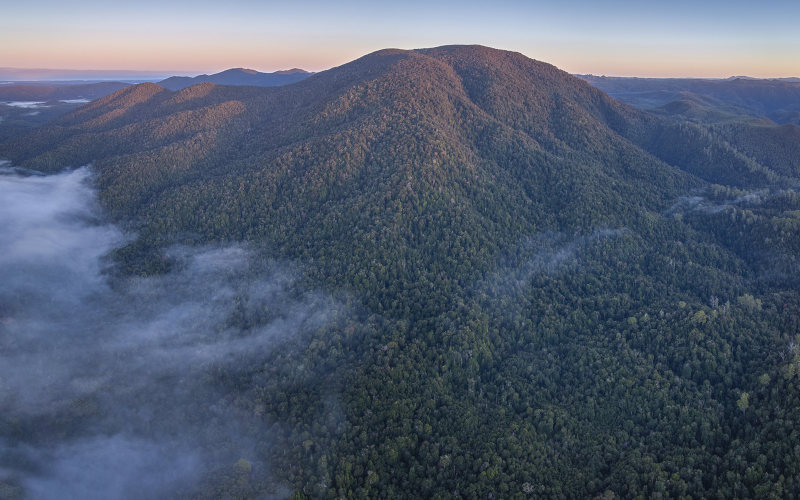
A proposed tungsten mine in Tasmania’s Takayna rainforest would feed a soaring global weapons market. Bob Brown cannot understand why we would contemplate both an attack on the ancient ecosystem at Mt Lindsay, and on the lives of innocent innocent children.
Tungsten has the highest melting point of all metals. It’s used to harden steel for missiles like those designed to deliver the nuclear weapons if, as he speculated at the United Nations recently, President Trump decides to “annihilate” Iran.
Tungsten is also vital for smaller lethal weapons like Israel’s M329 missile, which is 750 mm long and weighs 27 kg. Inside the missile shell are capsules which explode and spray tiny tungsten cubes for 20 metres in all directions. Tungsten cubes are used by the Israeli Defence Force in Gaza and are particularly lethal for children.
Orthopaedic surgeon Mark Perlmutter worked there and told The Guardian that “X-rays showed demolished bones with a pinhole wound on one side, a pinhole on the other, and a bone that looks like a tractor trailer drove over it.”
Perlmutter said that many children hit by pieces of tungsten died. “Most of the kids that survived had neurologic injuries and vascular injuries, a major cause of amputation. The blood vessels or the nerves get hit, and they come in a day later and the leg is dead or the arm is dead.”
It seems fanciful to suggest that these horrific harms could have anything to do with north-west Tasmania’s tranquil Takayna rainforests. But it’s not. There’s a small lode of tungsten and tin under the forests on the slopes of Takayna’s Mt Lindsay, and the American and allied military-industrial complexes would like to get it.
President Trump has a self-inflicted tungsten problem. China has 80 per cent of the world’s tungsten production. In response to the tariffs Trump imposed in 2025, China effectively stopped tungsten exports. That left America, which produces no tungsten, rushing to reopen disused mines in Nevada and Idaho.
On 14 September, Trump’s Secretary for War, Pete Hegseth, announced a $450 million investment to strengthen domestic tungsten manufacturing and secure America’s supply chain for critical missile and munition components. The Department of War said that this investment would “strengthen domestic tungsten capacity, bolster US industrial resilience and military readiness, and help secure an essential material for the defence industrial base”.
The world’s defence industrial base currently absorbs 15 per cent of tungsten production but, far outstripping diesel fuel in price rises since Trump and Israel went to war with Iran, the price of tungsten on global metal exchanges has soared more than 500 per cent in less than two years, largely to meet military needs.
That’s spurred Critica Minerals, based in West Perth, WA, to fast-track plans for a tungsten mine in the Tasmanian rainforest at Mt Lindsay. Supporting Hegseth and the Trump administration, the Albanese government is likely to fast-track and subsidise such a mine. The proposed site is near a sealed road and powerlines and, Critica says, “additional Mineral Resources lie outside the current Scoping Study focus, providing opportunities for further evaluation”. That is, more extensive and intrusive mining in the Mt Lindsay rainforest can be expected if this first mine goes ahead.
In its Australian Stock Exchange announcement last month, Critica was enthused: “The Base Case generates a pre-tax NPV (net present value) of approximately A$1.42 billion, a pre-tax IRR (internal rate of return) of approximately 65% and an after-tax payback period of approximately 1.9 years, against pre-production capital of approximately A$244.5 million. Mt Lindsay also gives Critica substantial exposure to tungsten, which contributes approximately 75% of modelled Base Case life-of-mine revenue, at a time when secure Western supply of this critical mineral is becoming increasingly strategically important.” The values of the rainforest and wildlife were not assessed.
Tungsten has a range of non-military uses from cutting tools to scratch-resistant wedding rings, protective X-ray gowns and golf club weights, but the current spike in demand is for missiles.
Of the estimated 4.4 million tonnes of tungsten available on Earth, most is in China, but 570,000 tonnes are in Australia. Two mines are already operating here: at Mt Carbine in north Queensland and on King Island in Tasmania. Mt Lindsay contains 28,000 tonnes, less than one per cent of global reserves.
Before tungsten boomed, Critica, in its previous iteration as Venture Minerals, withdrew plans for a Mt Lindsay mine to extract the more plentiful tin that, in this age of electronics, is a favoured solder. The project ran into on-site demonstrations from environmentalists, including arrests, and failed to get sufficient financial support. But now it’s back with a tungsten thwack. The ancient rainforest ecosystem has no idea of what’s coming.
Snow-covered at times in winter, Mt Lindsay is part of Australia’s largest tract of temperate rainforest. It sits in the Meredith Range Regional Reserve, within the Takayna area recommended for World Heritage listing. The forest supports numerous threatened species including wedge-tailed eagles, Tasmanian devils, spotted-tailed quolls, azure kingfishers and Tasmanian masked owls.
Mt Lindsay is nestled between the south-flowing Stanley and Wilson rivers. Besides beautiful waterfalls, these rivers’ catchments contain intact stands of ancient Huon pines with trees up to 3,000 years old.
The question for Australia and Prime Minister Albanese is this: should Mt Lindsay’s rainforest and wildlife be included in the Takayna World Heritage listing under the World Heritage Treaty, or would it be better exploited to supply a tiny aliquot of the world’s tungsten, primarily to the US Department for War, to make more killing and maiming missiles?
Critica’s Takayna mine proposal presents a cameo of the moral challenge facing humanity’s plunder of nature and life on Earth in 2026. Australia should meet that challenge by protecting the ancient rainforest ecosystem at Mt Lindsay and leaving the lethal tungsten in the ground.

Bob Brown
Bob Brown is an environmentalist who helped found the Australian Greens, was elected to the Tasmanian House of Assembly (1983-93) and the Australian Senate (1996-2012) and was the Leader of the Australian Greens. His books include Wild Rivers, Lake Pedder, The Greens, Memo for A Saner World, Earth, Green Nomads, Optimism, Thera and Defiance. He is currently appealing against his conviction for ‘trespass’ (a criminal offence in Tasmania) for peacefully defending swift parrot nesting trees. In 2012 he established the Bob Brown Foundation to take action for Earth.