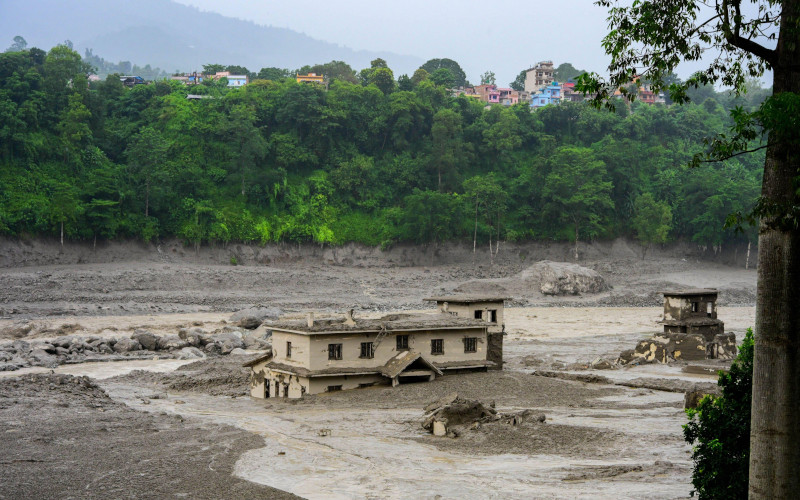
Bob Brown says Australia cannot keep expanding fossil fuel production while denying its share of responsibility for the mounting human toll of climate change.
Nepal estimates the monetary cost of its avalanche disaster at A$7 billion. Australia, which emits nearly 5 per cent of global greenhouse gases, should be booked $350 million. So far we’ve made a gift of $8 million. We can do nothing to reverse the death toll.
Denial is an evolutionary precaution against our minds being overwhelmed by the chaos in the universe and the awesome powers in which each of us lives as a near-irrelevance.
It also saves us from being crushed by the thought of personal death and eternal nothingness.
Denial is designed to keep our tails up, but has damning downsides. A case in point is human-induced global warming.
Besides the Australian government and opposition fostering fossil fuels, popular right-wing politicians like Pauline Hanson and Barnaby Joyce are wanting to stoke the flames higher. They depend on the denialism rife in Australia’s right-wing media.
The stakes are high. Rupert Murdoch’s eldest son, James, was dropped from his father’s favour by making public his frustration with News Corp’s “ongoing denial” of climate change during the 2019 Australian bushfire emergency.
Three decades earlier, in 1992, the ‘Warning to Humanity’ was signed by 1,700 top scientists including most Nobel Prize winners for science. They warned that “human beings and the natural world are on a collision course” and appealed that we “must move away from fossil fuels to more benign, inexhaustible energy sources to cut greenhouse gas emissions”.
Scientists have warned for years that the glaciers melting in the Himalayas threaten people living downstream and, in 2023, UN secretary-general António Guterres made a Gettysburg-like address to the world from Nepal. Here are excerpts from it.
The rooftops of the world are caving in. Record temperatures mean record glacier melt. Melting glaciers mean swollen lakes and rivers flooding, sweeping away entire communities; and seas rising at record rates – threatening coastal communities across the globe. I am here today to cry out from the rooftop of the world: stop the madness. We must end the fossil fuel age. The world can’t wait.
Ignoring Guterres, Australia’s Albanese government has since approved 36 fossil fuel projects including extending Woodside’s North West Shelf gas exports for 40 years, although the Australia Institute estimated that its emissions will be equivalent to 12 average Australian coal power stations continuing to fire that long.
Guterres’ ‘madness’ is Albanese’s and Taylor’s and Hanson’s and Joyce’s determined denial.
Bertrand Russell observed “in the modern world the stupid are cocksure while the intelligent are full of doubt.” That is, denialism rules. It comes down to a blatant lack of empathy for the future of life on Earth. As sub-trillionaire Elon Musk puts it, “the fundamental weakness of Western civilisation is empathy”.
A breakout of doubt-free intelligence came in 2019 when Greta Thunberg led school strikes against climate change and millions of young protesters hit the world’s streets, but their ardour was sideswiped by the Covid pandemic and the ingrained denialism of the world’s ruling billionaires, bullies and business leaders.
In 2026, the full extent of the Nepal disaster is yet unknown but estimates are that 6,000 people are dead or missing with many more injured. The Red Cross says “the trauma of this event is enormous. Thousands of homes have been destroyed or suffered significant damage. We believe that at least 93,000 people have been affected and are in great need.”
Australia, proportionately responsible for some 4,650 of those now affected, and for 300 of the dead or missing, has donated $8 million.
It’s worth revisiting Carl Jung’s century-old analysis of how a nation’s collective subconscious can deny the reasonable thinking of its collective conscience. He called it a psychic epidemic.
Jung could have been commenting on the most recent American or Australian elections when, a century ago, he wrote: “there is no adequate protection against psychic epidemics, which are infinitely more devastating than the worst natural catastrophes. The supreme danger which threatens individuals as well as whole nations is psychic danger. Reason has proved itself completely powerless, precisely because its arguments have an effect only on the conscious mind and not on the unconscious. The greatest danger of all comes from the masses on whom the effects of the unconscious pile up cumulatively and the reasonableness of the conscious mind is stifled.”
Our brains are battlegrounds between instinct and intellect, between greed and empathy. Instinct for self, given half a chance, will override the reasonableness that says we should share Earth’s plenitude and safeguard the interests of future generations and our fellow creatures.
Before the disaster in Tibet and Nepal, this northern summer’s European heatwaves caused 30,000 deaths. Australia’s fossil fuel industries might accept responsibility for 1,500 of those.
British actuaries predict that, with business as usual, there could be a 25 per cent loss of global productivity and 2 billion human deaths later this century – in the lives of kids now at school. How will Australians avoid the global anger at our share of the responsibility, including 100 million of those deaths, if this scenario becomes reality? Denying responsibility now, as the nation’s right-wing leaders and media are doing, won’t help those kids, as adults, deal with the consequences.
As the calamities mount, the repercussions are threatening to catch up with the culprits. In 2025 the International Court of Justice ruled unanimously that countries have a binding legal duty to protect the environment from greenhouse gas emissions and can be held responsible for climate damage. That ruling was endorsed by the General Assembly of the United Nations.
From prime minister Tony Abbott (climate change is “absolute crap”) to Scott Morrison holding up coal in parliament (“don’t be afraid, don’t be scared, it won’t hurt you”) to Anthony Albanese’s rollout of more massive greenhouse gas-emitting projects, Australia’s days of reckoning are inevitable.
The first thing we should do in the wake of the Himalayan disaster is stop more fossil fuel projects. The 2028 election will be the next test of the nation’s conscience.
Bob Brown
Bob Brown is an environmentalist who helped found the Australian Greens, was elected to the Tasmanian House of Assembly (1983-93) and the Australian Senate (1996-2012) and was the Leader of the Australian Greens. His books include WILD RIVERS, LAKE PEDDER, THE GREENS, MEMO FOR A SANER WORLD, EARTH, GREEN NOMADS, OPTIMISM, THERA and DEFIANCE. He is currently appealing against his conviction for ‘trespass’ (a criminal offence in Tasmania) for peacefully defending swift parrot nesting trees. In 2012 he established the Bob Brown Foundation to take action for Earth.