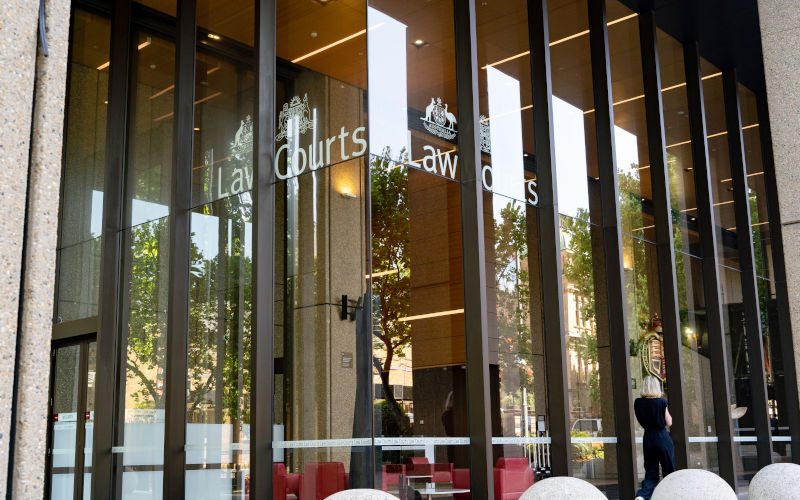
A NSW Supreme Court judgment has sharply distinguished criticism of Israel from antisemitism, raising important questions about the IHRA definition and its use by governments and institutions.
On Tuesday this week a momentous decision on freedom of speech and the issue of criticism of Israel was delivered by Justice Des Fagan, a senior member of the New South Wales Supreme Court. The decision is a wake-up call to politicians, universities and other institutions who have adopted the IHRA (International Holocaust Remembrance Alliance) definition of antisemitism, pushed by the partisan antisemitism commissioner Jillian Segal.
Justice Fagan’s careful but decisive analysis of the intersection between freedom of speech and antisemitism was made in the context of an application by the New South Wales government to have 22-year-old Mohammed Farhat declared a high-risk offender for a year after he is released from prison. The reason: he was argued to be someone who ‘poses an unacceptable risk of committing a serious terrorism offence’.
Farhat was jailed two years ago for participating in spray painting slogans on cars and buildings in Woollahra. The graffiti included phrases such as “Fuk Israel” and “PKK coming”. The PKK is a Kurdish liberation party. Mr Farhat also sports on his neck a tattoo of the Hezbollah symbol. A major part of the argument against Mr Farhat was that “Fuk Israel” ‘conveyed an antisemitic message’.
The case was messy but in the end Justice Fagan dismissed the New South Wales government’s application. In doing so he comprehensively put to bed myths and intellectual sophistry and mischief pushed by those who constantly conflate critique, including harsh words, of Israel with antisemitism.
Here is what Justice Fagan said about the phrase “Fuk Israel”: “A curse in those terms is not antisemitic, either self-evidently or by any degree of analysis or construction. It is a crude political expression of contempt and dismissal of a foreign state.”
In fact Justice Fagan said: “Disparagement of Israel is not antisemitic in the accepted sense of the term firstly because the Jewish people, who as a whole are the object of antisemitism, are not coextensive with or in any sense equivalent to the state of Israel.” You might think this is a matter of incontestable logic – which it is – but good that a senior judicial figure reminds us.
What is important to remember is that many Jews are sickened by the genocide in Gaza, and the brutality of Israel in Lebanon and the actions of West Bank settlers. Justice Fagan refers in this context to the Jewish Council of Australia – loathed by the Israel lobby. As Justice Fagan concludes, the JCA and other critics here and overseas “shows the fallacy of treating the defendant’s spray-painted curse ‘Fuk Israel’, as antisemitic”.
But it is on the IHRA definition that Justice Fagan articulates what is self-evident but deliberately ignored by those who embrace this intellectually dishonest ‘definition’.
To remind ourselves, while the IHRA definition of antisemitism is not problematic, it is in the examples used to illustrate what is meant by it that is designed to chill speech. As Sarah Schwartz from the JCA and Professor Shahram Akbarzadeh from Deakin University have observed, the examples “include treating the existence of Israel as ‘a Jewish collectivity’, characterising criticism of Israel’s founding as a denial of Jewish self-determination and applying ‘double standards’ to Israel. In practice, these examples have been used to argue that critics who describe Israel as a ‘racist’ or ‘apartheid’ state are engaging in antisemitism.”
Justice Fagan’s observations about the IHRA definition reflect the views of many of us. “The IHRA core text is so verbose and imprecise that it could not realistically be attributed to the ordinary, reasonably informed member of the Australian public,” Justice Fagan says. The examples, he says, “indicate that the IHRA wording is not intended to give effect to the extant common understanding of antisemitism” but is directed to grafting “onto the community’s abhorrence of antisemitism, understood as hostility to Jews for their Jewishness, a parasitic rejection of protest against Israel. Seen in that light, the IHRA proposal is detached from the reality of the common usage and understanding of antisemitism in this country.”
None of Justice Fagan’s remarks and findings could be challenged by anyone but an uncritical supporter of Israel or those who are too timid to stand against people like Ms Segal and the Israel lobby.
What Justice Fagan has done represents a vital contribution to the issue of freedom of speech. Freedom of speech can be uncomfortable. And just because it is criticism of Israel does not mean one should tiptoe to avoid giving offence to those who, for example, think there is no genocide in Gaza.
The IHRA definition is exposed by Justice Fagan for what it is, and governments and other institutions that have adopted it are guilty of seeking to undermine a core tenet of democracy – freedom of speech.
This is a judgment that is intellectually sound and must find its way onto the desk of decision-makers across this nation. It also represents a substantial contribution globally to jurisprudence pushing back on the conflation between antisemitism and criticism of Israel.

Greg Barns SC is a former National President of the Australian Lawyers Alliance and Deputy Chair The Information Rights Project