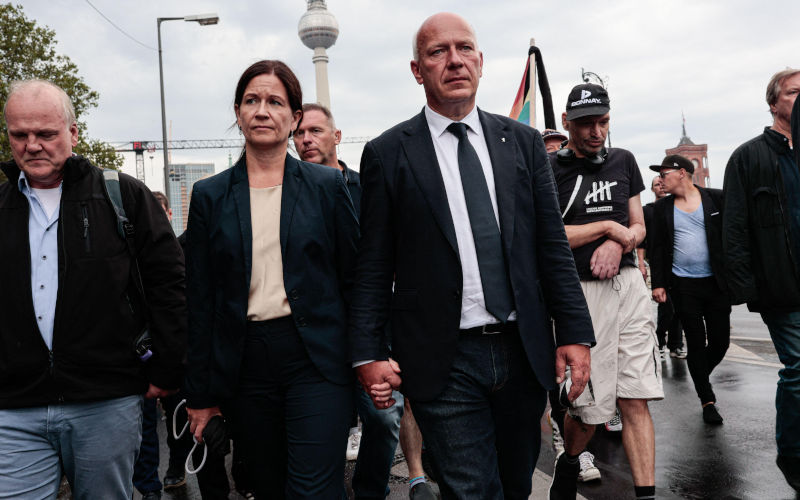
In the aftermath of the deadly Berlin Pride attack, grief is being pulled between silence, scapegoating and political recruitment – when what communities need is empathy, leadership and difficult conversation.
The attack in Berlin is the moment that brings me to these words. Like so many others, my first response is grief. Our community grief.
What follows isn’t really about explaining Berlin. It’s about what happens as communities walk around grief. Who reaches out to us. Who recruits us. Who stays silent. Who asks us to think more deeply. And who simply waits for another opportunity.
I’ve walked this path before. I remember the HIV/AIDS years. I remember Matthew Shepard. I remember Orlando. These moments don’t simply accumulate. They repeat. They leave us grieving, frightened and searching for meaning. They also leave us vulnerable to people who already know what story they want us to believe. That looks like its happening again.
Within hours of Berlin, familiar narratives began circulating. Some sought to turn the attack into evidence that all Muslims are somehow suspect. Others retreated into silence, worried that acknowledging uncomfortable realities would fuel Islamophobia. Neither response is enough.
After Orlando I found myself working closely with Muslim community leaders in Australia. It wasn’t easy. I carried many of the same fears and questions that others are carrying today. What I discovered was not a community trying to excuse violence, but leaders exhausted by being expected to answer for every individual who commits an atrocity while claiming their faith.
That expectation is unfair. It is one of the ways Islamophobia works.
But leadership is not the same thing as collective guilt.
Leadership means entering the civic space when someone associated with your community has caused profound harm. Not to accept blame, but to acknowledge pain. We should expect that from Muslim leaders. We should expect it from Christian leaders. We should expect it from political leaders of every persuasion. Leadership begins with empathy before it begins with argument.
I also want to ask something of my own queer community. What are we asking people to become in moments like this? What do we need them to become so that we feel less vulnerable?
If someone’s concern for queer lives appears only when it can be used against Muslims, is that solidarity? Or has our grief become another political opportunity?We should be asking those questions before we project hopes onto anyone.
The same applies within our own community. We speak proudly about inclusion, yet queer Muslims, queer Christians, queer Jews and queer people from multicultural communities often carry these moments in ways the rest of us barely see. They grieve as queer people while watching their faith or community become the next political battleground. They should not have to carry that burden alone.
Over the years I’ve come to believe that complexity is held together by empathy. Empathy doesn’t dissolve disagreement. It allows us to stay in relationship long enough to learn from one another instead of retreating into slogans.
People often tell us to become more resilient after attacks like this. I’m tired of resilience being treated as a slogan, or something that can be downloaded between tragedies. Real resilience is built before the next attack. It grows from difficult conversations that continue after the headlines disappear. It grows from learning to recognise political recruitment before we become part of it. It grows from listening to people whose lives sit at the intersection of our communities rather than their edges. Otherwise we’ll be here again.
Another attack. Another cycle of grief. Another rush to divide ourselves before we’ve had time to mourn. Surely, after all these years, we owe ourselves something better.

Carl Gopalkrishnan
Carl Gopalkrishnan is an Australian/UK international visual artist and writer whose art works explore intergenerational trauma, faith and queerness, and creative thinking in international intervention. As an Australian of Indian, Chinese and English heritage based in Australia, Carl has also worked in senior policy adviser roles on social cohesion issues for The Ethnic Communities Council of Victoria (ECCV) and the Islamic Council of Victoria (ICV), and as a researcher for State Governments. Carl advises communities and government on social cohesion issues at the intersections of multiculturalism, faith and diverse sexuality and gender (LGBTQIA+).