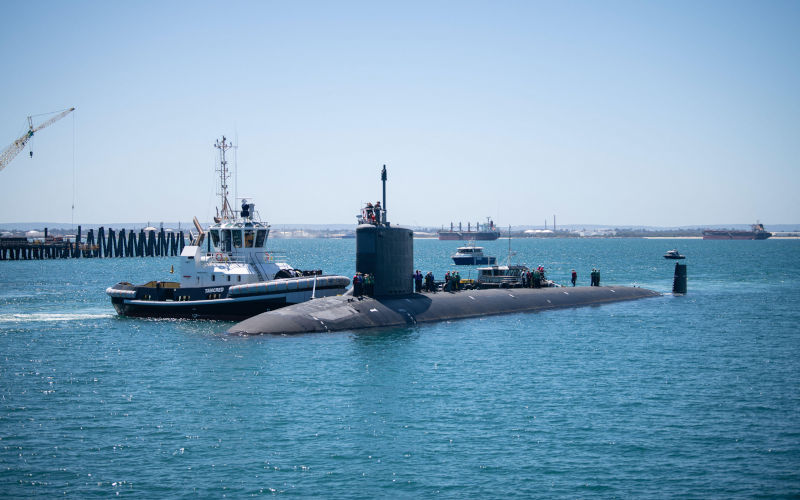
The first in a six-part series examines the maintenance reality behind AUKUS Pillar 1, and the looming risk that Australia may receive Virginia-class submarines before it has certified infrastructure to dock and sustain them.
Public debate on AUKUS Pillar 1 remains fixated on platform delivery schedules, budget line items, and geopolitical messaging. This six-part series examines the missing foundation of the enterprise: the physical shore-based infrastructure, land tenure, regulatory frameworks, and human capital required to build and sustain nuclear-powered submarines in Australia and the strategic advantages of Low-Enriched Uranium (LEU) propulsion.
Australia faces a cascading set of single-point vulnerabilities: an imminent 2032 docking vacuum at Henderson that risks triggering US legal sales bans under NDAA Section 10431; an unaddressed post-criticality safety vacuum at Osborne; an “all in Osborne” single-site workforce overload; total reliance on an un-prototyped Highly Enriched Uranium (HEU) reactor design and the severe liabilities attached to HEU.
Transitioning to an LEU propulsion pathway, and leveraging mature international partners like France or South Korea, provides a rational, sovereign mechanism to bypass domestic infrastructure logjams, eliminate proliferation risks, simplify waste disposal, and restore national sovereignty.
This six-part series examines:
- Part 1: Technical & Maintenance Reality
- Part 2: The Henderson Waterfront & Land-Tenure Bottleneck
- Part 3: The Osborne Construction Enterprise
- Part 4: The Dual-Site Workforce Imperative
- Part 5: LEU vs. HEU: Proliferation, Physics, and Civilian Risks
- Part 6: LEU Refuelling, Industrial Partnerships, and Series Conclusions
Maintenance realities of the Virginia Class
With over 35 per cent of the US attack submarine fleet unavailable due to maintenance backlogs in overburdened American public shipyards as documented by the US Government Accountability Office, Australia’s ability to build certified, heavy maintenance facilities is an immediate statutory requirement, not a long-term goal.
The Block IV Virginia-class design targeted for transfer was built for three major depot-level overhauls across a 33-year service life, known as Extended Docking Selected Restricted Availabilities (EDSRAs), occurring every 8 to 10 years. While official US Navy schedules budgeted these overhauls at 15 to 18 months, US Congressional Budget Office analysis shows Virginia-class major overhauls average 760 days (over 25 months) in dry dock. Public shipyard trade deficits, supply chain delays, and acoustic hull-coating repairs push realistic operational planning figures to 24–30 months.
Even if Australia receives submarines fresh from a US overhaul, each hull requires a 24–30 month overhaul after 8 to 9 years of Australian service. Across three transferred submarines, Australia faces a guaranteed demand for three major overhauls between the late 2030s and 2050s. If vessels arrive mid-cycle, that requirement could increase over a 15-year window.
Maintenance falls into three distinct categories: Intermediate maintenance (routine pier-side work, minor system repairs, and short maintenance periods at HMAS Stirling on Garden Island); emergency/contingency docking (unscheduled short-duration out-of-water access (propeller repairs, sonar dome damage, hull tile replacement) where primary reactor systems remain sealed); and depot maintenance (major overhaul – long-term dry-docking to cut pressure-hull access openings, service primary reactor loops, overhaul steam propulsion machinery, and replace acoustic coatings).
The docking dilemma: ship lifts, floating docks, and rail transfer systems
Mechanical ship lifts supported by cables and winches cannot be used for nuclear submarine overhauls. They introduce unacceptable risks during seismic events and cannot deliver the absolute structural rigidity required when large sections of a pressure hull are cut open.
The UK Royal Navy’s 30-year operational experience with the Faslane shiplift provides a stark warning.
The UK Defence Nuclear Safety Regulator forbids intrusive nuclear work, pressure-hull cuts, or long-term overhauls on the lift. It was licensed strictly for short-duration, non-intrusive repairs.
Audits, though, identified severe seismic vulnerabilities. A platform shift or winch failure during a seismic event, risks severing primary shore-cooling umbilicals, creating an unmanageable decay-heat hazard for live cores.
Ultimately, the concept was abandoned. The Faslane lift reached the end of its safety life due to rusted piling and safety-case constraints. The UK Ministry of Defence launched Programme Euston to transition back to floating docks.
The Commonwealth’s Henderson Defence Precinct plan includes a floating dry dock for early contingency docking. While a floating dock can handle emergency short-duration access, modern regulators reject floating docks for planned depot overhauls for a number of reasons.
Firstly, flexing under hull cuts. Floating docks flex under wave motion, tidal shifts, and ballast adjustments. Cutting primary pressure hull rings on a dynamic platform risks permanent structural deformation and weld misalignment.
Second, because of cooling water redundancy. A shut-down HEU reactor core generates residual decay heat (1 to 2 MW thermal). Regulators, including the Australian Radiation Protection and Nuclear Safety Agency (ARPANSA), mandate unbroken, redundantly powered shore cooling loops, refusing to rely solely on the SSN’s batteries or diesel generators.
Finally, because of lead times and infrastructure. Designing, procuring, and certifying a nuclear-capable floating dock requires seven to 10 years and exceeds AUD $1 to $2 billion. It demands deep capital dredging, heavy piling, high-capacity shore power, and nuclear-certified cooling piping.
Lifts or floating docks paired with heavy rail-car bogies or multi-wheel transporters to move hulls onto land and transfer into a covered workspace are unviable.
These lifts or floating docks have concentrated point stress. A 7,800 to 10,000-tonne Virginia-class hull on a transfer cradle creates extreme point-load pressures. Moving a hull across transfer gaps creates shear stresses and microscopic hull flexing, risking permanent pressure-hull seal failure.
Then there’s the problem with cooling umbilicals. Moving a live-reactor vessel dynamically along a rail grid requires disconnecting primary shore cooling lines or dragging pressurized umbilicals across an active transport corridor, a manoeuvre prohibited by nuclear safety authorities.
Finally, depot overhauls require certified containment structures, radiation monitoring, liquid waste capture, and physical security. A permanent concrete graving dock provides a deeply embedded, rock-anchored vault with integrated backup power, drainage, and cooling infrastructure.
The imminent docking vacuum
The proposed floating dock for Henderson remains in preliminary master planning. No contracts are signed, and physical site works have not commenced. Given lead times for steel fabrication, site preparation, and nuclear safety licensing, an operational floating dock is at least seven to 10 years away (2034–2037), possibly much later.
Should Australia take delivery of its first Virginia-class submarine in 2032, it faces a multi-year window with neither a certified floating dock for emergency repairs nor a graving dock for major overhauls. If an Australian hull requires emergency out-of-water access or reaches a scheduled maintenance availability before certified infrastructure exists, Australia will have zero domestic options.
As Part 2 demonstrates, the on-the-ground logjam at Henderson ensures that resolving this docking vacuum will take far longer than official timelines admit.

Peter Briggs
Peter Briggs retired from the RAN in 2001 after a 40-year career, specialising in submarines. This included two submarine commands, command of the RAN Submarine Squadron, director of Submarine Policy and Warfare and Head of Submarine Capability Team, established to rectify Collins introduction into service issues. He was the president of the Submarine Institute of Australia from 2006-09 and is a frequent contributor to public debate on Australian submarine matters.