China’s use of AI in industrial production is reviving Marxist ideas about labour and value – and raising the possibility of an economy less dependent on capitalist accumulation.
As China embraced capitalism, its leading universities adopted mainstream Western textbooks to mould their students’ thinking about the economy. “Most of my colleagues pay only lip service to Marxism,” an economics professor in one of China’s top economics departments confessed to me. “Only a tiny minority take Marx seriously.”
That was two years ago. Today, the AI revolution is giving Chinese Marxist economics a mighty boost.
Chinese Marxists have long feared that the country’s capitalist turn would lead it into the “rent trap” familiar from the North Atlantic economies: a period of asset-price inflation, a rapid slowdown, stagnation, deindustrialisation, and social discord. When competition in the productive sectors drives profit rates down, rent-yielding property becomes more attractive to investors seeking the greatest risk-weighted return.
The more wealth chases rents, the higher asset prices rise, and the faster wealth moves from industry to the rentier sector. Rent traps hollow out industry and turn once-proud industrial powerhouses, like England’s North and the American Midwest, into wastelands.
China already came close to a rent trap with the collapse of real-estate developer Evergrande – the tip of a speculative iceberg that nearly sank the Chinese economic miracle. Chinese loyalist academics dismiss such fears, confident that the Chinese state, unlike its Western counterparts, knows how to direct investment so as to evade the rent trap. They point to success stories like critical minerals, green energy, electric vehicles, ultra-fast railways, microchips and, more recently, AI.
The minority of Chinese economists who remained loyal to Marxism secretly worried that the Chinese state, however competent, might not be enough for China to sidestep its rent trap. In early 2025, several of them suggested to me that they saw the country’s enormous trade surplus as the result of a vicious class war against both the Chinese and the Western working classes in which the only victors are Chinese and Western capitalists.
If the emergent Chinese capitalist class channels the approximately CN¥170 trillion (US$25 trillion) of accumulated savings from the surplus into asset purchases, China will not avoid its rent trap. If, alternatively, the savings are invested abroad, say, in the BRICS+ countries or in Africa, China will become, like the West before it, a rentier extracting surpluses from developing countries – not exactly a Marxist goal. Moreover, by sending their savings overseas, Chinese savers will one day find themselves bound, like German savers before them, to the whims of foreign borrowers – another unappealing prospect.
A similar sense of unease used to engulf China’s Marxist economists when facing the standard policy recommendation, mainly by Anglo-Saxon economists, that China must increase domestic expenditure – both private and public – to avoid a rent trap. China’s Marxists doubt that consumerism will steer the country clear of capitalism’s rent trap sustainably. “I have read Galbraith’s The Affluent Society, and thus I know that running faster on the consumerist treadmill is a special kind of hell,” one of them told me.
To understand how China’s AI-driven robots helped its Marxist economists to return from the sidelines, we must recall a fundamental tenet of Marxist economics: economic value is created only by human labour. A widget’s value reflects the minimum labour time required to produce widgets, given the current state of technology and expertise. Capitalists can never extract surplus value from a machine – only from human beings. Industrial machines may be immensely useful, but they merely transfer the value infused in them by the humans who built them.
Since the invention of the steam engine, as machines progressively replaced human labour, the value of commodities dropped, profit margins shrank, and the rent trap deepened. Soon, to restore value creation, capitalism needed a war to shrink the labour supply or a major crisis to cheapen labour. This is the standard Marxist critique of capitalism.
Chinese Marxists believe that this is happening with renewed vigour in the United States, courtesy of Big Tech. Silicon Valley pays little attention to material production but is obsessed with building AI agents to rent out to persons and companies as service providers. While America’s service sector sheds human labour and loses its capacity to generate surplus value, US tech lords siphon off more surplus value from the material production that AI leaves relatively unaffected. America’s rent trap grows, as does inequality, populism, and social strife.
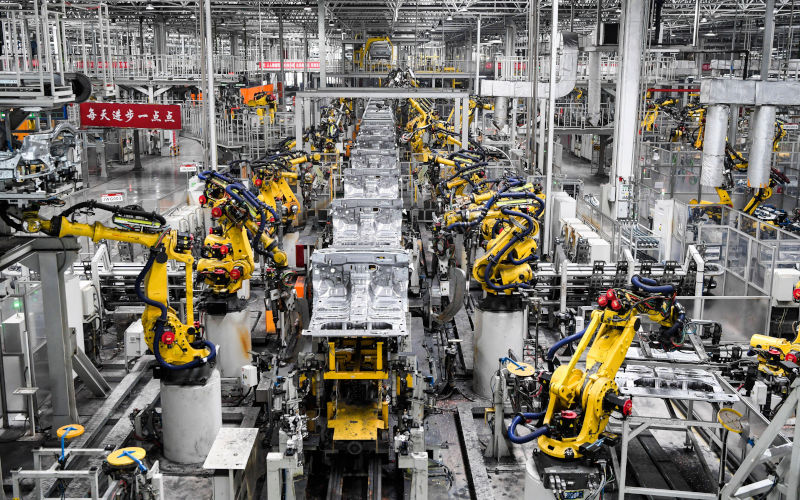
In contrast, Chinese AI firms have been focusing on material production, deploying their industrial robotics to the production of things, including vegetables. Entire supply chains are being automated, including the design of the production process itself.
Moreover, all of these AI capabilities are open source, available to the smallest Chinese manufacturer for a pittance. This is not merely a technology that grants a competitive advantage to a Henry Ford or a Steve Jobs. In China’s emergent AI-driven industrial model, Chinese Marxists detect the material basis for the abolition of value itself!
When necessary labour time shrinks to nothing across all industries at once, goods become so abundant that their exchange-value plummets. What is left is massive use-value, utility, and usefulness. Suddenly, wealth no longer props up asset prices, the rent trap disappears, and it becomes possible to fathom a future China that no longer needs to export in order to maintain its internal equilibrium.
The deeper point that Chinese Marxists are making is that capitalism cannot survive the AI great leap forward. Sooner or later, it must spit out crises and wars to survive. But China is not constrained by the same logic of capitalist wealth accumulation. Because it operates within a state-capitalist framework that privileges long-term objectives over short-term gains, it can push automation to its logical conclusion without fear of falling profits. It can absorb the shock, redistribute the gains in the form of dirt-cheap, high-quality goods and services, and create the material preconditions for a realm of free association where we produce according to ability and distribute according to need, and where the state, having helped deliver the communist utopia, withers away.
Even if China’s renascent Marxists are right, hard questions remain: when this productivity singularity arrives, will the Chinese state ensure that the goodies and free time enabled by AI-driven robots are used to enable genuine human flourishing? Will it wither away eagerly? Or will it give rise to a parasitic elite using AI, as Big Tech does, to enrich itself?
Copyright Project Syndicate 2026


Yanis Varoufakis
Ioannis Georgiou “Yanis” Varoufakis is a former finance minister of Greece, is Leader of the MeRA25 party, Professor of Economics at the University of Athens, and a senior research fellow at Fudan University.